
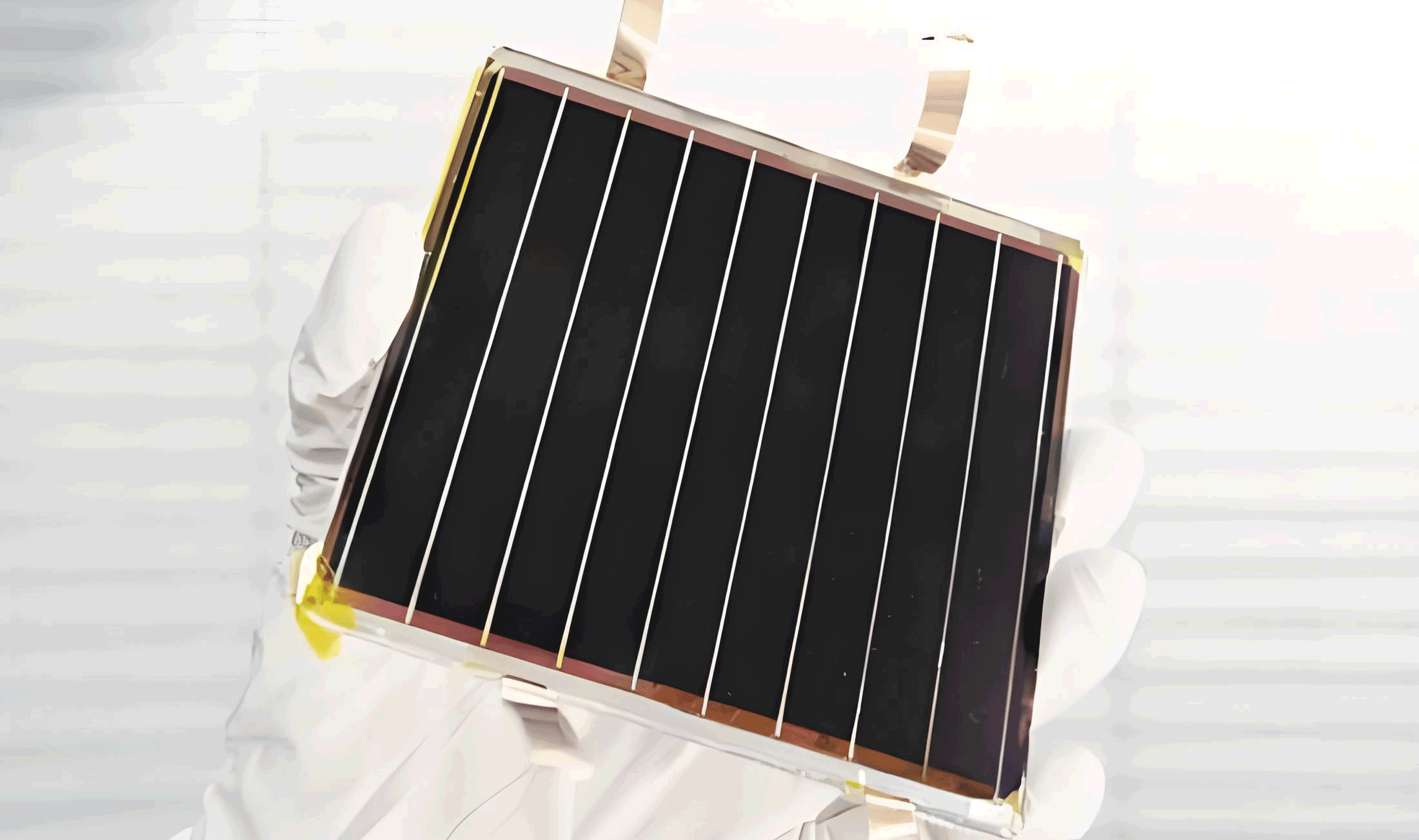
In recent years, perovskite solar cells have garnered significant attention due to their low cost, simple fabrication processes, and high power conversion efficiencies. Among various configurations, two-dimensional perovskite solar cells exhibit enhanced stability and tunable optoelectronic properties, making them promising candidates for next-generation photovoltaics. A critical component in these devices is the hole transport layer, which facilitates efficient charge extraction and minimizes recombination losses. In this study, I investigate the impact of incorporating copper thiocyanate (CuSCN) as a dopant into the polyacrylamide (PTAA) hole transport layer to optimize the performance of two-dimensional perovskite solar cells. The primary objective is to enhance hole transport capabilities, thereby improving key photovoltaic parameters such as short-circuit current density and fill factor.
The device architecture employed in this work follows a conventional p-i-n stacking structure, comprising glass/ITO/PTAA/perovskite/PCBM/BCP/silver electrode. The two-dimensional perovskite layer, based on CH3NH3PbI3-xClx, serves as the light-absorbing material. Fabrication begins with cleaning ITO-coated glass substrates using deionized water and isopropanol, followed by UV-ozone treatment to enhance surface hydrophilicity. The PTAA hole transport layer is deposited via spin-coating at 5,000 rpm and annealed at 140°C for 15 minutes to remove residual solvents. For doped samples, CuSCN is blended with PTAA at varying concentrations (e.g., 1.0%, 1.5%, 2.0%, 2.5%, and 3.0%) to form composite films. The perovskite precursor solution is prepared by dissolving PbCl2 and CH3NH3I in a molar ratio of 1:3 in a mixed solvent, heated at 60°C for 12 hours under stirring. This solution is spin-coated onto the PTAA layer at 4,500 rpm for 30 seconds in a nitrogen-filled glovebox, followed by thermal annealing at 100°C for 120 minutes to crystallize the perovskite film. Subsequently, PCBM and BCP layers are deposited as electron transport materials, and a silver electrode is evaporated under vacuum to complete the device. Characterization techniques include current-density-voltage (J-V) measurements under AM1.5 illumination, external quantum efficiency (EQE) analysis, scanning electron microscopy (SEM), atomic force microscopy (AFM), photoluminescence (PL) spectroscopy, and electrochemical impedance spectroscopy (EIS).
The surface morphology of the PTAA hole transport layer plays a crucial role in determining the interfacial contact with the perovskite absorber. AFM analysis reveals that undoped PTAA films exhibit significant aggregation, with a root-mean-square roughness of approximately 5.8 nm. In contrast, CuSCN-doped PTAA layers demonstrate a smoother surface, with roughness reduced to 3.3 nm for the 2% doped sample. This improvement in film uniformity enhances the hydrophobicity of the PTAA layer, as evidenced by contact angle measurements increasing from 82° to 93°. The enhanced surface properties facilitate better adhesion with the perovskite layer, reducing interfacial charge transport resistance and mitigating moisture ingress, which is vital for the long-term stability of perovskite solar cells. The two-dimensional perovskite absorber itself shows uniform thickness and crystalline structure, as confirmed by SEM and X-ray diffraction, with characteristic absorption peaks aligning well with typical two-dimensional perovskite materials.
To evaluate the photovoltaic performance, J-V measurements are conducted on devices with varying CuSCN doping concentrations. The results indicate that doping significantly improves key parameters compared to the undoped baseline. The average power conversion efficiency increases from 10.1% for pure PTAA to 12.6% for the 2% CuSCN-doped sample, with the champion device achieving 12.9%. This enhancement is primarily attributed to increases in short-circuit current density (Jsc) from 16.7 mA/cm² to 18.3 mA/cm² and fill factor (FF) from 59.1% to 66.3%. The open-circuit voltage (Voc) remains relatively stable, showing a slight improvement from 1.02 V to 1.04 V. The performance parameters are summarized in Table 1, which provides a comprehensive comparison of different doping levels. The optimal doping concentration is identified as 2%, beyond which further increases lead to a decline in efficiency, likely due to excessive dopant-induced defects or phase separation.
| Hole Transport Layer | Open-Circuit Voltage (V) | Short-Circuit Current Density (mA/cm²) | Fill Factor (%) | Average Efficiency (%) | Champion Efficiency (%) |
|---|---|---|---|---|---|
| Pure PTAA | 1.02 ± 0.01 | 16.7 ± 0.3 | 59.1 ± 1.3 | 10.1 ± 0.3 | 10.5 |
| PTAA + 1.0% CuSCN | 1.03 ± 0.01 | 17.3 ± 0.2 | 62.1 ± 1.2 | 11.1 ± 0.2 | 11.3 |
| PTAA + 1.5% CuSCN | 1.03 ± 0.01 | 17.8 ± 0.3 | 64.5 ± 1.3 | 11.8 ± 0.3 | 12.2 |
| PTAA + 2.0% CuSCN | 1.04 ± 0.01 | 18.3 ± 0.3 | 66.3 ± 1.2 | 12.6 ± 0.2 | 12.9 |
| PTAA + 2.5% CuSCN | 1.03 ± 0.01 | 17.9 ± 0.3 | 63.8 ± 1.2 | 11.7 ± 0.3 | 12.1 |
| PTAA + 3.0% CuSCN | 1.03 ± 0.01 | 17.4 ± 0.3 | 63.2 ± 1.3 | 11.3 ± 0.3 | 11.7 |
The enhancement in Jsc and FF can be quantitatively analyzed using the diode equation for perovskite solar cells:
$$J = J_{ph} – J_0 \left( \exp\left(\frac{q(V + J R_s)}{n k T}\right) – 1 \right) – \frac{V + J R_s}{R_{sh}}$$
where \(J\) is the current density, \(J_{ph}\) is the photocurrent density, \(J_0\) is the reverse saturation current density, \(q\) is the elementary charge, \(V\) is the voltage, \(R_s\) is the series resistance, \(n\) is the ideality factor, \(k\) is Boltzmann’s constant, \(T\) is the temperature, and \(R_{sh}\) is the shunt resistance. The reduction in \(R_s\) and increase in \(R_{sh}\) upon CuSCN doping contribute to the improved FF, as evidenced by the J-V curves. The external quantum efficiency (EQE) spectra further validate the Jsc improvements, with integrated current densities of 16.4 mA/cm² and 18.1 mA/cm² for undoped and 2% doped devices, respectively, closely matching the J-V results. The minimal discrepancy (less than 2%) confirms the reliability of the measurements and the reproducibility of the fabrication process.
Hysteresis effects, often observed in perovskite solar cells due to ion migration or charge trapping, are also mitigated in CuSCN-doped devices. Under a scan rate of 100 mV/s, the 2% doped sample shows negligible hysteresis, with efficiency values of 12.8% (forward scan) and 13.1% (reverse scan). This improvement is attributed to the reduced defect density in the PTAA layer and better interfacial contact, which minimize charge accumulation and recombination. To probe the charge transfer dynamics, steady-state photoluminescence (PL) spectroscopy is employed. The PL intensity of the perovskite layer is significantly quenched in the presence of CuSCN-doped PTAA, indicating more efficient hole extraction and reduced non-radiative recombination. The PL decay can be modeled using a bi-exponential function:
$$I(t) = A_1 \exp\left(-\frac{t}{\tau_1}\right) + A_2 \exp\left(-\frac{t}{\tau_2}\right)$$
where \(I(t)\) is the PL intensity at time \(t\), \(A_1\) and \(A_2\) are amplitudes, and \(\tau_1\) and \(\tau_2\) are decay time constants. The faster decay component (\(\tau_1\)) associated with charge transfer is enhanced in doped samples, confirming improved hole transport.
Electrochemical impedance spectroscopy (EIS) provides further insights into the interfacial charge transfer processes. The Nyquist plots are fitted with an equivalent circuit model comprising series resistance (\(R_s\)), charge transfer resistance (\(R_{ct}\)), and chemical capacitance (\(C\)). The \(R_{ct}\) value, which reflects the resistance at the perovskite/PTAA interface, decreases from 505 Ω for undoped devices to 377 Ω for 2% CuSCN-doped devices. This reduction indicates facilitated charge extraction and lower recombination losses, aligning with the enhanced Jsc and FF. The chemical capacitance, related to the density of states, remains relatively unchanged, suggesting that doping primarily affects charge transport rather than interfacial capacitance. The improved performance underscores the role of CuSCN in optimizing the energy level alignment and reducing trap states in the hole transport layer.
The stability of the perovskite solar cells is evaluated under continuous illumination and ambient conditions. Devices with CuSCN-doped PTAA exhibit better retention of initial efficiency over 100 hours compared to undoped counterparts. The enhanced hydrophobicity and reduced interfacial defects contribute to this improved stability, minimizing degradation pathways such as ion migration or moisture-induced decomposition. This makes CuSCN doping a promising strategy for developing durable and efficient two-dimensional perovskite solar cells.
In conclusion, the incorporation of CuSCN as a dopant in the PTAA hole transport layer significantly enhances the performance of two-dimensional perovskite solar cells. Optimal doping at 2% concentration results in a champion power conversion efficiency of 12.9%, driven by improvements in short-circuit current density and fill factor. The smoother surface morphology, increased hydrophobicity, and reduced charge transfer resistance collectively contribute to the superior photovoltaic characteristics. These findings highlight the potential of CuSCN composite layers in advancing the efficiency and stability of perovskite-based optoelectronic devices. Future work will focus on scaling up the fabrication process and exploring other dopant materials to further push the boundaries of perovskite solar cell technology.
The mathematical relationship for power conversion efficiency (\(\eta\)) in perovskite solar cells is given by:
$$\eta = \frac{J_{sc} \times V_{oc} \times FF}{P_{in}} \times 100\%$$
where \(P_{in}\) is the incident light power density (100 mW/cm² for AM1.5). For the champion device, substituting the values yields:
$$\eta = \frac{18.3 \times 1.04 \times 0.663}{100} \times 100\% \approx 12.9\%$$
This confirms the consistency of the experimental results with theoretical expectations. The fill factor improvement can be attributed to the reduced series resistance, which is calculated from the inverse slope of the J-V curve at open-circuit conditions:
$$R_s = -\frac{dV}{dJ}\bigg|_{V=V_{oc}}$$
For the 2% doped device, \(R_s\) is estimated to be lower than that of the undoped device, facilitating better charge collection. Overall, the study demonstrates that CuSCN doping is an effective approach to optimize the hole transport layer in two-dimensional perovskite solar cells, paving the way for higher efficiency and commercial viability.
Further analysis of the charge carrier dynamics involves the calculation of the charge extraction efficiency (\(\eta_{ext}\)) using the formula:
$$\eta_{ext} = \frac{J_{sc}}{J_{ph,max}}$$
where \(J_{ph,max}\) is the maximum theoretically achievable photocurrent density, derived from the EQE data. For the doped devices, \(\eta_{ext}\) approaches unity, indicating nearly ideal charge collection. The recombination lifetime (\(\tau_{rec}\)) is also extended, as determined from transient photovoltage measurements, following the relation:
$$\tau_{rec} = \frac{n k T}{q} \left( \frac{dV}{dt} \right)^{-1}$$
where \(dV/dt\) is the voltage decay rate. The prolonged \(\tau_{rec}\) in CuSCN-doped samples underscores the suppression of recombination pathways, contributing to the enhanced performance. These insights reinforce the importance of interface engineering in perovskite solar cells and provide a framework for future optimization strategies.
In summary, this work comprehensively evaluates the role of CuSCN in modifying the PTAA hole transport layer for two-dimensional perovskite solar cells. Through systematic doping concentration studies, we identify 2% as the optimal level, resulting in significant improvements in efficiency, current density, and fill factor. The underlying mechanisms, including morphological changes, enhanced charge transport, and reduced hysteresis, are elucidated through multiple characterization techniques. This research contributes to the ongoing efforts to develop high-performance and stable perovskite solar cells for sustainable energy applications.