
Perovskite solar cells have emerged as a transformative technology in photovoltaics, offering remarkable power conversion efficiencies and cost-effective fabrication. However, the solution-processed polycrystalline films often suffer from intrinsic challenges such as poor crystallization quality, high defect densities, and inadequate long-term stability. These issues primarily stem from uncontrolled nucleation and rapid crystallization kinetics during film formation, leading to non-uniform grain sizes, abundant grain boundaries, and surface roughness. Defects like uncoordinated Pb²⁺ and I⁻ ions, as well as Pb-I antisite defects, act as non-radiative recombination centers and facilitate ion migration, ultimately degrading device performance. To address these limitations, various strategies, including additive engineering, surface treatment, and solvent optimization, have been explored. Among these, the introduction of functional molecules capable of modulating crystallization and passivating defects has shown significant promise. In this study, we investigate the use of cucurbit[6]uril (CB[6]), a macrocyclic compound with a columnar structure and carbonyl-rich portals, as a multifunctional additive in perovskite precursor solutions. Our findings demonstrate that CB[6] not only enhances grain growth and reduces grain boundaries but also effectively passivates defects through Lewis acid-base interactions, thereby improving both efficiency and stability of perovskite solar cells.
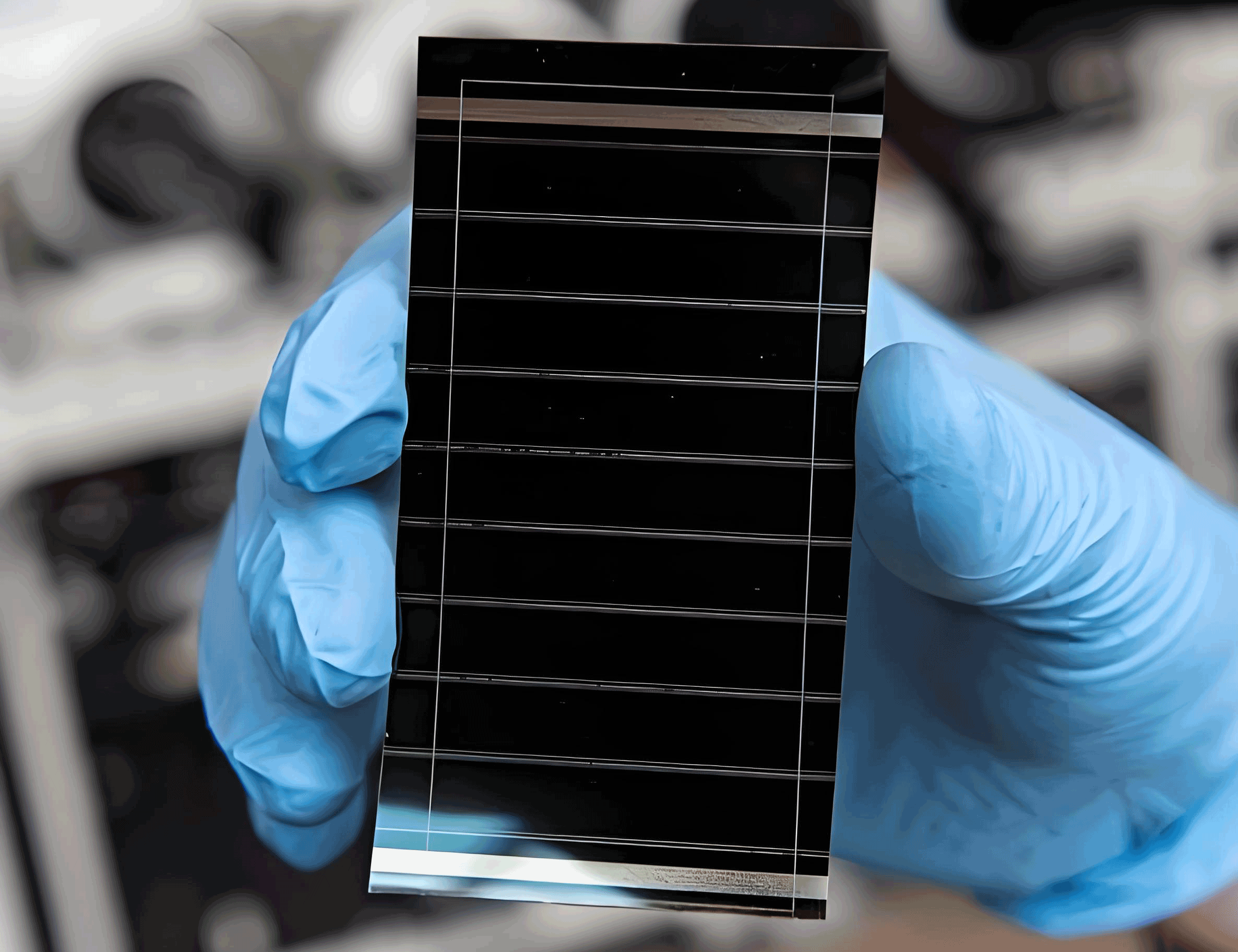
The performance of perovskite solar cells is critically dependent on the quality of the perovskite layer. Defects at grain boundaries and interfaces serve as pathways for ion migration and recombination, limiting the open-circuit voltage (VOC) and fill factor (FF). The inherent instability of perovskite materials under environmental stressors, such as moisture and heat, further impedes their commercialization. Additive engineering has been widely adopted to mitigate these issues by incorporating molecules that interact with perovskite precursors to control crystallization and passivate defects. For instance, carbonyl-containing compounds can coordinate with uncoordinated Pb²⁺ ions, reducing defect states. However, many small molecules exhibit limited multidentate anchoring capabilities due to their planar structures. In contrast, CB[6]’s rigid pillar-shaped framework and multiple carbonyl groups enable robust multidentate binding with Pb²⁺, offering a novel approach to enhance perovskite solar cell performance. This study systematically evaluates the impact of CB[6] concentration on film morphology, defect passivation, and device outcomes, providing insights into the design of effective additives for high-efficiency and stable perovskite solar cells.
Experimental Methods and Material Characterization
Perovskite solar cells were fabricated using a conventional n-i-p structure. The perovskite precursor solution was prepared by dissolving lead iodide (PbI₂), lead bromide (PbBr₂), formamidinium iodide (FAI), cesium iodide (CsI), methylammonium bromide (MABr), and methylammonium chloride (MACl) in a mixed solvent of dimethylformamide (DMF) and dimethyl sulfoxide (DMSO). CB[6] was added to the precursor at varying concentrations (0, 0.25, 0.5, 1, and 2 mmol·L⁻¹) to optimize its effect. The solutions were stirred at 60°C for 2 hours before deposition. Fluorine-doped tin oxide (FTO) substrates were cleaned and coated with a SnO₂ electron transport layer via spin-coating, followed by annealing. The perovskite layer was deposited by spin-coating the precursor solution with chlorobenzene as an anti-solvent, and then annealed at 150°C. A spiro-OMeTAD hole transport layer and silver electrodes were sequentially deposited to complete the device.
Material characterization included X-ray diffraction (XRD) to assess crystallinity, scanning electron microscopy (SEM) and atomic force microscopy (AFM) for morphological analysis, and Fourier-transform infrared (FTIR) spectroscopy and X-ray photoelectron spectroscopy (XPS) to investigate molecular interactions. Photoluminescence (PL) spectroscopy and mapping were employed to evaluate defect states and carrier recombination. Device performance was measured under simulated AM 1.5G illumination, and electrochemical impedance spectroscopy (EIS) and Mott-Schottky analysis were conducted to study charge transport and recombination. Stability tests were performed under controlled humidity and thermal conditions to assess long-term durability.
Optimization of CB[6] Concentration and Its Impact on Perovskite Solar Cell Performance
The concentration of CB[6] in the perovskite precursor was optimized to achieve maximal device efficiency. XRD analysis revealed that the intensity of the (100) peak at 14.1° increased with CB[6] concentration up to 1 mmol·L⁻¹, indicating enhanced crystallinity. The full width at half maximum (FWHM) of this peak decreased, suggesting larger grain sizes and reduced microstrain. Beyond 1 mmol·L⁻¹, excessive additive led to deteriorated crystallinity, as evidenced by broader peaks and lower intensity. Current density-voltage (J-V) measurements of devices with different CB[6] concentrations demonstrated a significant improvement in power conversion efficiency (PCE) at 1 mmol·L⁻¹, attributed to higher VOC and FF. The optimal concentration was determined to be 1 mmol·L⁻¹, and subsequent experiments focused on this condition. The control device (without CB[6]) and target device (with 1 mmol·L⁻¹ CB[6]) are referred to as Control and Target, respectively.
| Concentration (mmol·L⁻¹) | VOC (V) | JSC (mA·cm⁻²) | FF (%) | PCE (%) |
|---|---|---|---|---|
| 0 | 1.155 | 24.84 | 78.97 | 22.66 |
| 0.25 | 1.158 | 24.90 | 79.92 | 23.04 |
| 0.50 | 1.164 | 24.99 | 82.95 | 24.12 |
| 1.00 | 1.179 | 25.16 | 83.43 | 24.76 |
| 2.00 | 1.162 | 24.95 | 80.53 | 23.37 |
The enhancement in PCE can be attributed to reduced non-radiative recombination and improved charge extraction. The VOC and FF increases are consistent with effective defect passivation, which minimizes voltage losses. The JSC also showed a slight improvement due to better light absorption and reduced recombination. The hysteresis index (HI) decreased significantly in Target devices, indicating suppressed ion migration and enhanced interfacial stability. The formula for HI is given by:
$$HI = \frac{PCE_{reverse} – PCE_{forward}}{PCE_{reverse}}$$
where PCEreverse and PCEforward are the power conversion efficiencies measured in reverse and forward scan directions, respectively. For the Target device, HI was reduced to 0.007, compared to 0.076 for the Control, underscoring the beneficial role of CB[6] in mitigating hysteresis.
Structural and Morphological Modifications Induced by CB[6]
The incorporation of CB[6] into perovskite films led to notable changes in morphology and structure. SEM images revealed that Target films exhibited larger grains and fewer grain boundaries compared to Control films. This uniformity reduces the density of defect states at boundaries, which are common sites for non-radiative recombination. AFM analysis further confirmed a smoother surface for Target films, with the average roughness (Ra) decreasing from 31.5 nm to 27.6 nm. This improvement facilitates better contact between layers in the perovskite solar cell, enhancing charge transport and reducing series resistance.
FTIR spectroscopy demonstrated a redshift in the C=O stretching vibration of CB[6] from 1749.6 cm⁻¹ to 1731.4 cm⁻¹ upon interaction with PbI₂, confirming coordination between carbonyl groups and Pb²⁺ ions. XPS analysis showed shifts in Pb 4f and I 3d peaks, indicating strong interactions between CB[6] and the perovskite lattice. The Pb 4f7/2 peak shifted from 138.28 eV in Control to lower binding energy in Target, while the I 3d5/2 peak shifted to higher binding energy. These changes suggest electron transfer from CB[6] to Pb²⁺, reinforcing the defect passivation mechanism. The multidentate anchoring of CB[6]’s carbonyl groups to uncoordinated Pb²⁺ ions at grain boundaries and interfaces effectively suppresses defect formation and ion migration, contributing to the stability of the perovskite solar cell.
Photoelectrical Properties and Defect Passivation
Steady-state PL measurements showed a significant increase in PL intensity for Target films, indicating reduced non-radiative recombination. PL mapping images displayed brighter and more uniform emission, confirming enhanced film homogeneity and effective defect passivation. To quantify defect density, space-charge-limited current (SCLC) measurements were performed on hole-only devices. The trap-filled limit voltage (VTFL) decreased from 0.38 V for Control to 0.20 V for Target, corresponding to a reduction in defect density from 7.89 × 10¹⁵ cm⁻³ to 4.15 × 10¹⁵ cm⁻³. The defect density Nt is calculated using the formula:
$$N_t = \frac{2\epsilon \epsilon_0 V_{TFL}}{e L^2}$$
where ε is the relative permittivity, ε₀ is the vacuum permittivity, e is the elementary charge, and L is the film thickness. This reduction in defect density directly correlates with the improved VOC and FF in perovskite solar cells.
EIS Nyquist plots revealed a larger recombination resistance (Rrec) for Target devices, signifying suppressed charge recombination. The charge transfer resistance (Rct) decreased, indicating improved interfacial charge transport. Mott-Schottky analysis showed a higher built-in potential (Vbi) for Target devices (0.96 V) compared to Control (0.89 V), which enhances the electric field across the junction, promoting charge separation and reducing recombination. The Vbi is derived from the capacitance-voltage relationship:
$$\frac{1}{C^2} = \frac{2}{A^2 e \epsilon \epsilon_0} (V_{bi} – V)$$
where C is the capacitance, A is the area, and V is the applied voltage. The increased Vbi in Target devices contributes to the higher VOC and overall performance of the perovskite solar cell.
Efficiency and Stability Assessment
The champion Target device achieved a PCE of 25.14%, with a VOC of 1.180 V, JSC of 25.19 mA·cm⁻², and FF of 84.55%. In contrast, the Control device had a PCE of 22.92%, with lower VOC and FF. External quantum efficiency (EQE) spectra showed integrated current densities of 24.16 mA·cm⁻² and 24.35 mA·cm⁻² for Control and Target, respectively, consistent with J-V results. The efficiency enhancement is primarily due to improved charge collection and reduced recombination, stemming from CB[6]’s dual role in crystallization control and defect passivation.
| Device | Scan Direction | VOC (V) | JSC (mA·cm⁻²) | FF (%) | PCE (%) | HI |
|---|---|---|---|---|---|---|
| Control | Forward | 1.153 | 24.88 | 77.29 | 22.19 | 0.076 |
| Control | Reverse | 1.157 | 24.89 | 79.58 | 22.92 | |
| Target | Forward | 1.179 | 25.24 | 83.82 | 24.95 | 0.007 |
| Target | Reverse | 1.180 | 25.19 | 84.55 | 25.14 |
Stability tests under thermal and humid conditions demonstrated the robustness of Target devices. XRD patterns of films aged at 85°C in N₂ atmosphere showed minimal PbI₂ formation in Target compared to Control, indicating superior phase stability. Contact angle measurements revealed increased hydrophobicity for Target films (63.7° vs. 38.0° for Control), attributed to CB[6]’s hydrophobic cavity. Unencapsulated Target devices retained 80.9% of their initial PCE after 800 hours at 25°C and 50 ± 5% relative humidity, while Control devices degraded to 60.3% after 400 hours. The enhanced stability is linked to the suppression of ion migration and moisture ingress, key factors in the longevity of perovskite solar cells.
Conclusion
In summary, the incorporation of CB[6] as a multifunctional additive in perovskite solar cells effectively addresses critical issues related to defect density and instability. The columnar structure and carbonyl-rich portals of CB[6] facilitate uniform grain growth, reduce grain boundaries, and passivate defects through multidentate coordination with uncoordinated Pb²⁺ ions. This results in significant improvements in PCE, from 22.92% to 25.14%, and enhanced stability under environmental stressors. The strategies outlined here provide a viable pathway for developing high-performance and durable perovskite solar cells, emphasizing the importance of molecular design in additive engineering. Future work could explore variations in CB[n] homologues or combinations with other passivators to further optimize the performance and scalability of perovskite solar cells.