
In the pursuit of high-performance perovskite solar cells, interface engineering has emerged as a critical strategy to mitigate defects and enhance charge transport. The buried interface between the perovskite layer and the hole transport layer (HTL) often harbors a high density of traps, leading to non-radiative recombination and degradation. In this study, we introduce a novel approach using bis(triphenylphosphine) cobalt chloride (BTPPCC) as a modifier for the buried interface. This treatment significantly improves the crystallinity of the perovskite film, passivates interfacial defects, and optimizes energy level alignment, resulting in enhanced efficiency and stability of the devices.
We fabricated p-i-n structured perovskite solar cells with the configuration FTO/NiOx/BTPPCC/MAPbI3/PCBM/BCP/Ag. The NiOx layer was deposited via spin-coating and annealed at high temperature, followed by the application of BTPPCC dissolved in dimethyl sulfoxide (DMSO). The perovskite precursor solution was then spin-coated with anti-solvent treatment to form the active layer. Characterization techniques including scanning electron microscopy (SEM), X-ray diffraction (XRD), ultraviolet-visible (UV-Vis) spectroscopy, photoluminescence (PL), and electrochemical impedance spectroscopy (EIS) were employed to analyze the films and devices.
The modification with BTPPCC led to a remarkable improvement in the perovskite film’s morphology. As observed in SEM images, the treated samples exhibited larger grain sizes and reduced pinholes, indicating enhanced crystallization. This was corroborated by XRD patterns, which showed intensified diffraction peaks for the (110) and (220) planes, suggesting better crystallographic orientation. The optical properties were also affected; UV-Vis absorption spectra revealed increased absorbance in the visible range, while steady-state and transient PL measurements indicated more efficient charge extraction due to reduced non-radiative recombination. The average carrier lifetime decreased from approximately 605 ns to 297 ns, confirming accelerated hole transfer at the interface.
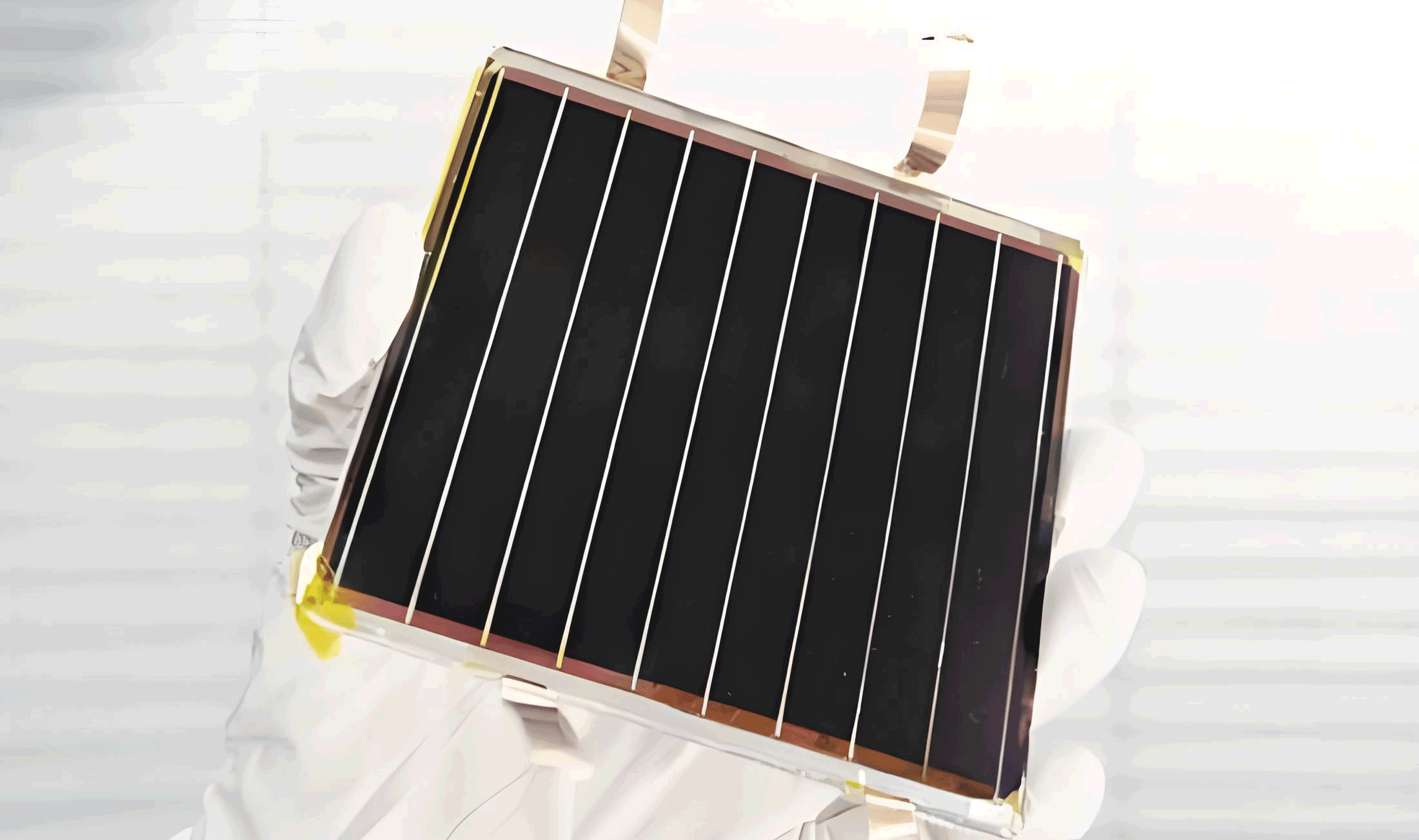
To quantify the defect density, we performed space-charge-limited current (SCLC) measurements on hole-only devices. The trap-filled limit voltage ($V_{\text{TFL}}$) was lower for the BTPPCC-treated samples, indicating a reduction in defect states. The defect density ($N_t$) can be calculated using the formula:
$$N_t = \frac{2 \epsilon \epsilon_0 V_{\text{TFL}}}{e L^2}$$
where $\epsilon$ is the relative permittivity, $\epsilon_0$ is the vacuum permittivity, $e$ is the electron charge, and $L$ is the film thickness. For the control device, $N_t$ was $8.92 \times 10^{15} \, \text{cm}^{-3}$, which decreased to $4.77 \times 10^{15} \, \text{cm}^{-3}$ after treatment. This reduction underscores the effectiveness of BTPPCC in passivating interfacial traps.
The energy level alignment at the buried interface was investigated using ultraviolet photoelectron spectroscopy (UPS). The work function of NiOx shifted from 4.51 eV to 4.74 eV upon BTPPCC modification, and the valence band maximum moved closer to the Fermi level. This adjustment facilitates better hole extraction and blocks electron recombination, as illustrated in the energy band diagram. The improved alignment contributes to the higher open-circuit voltage ($V_{OC}$) observed in the devices.
We evaluated the photovoltaic performance of the perovskite solar cells under AM 1.5G illumination. The current density-voltage ($J-V$) curves showed a significant increase in power conversion efficiency (PCE) from 18.37% to 20.12% after buried interface modification. Key parameters, including short-circuit current density ($J_{SC}$), fill factor (FF), and $V_{OC}$, are summarized in Table 1. The hysteresis index (HI) decreased from 0.041 to 0.012, indicating suppressed ion migration and interface recombination.
| Device | $V_{OC}$ (V) | $J_{SC}$ (mA/cm²) | FF | PCE (%) |
|---|---|---|---|---|
| Control | 1.02 | 22.70 | 0.79 | 18.37 |
| BTPPCC-treated | 1.08 | 23.37 | 0.80 | 20.12 |
External quantum efficiency (EQE) spectra further validated the enhancement in $J_{SC}$, with integrated current densities matching the $J-V$ measurements. Steady-state power output tracking confirmed the reliability of the efficiency values, showing sustained performance over time. The stability of the perovskite solar cells was assessed under ambient conditions (50% relative humidity, 25°C). The BTPPCC-treated devices retained over 76% of their initial PCE after 500 hours, whereas the control devices degraded to 50.5%, highlighting the role of interface modification in long-term durability.
Electrochemical impedance spectroscopy (EIS) revealed a lower charge transfer resistance ($R_{ct}$) for the modified devices, as shown in Table 2. This reduction aligns with improved interfacial charge transport and decreased recombination losses. The dependence of $V_{OC}$ on light intensity was analyzed to understand recombination mechanisms. The slope of the $V_{OC}$ vs. ln(light intensity) plot decreased from $1.82 \, kT/q$ to $1.37 \, kT/q$ after treatment, suggesting a shift from trap-assisted recombination towards ideal diode behavior.
| Parameter | Control | BTPPCC-treated |
|---|---|---|
| $R_s$ (Ω) | 18.18 | 19.20 |
| $R_{ct}$ (Ω) | 1461.2 | 701.09 |
| $C_{ct}$ (nF) | 6.47 | 6.25 |
In conclusion, our work demonstrates that buried interface modification with BTPPCC is a highly effective strategy for enhancing the performance and stability of perovskite solar cells. By improving crystallinity, passivating defects, and optimizing energy levels, this approach addresses key challenges in perovskite photovoltaics. The significant improvements in PCE and environmental stability underscore the potential of interface engineering for advancing perovskite solar cell technology. Future studies could explore the application of similar modifiers in large-area devices and other perovskite compositions to further push the boundaries of efficiency and durability.
The development of efficient and stable perovskite solar cells relies heavily on minimizing interfacial losses. Our findings highlight the importance of the buried interface, which is often overlooked in favor of top-surface treatments. The use of BTPPCC not only enhances the initial performance but also provides a buffer against degradation, making it a promising candidate for commercial applications. As research in perovskite solar cells continues to evolve, interface engineering will remain a cornerstone for achieving high-efficiency and long-lasting devices.
To further elucidate the impact of BTPPCC, we derived a quantitative relationship between defect density and device parameters. The recombination current density ($J_r$) can be expressed as:
$$J_r = J_0 \left( \exp\left(\frac{eV}{nkT}\right) – 1 \right)$$
where $J_0$ is the reverse saturation current, $n$ is the ideality factor, $k$ is Boltzmann’s constant, and $T$ is temperature. With reduced defect density, $J_0$ decreases, leading to higher $V_{OC}$. This correlates with our observations and confirms the role of defect passivation in improving perovskite solar cell performance.
In summary, the integration of BTPPCC into the buried interface of perovskite solar cells offers a multifaceted solution to common issues such as recombination, poor crystallization, and instability. This method paves the way for more robust and efficient perovskite-based photovoltaics, contributing to the broader adoption of this promising technology. The continuous optimization of interface materials and processes will be crucial for meeting the demands of next-generation solar energy systems.