
As we delve deeper into the exploration of space, the demand for reliable and efficient energy sources in extraterrestrial environments has become increasingly critical. Space missions, including satellites, probes, and space stations, rely heavily on sustainable power systems to support their operations. Among various energy solutions, solar cells have emerged as a cornerstone due to their ability to harness solar energy directly. While gallium arsenide (GaAs) solar cells currently dominate space applications, the emergence of perovskite solar cells presents a promising alternative. In our research, we investigate the potential of perovskite solar cells for space use, focusing on their exceptional properties and the challenges they face in harsh space conditions. This article provides an in-depth analysis of perovskite solar cells, highlighting their advantages, such as high power conversion efficiency, tunable bandgap, superior specific power, and flexibility, while addressing stability issues under space environments like extreme temperatures, radiation, and vacuum. We also explore future directions for enhancing the reliability and widespread adoption of perovskite solar cells in space.
The rapid advancement of space technology necessitates energy systems that are not only efficient but also lightweight and durable. Perovskite solar cells have garnered significant attention due to their remarkable performance in laboratory settings, with power conversion efficiencies exceeding 25% in single-junction configurations and over 30% in tandem structures. However, the latter often sacrifices specific power, a key metric for space applications. In our assessment, perovskite solar cells offer a unique combination of properties that make them suitable for space: high specific power, radiation tolerance, and adaptability to flexible substrates. Nonetheless, their stability under space conditions remains a concern, requiring further investigation into material degradation, encapsulation techniques, and long-term performance. Through this work, we aim to contribute to the growing body of knowledge on perovskite solar cells, emphasizing their role in the future of space energy systems.
Space environments pose unique challenges for solar cells, including exposure to high-energy particle radiation, extreme temperature fluctuations, and ultra-high vacuum. These factors can accelerate degradation and reduce the lifespan of photovoltaic devices. For perovskite solar cells, understanding and mitigating these effects is crucial. In our analysis, we consider the requirements for space-grade solar cells, as summarized in the following table. This table outlines key parameters that define the suitability of solar cells for space missions, based on factors such as specific power, radiation hardness, temperature range, reliability, and foldability.
| Requirement | Description |
|---|---|
| High Specific Power | Power output per unit mass or area must be high to maximize energy generation within limited mass and volume constraints of spacecraft. |
| Strong Radiation Resistance | Ability to withstand high-energy particle radiation (e.g., protons, electrons) without significant performance degradation over time. |
| Wide Temperature Adaptability | Operational stability across extreme temperature ranges, from below -100°C in shadows to above 100°C under direct sunlight. |
| High Reliability | Long-term durability and minimal failure rates over extended mission durations, often lasting years or decades. |
| Good Foldability | Compatibility with compact, foldable designs for efficient storage during launch and deployment in space. |
To evaluate the potential of various solar cell technologies for space, we compare common types, including silicon, GaAs, copper indium gallium selenide (CIGS), and perovskite solar cells. The table below provides a preliminary assessment based on parameters like specific power, radiation resistance, temperature adaptability, reliability, and foldability. This comparison highlights the strengths and weaknesses of perovskite solar cells relative to established technologies.
| Solar Cell Type | Specific Power | Radiation Resistance | Temperature Adaptability | Reliability | Foldability |
|---|---|---|---|---|---|
| Silicon Solar Cell | Low | Weak | Poor | High | Poor |
| GaAs Solar Cell | Moderate | Strong | Good | High | Moderate |
| CIGS Solar Cell | Moderate | Moderate | Good | Moderate | Moderate |
| Perovskite Solar Cell | High | Moderate to Strong | Good | Moderate | Good |
One of the most compelling advantages of perovskite solar cells is their high specific power, which refers to the power output per unit mass. This is critical for space applications, where reducing mass directly lowers launch costs and enhances mission flexibility. For instance, perovskite solar cells can achieve specific power values as high as 32 W/g, significantly outperforming traditional cells like silicon (0.07 W/g), GaAs (0.36 W/g), and CIGS (2 W/g). This high specific power stems from the thin-film nature of perovskite solar cells, which can be fabricated on lightweight substrates such as polymers. The power conversion efficiency (PCE) of a solar cell is defined as:
$$ \eta = \frac{P_{\text{out}}}{P_{\text{in}}} $$
where \( P_{\text{out}} \) is the electrical power output and \( P_{\text{in}} \) is the incident solar power. For perovskite solar cells, high PCE values above 25% contribute to their superior specific power. Moreover, the tunable bandgap of perovskite materials, typically described by the equation:
$$ E_g = \frac{hc}{\lambda} $$
where \( E_g \) is the bandgap energy, \( h \) is Planck’s constant, \( c \) is the speed of light, and \( \lambda \) is the wavelength, allows optimization for different spectral conditions in space. This tunability enables perovskite solar cells to adapt to varying solar intensities, from Earth’s orbit to deep space missions.
Radiation resistance is another key factor for space applications, as solar cells are exposed to galactic cosmic rays and solar particle events. Perovskite solar cells have demonstrated remarkable radiation hardness compared to conventional technologies. For example, studies show that perovskite solar cells based on MAPbI3 retain 92% of their initial efficiency after irradiation with 1 MeV electrons at a fluence of \( 1 \times 10^{16} \, \text{cm}^{-2} \), whereas silicon and III-V compound solar cells retain only 60% and 62%, respectively. The damage threshold for proton irradiation in perovskite absorbers can be as high as \( 10^{12} \, \text{p/cm}^2 \), which is three orders of magnitude higher than that of crystalline silicon. The radiation-induced defect density \( N_{\text{trap}} \) can be modeled using:
$$ N_{\text{trap}} = \phi \sigma $$
where \( \phi \) is the particle fluence and \( \sigma \) is the damage cross-section. In perovskite solar cells, low defect densities (e.g., \( N_{\text{trap}} = 4 \times 10^{12} \, \text{cm}^{-3} \)) contribute to their resilience. However, charge transport layers, such as Spiro-OMeTAD and PC61BM, may degrade under high radiation doses, emphasizing the need for robust interfacial materials. Overall, the radiation hardness of perovskite solar cells suggests potential for reduced shielding requirements, lowering system mass and cost.
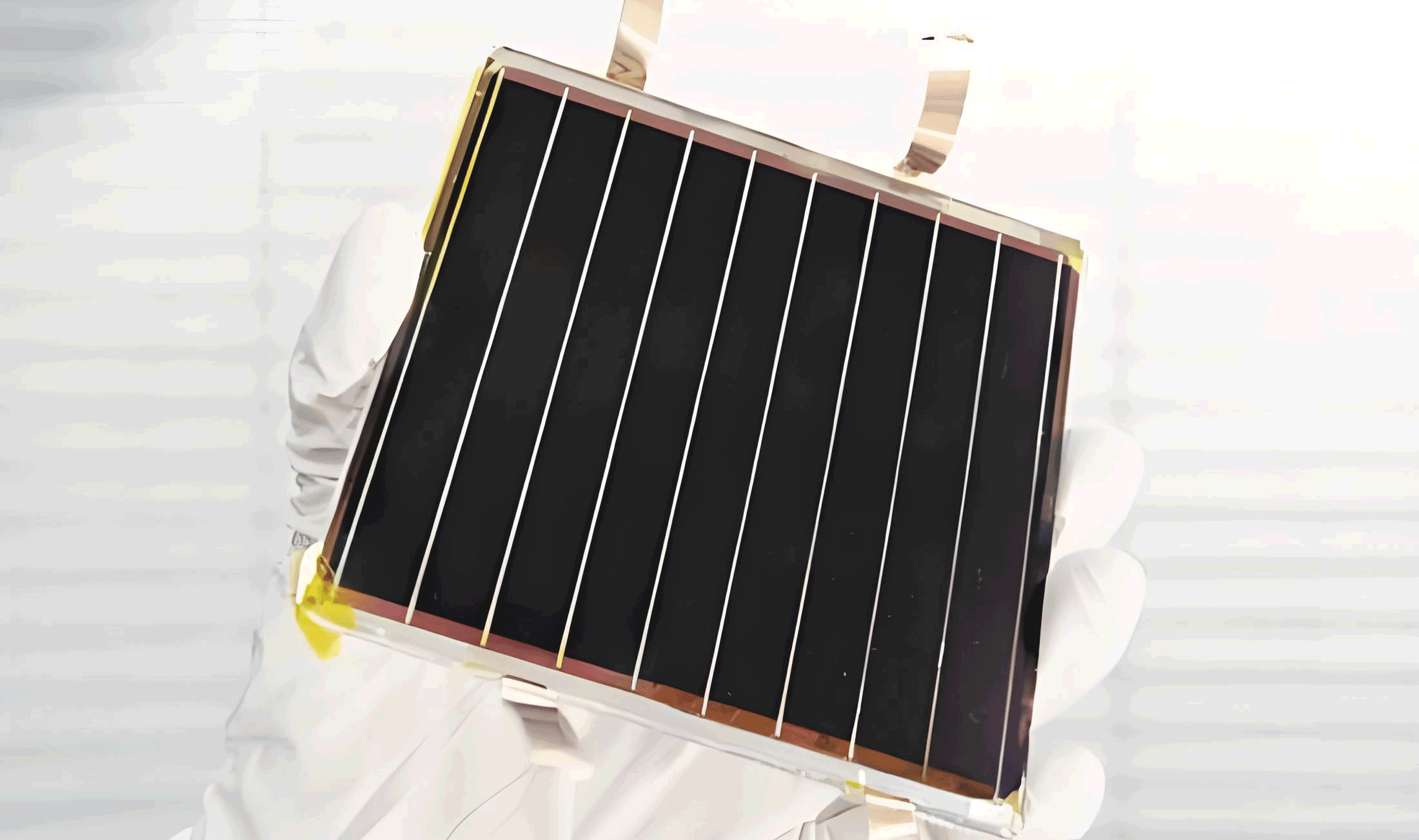
Temperature adaptability is crucial for solar cells in space, where temperatures can swing from -100°C to over 100°C. Perovskite solar cells exhibit promising behavior under low-temperature conditions, such as those on Mars, where self-healing effects occur due to photo-induced decomposition and recrystallization at the perovskite/hole transport layer interface. This process stabilizes the β-phase perovskite, enhancing charge extraction and protecting the bulk material. The self-healing can be described by a kinetic model:
$$ \frac{d[P]}{dt} = k_1[P] – k_2[D] $$
where \( [P] \) is the concentration of perovskite phase, \( [D] \) is the concentration of decomposed products, and \( k_1 \) and \( k_2 \) are rate constants. However, at high temperatures, perovskite solar cells face challenges like accelerated ion migration and organic component volatilization, leading to efficiency loss. The temperature coefficient of efficiency, \( \beta \), defined as:
$$ \beta = \frac{d\eta}{dT} $$
where \( T \) is temperature, is typically negative for perovskite solar cells, indicating efficiency decrease with rising temperature. Thermal cycling tests simulate space conditions, showing that repeated temperature changes induce lattice defects and increase series resistance, reducing fill factor and open-circuit voltage. To mitigate this, encapsulation and material engineering are essential for improving thermal stability.
Comprehensive environmental testing, including near-space experiments and suborbital rocket flights, provides valuable insights into the performance of perovskite solar cells under conditions closer to actual space. In near-space balloon tests at altitudes around 35 km, perovskite solar cells are exposed to enhanced UV radiation, low pressure, and minimal atmospheric filtering, resembling space-like environments. During suborbital flights, perovskite solar cells have demonstrated power densities exceeding 14 mW/cm² under direct solar irradiation, outperforming organic solar cells. The current-voltage characteristics during these tests can be analyzed using the diode equation:
$$ I = I_{\text{ph}} – I_0 \left( \exp\left(\frac{qV}{nkT}\right) – 1 \right) $$
where \( I \) is the current, \( I_{\text{ph}} \) is the photocurrent, \( I_0 \) is the reverse saturation current, \( q \) is the electron charge, \( V \) is the voltage, \( n \) is the ideality factor, \( k \) is Boltzmann’s constant, and \( T \) is temperature. These experiments validate the functionality of perovskite solar cells in high-altitude conditions, but long-term orbital testing is needed to assess durability under continuous radiation, vacuum, and microgravity.
Looking ahead, the future of perovskite solar cells in space applications depends on addressing stability concerns through material innovations, structural optimizations, and advanced encapsulation. For instance, developing inorganic or mixed perovskite compositions can enhance thermal and radiation stability. The use of barrier layers and edge-sealing techniques, as described by the diffusion equation:
$$ \frac{\partial C}{\partial t} = D \nabla^2 C $$
where \( C \) is the concentration of degrading species and \( D \) is the diffusion coefficient, can prevent moisture and oxygen ingress. Additionally, scaling up production and reducing costs will be vital for commercialization. In summary, perovskite solar cells hold immense promise for space energy systems due to their high specific power, radiation tolerance, and flexibility. However, overcoming stability hurdles requires interdisciplinary efforts in materials science, engineering, and space testing. As we continue our research, we focus on optimizing perovskite solar cells for long-term space missions, contributing to sustainable exploration beyond Earth.
In conclusion, perovskite solar cells represent a transformative technology for space applications, offering a blend of high efficiency, lightweight design, and adaptability. Their performance in radiation and temperature extremes, coupled with potential for self-healing, positions them as a viable alternative to conventional solar cells. However, challenges in reliability under vacuum and thermal cycling necessitate further investigation. Through collaborative research and testing, we anticipate that perovskite solar cells will play a pivotal role in powering future space endeavors, from satellite constellations to interplanetary missions. The ongoing development of perovskite solar cells underscores their potential to revolutionize space energy, paving the way for more efficient and sustainable exploration of the cosmos.