
Accurate real-time temperature monitoring in energy storage lithium battery systems is critical for enhancing performance, ensuring safety, and preventing thermal runaway. As energy storage lithium battery technologies evolve toward higher energy and power densities, managing thermal behavior becomes increasingly complex due to the large scale of modules and limited sensor placement. Traditional methods relying on extensive sensor networks are often impractical due to cost and spatial constraints. This study addresses these challenges by proposing a data-driven approach using the Gappy Proper Orthogonal Decomposition (Gappy POD) algorithm, which leverages sparse temperature measurements to reconstruct the full thermal field of large-scale energy storage lithium battery modules. By integrating numerical simulations with experimental data, we develop a digital twin of the battery thermal management system, enabling efficient temperature prediction under varying operating conditions.
The core of our methodology involves constructing a small but representative temperature database using Latin Hypercube Sampling (LHS), which reduces computational costs while capturing essential thermal characteristics. The Gappy POD algorithm, a reduced-order modeling technique, is then applied to reconstruct temperature distributions across multiple battery cells using only a few optimal sensor points. We enhance this process with a correlation coefficient filtering method to identify the most informative measurement locations, ensuring high reconstruction accuracy. Our results demonstrate that this approach can predict temperatures across 48 battery cells (240 internal and external points) with minimal error, highlighting its potential for real-time monitoring in energy storage lithium battery applications.
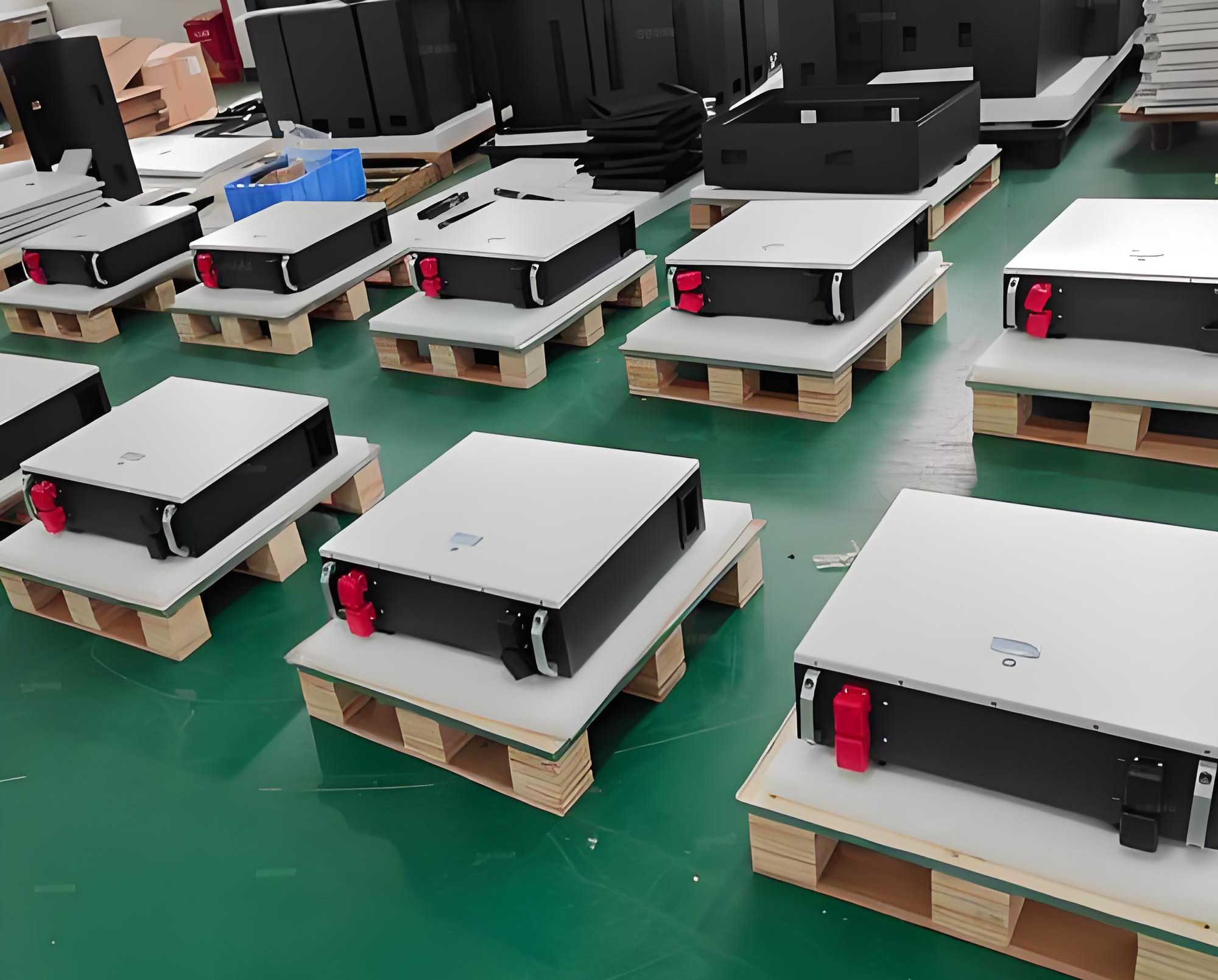
Energy storage lithium battery systems are pivotal in applications such as electric vehicles and grid storage, where thermal management is essential for maintaining efficiency and safety. The optimal operating temperature range for lithium-ion batteries is typically between 15°C and 40°C; deviations can lead to performance degradation or hazardous conditions like thermal runaway. However, comprehensive temperature monitoring in large-scale energy storage lithium battery modules is hindered by the infeasibility of deploying dense sensor arrays. Data-driven methods, particularly those based on reduced-order models, offer a promising solution by inferring complete temperature fields from limited measurements. In this work, we focus on the Gappy POD algorithm, which exploits spatial correlations in temperature data to achieve accurate reconstructions with minimal computational overhead.
To model the thermal behavior of energy storage lithium battery modules, we develop a computational fluid dynamics (CFD) framework that simulates heat transfer and fluid flow in a liquid-cooled battery system. The system comprises 48 prismatic lithium iron phosphate cells arranged in a 4P12S configuration, coupled with aluminum liquid cooling plates and thermal conductive silicone interfaces. The governing equations for energy conservation in the battery, cooling plate, and silicone layers are expressed as follows:
For the battery domain:
$$ \frac{\partial}{\partial t} (\rho_b C_b T_b) = \nabla \cdot (\lambda_b \nabla T_b) + q $$
where \( \rho_b \), \( C_b \), \( T_b \), and \( \lambda_b \) represent the density, specific heat capacity, temperature, and thermal conductivity of the battery, respectively, and \( q \) denotes the volumetric heat generation rate. Similarly, for the aluminum cooling plate:
$$ \frac{\partial}{\partial t} (\rho_{al} C_{al} T_{al}) = \nabla \cdot (\lambda_{al} \nabla T_{al}) $$
and for the thermal conductive silicone:
$$ \frac{\partial}{\partial t} (\rho_d C_d T_d) = \nabla \cdot (\lambda_d \nabla T_d) $$
The fluid flow in the cooling channels is modeled using the SST k-ω turbulence model, with conservation equations for mass, energy, and momentum:
Continuity equation:
$$ \frac{\partial \rho_l}{\partial t} + \frac{\partial (\rho u_x)}{\partial x} + \frac{\partial (\rho u_y)}{\partial y} + \frac{\partial (\rho u_z)}{\partial z} = 0 $$
Energy equation:
$$ \rho_l C_l \left( \frac{\partial T}{\partial t} + u_x \frac{\partial T}{\partial x} + u_y \frac{\partial T}{\partial y} + u_z \frac{\partial T}{\partial z} \right) = \lambda_l \nabla^2 T + \Phi $$
Momentum equations:
$$ \rho_l \left( \frac{\partial u_x}{\partial t} + u_x \frac{\partial u_x}{\partial x} + u_y \frac{\partial u_x}{\partial y} + u_z \frac{\partial u_x}{\partial z} \right) = -\frac{\partial p}{\partial x} + \mu \nabla^2 u_x $$
$$ \rho_l \left( \frac{\partial u_y}{\partial t} + u_x \frac{\partial u_y}{\partial x} + u_y \frac{\partial u_y}{\partial y} + u_z \frac{\partial u_y}{\partial z} \right) = -\frac{\partial p}{\partial y} + \mu \nabla^2 u_y $$
$$ \rho_l \left( \frac{\partial u_z}{\partial t} + u_x \frac{\partial u_z}{\partial x} + u_y \frac{\partial u_z}{\partial y} + u_z \frac{\partial u_z}{\partial z} \right) = -\frac{\partial p}{\partial z} + \mu \nabla^2 u_z $$
The turbulence model includes equations for turbulent kinetic energy \( k \) and specific dissipation rate \( \omega \):
Turbulent kinetic energy equation:
$$ \frac{\partial \rho_l k}{\partial t} + u_x \frac{\partial \rho_l k}{\partial x} + u_y \frac{\partial \rho_l k}{\partial y} + u_z \frac{\partial \rho_l k}{\partial z} = \nabla \cdot \left( \frac{\mu_t}{\sigma_k} \nabla k \right) + P_k – \beta^* \rho_l k \omega $$
Specific dissipation rate equation:
$$ \frac{\partial \rho_l \omega}{\partial t} + u_x \frac{\partial \rho_l \omega}{\partial x} + u_y \frac{\partial \rho_l \omega}{\partial y} + u_z \frac{\partial \rho_l \omega}{\partial z} = \nabla \cdot \left( \frac{\mu_t}{\sigma_\omega} \nabla \omega \right) + \alpha_\omega \omega (P_k – \beta \rho_l \omega^2) $$
Material properties used in the simulations are summarized in Table 1, which includes parameters for the energy storage lithium battery components. The battery thermal model assumes anisotropic thermal conductivity and constant heat generation rates representative of typical discharge scenarios.
| Material | Density (kg/m³) | Thermal Conductivity (W/m·K) | Specific Heat Capacity (J/kg·K) |
|---|---|---|---|
| Lithium Iron Phosphate Battery | 2094.54 | 10.90 (x), 1.20 (y), 13.69 (z) | 1000 |
| Thermal Conductive Silicone | 2380 | 2.00 | 1000 |
| Aluminum Cooling Plate | 2719 | 202.40 | 900 |
| Coolant (Water) | 997 | 0.6 | 4182 |
To build a temperature database for the Gappy POD algorithm, we employ Latin Hypercube Sampling (LHS) to design a small set of experimental conditions that capture the thermal dynamics of the energy storage lithium battery module. LHS ensures uniform coverage of the parameter space while minimizing the number of simulations. We define three heat generation levels (5000, 10000, and 20000 W/m³) representing low, medium, and high load conditions, and assign these to the 48 batteries based on LHS designs. This results in 7 distinct operational scenarios, as outlined in Table 2, which significantly reduces the computational burden compared to full-factorial designs.
| Battery ID | Condition 1 | Condition 2 | Condition 3 | Condition 4 | Condition 5 | Condition 6 | Condition 7 |
|---|---|---|---|---|---|---|---|
| 1 | 5000 | 10000 | 5000 | 10000 | 20000 | 20000 | 5000 |
| 2 | 10000 | 5000 | 20000 | 5000 | 5000 | 5000 | 20000 |
| 3 | 5000 | 10000 | 10000 | 5000 | 10000 | 5000 | 10000 |
| … | … | … | … | … | … | … | … |
| 48 | 5000 | 20000 | 20000 | 5000 | 20000 | 5000 | 20000 |
The Gappy POD algorithm is a reduced-order modeling technique that reconstructs full-field data from incomplete measurements. It begins with the Proper Orthogonal Decomposition (POD) method, which extracts dominant spatial modes from a snapshot matrix of temperature data. Let \( \mathbf{T} \) be the snapshot matrix containing temperature values at \( P \) measurement points under \( M \) conditions and \( N \) time steps:
$$ \mathbf{T} = [\mathbf{T}_1, \mathbf{T}_2, \ldots, \mathbf{T}_M] $$
After normalizing \( \mathbf{T} \), we compute the correlation matrix \( \mathbf{R} \):
$$ \mathbf{R} = \frac{1}{N} \mathbf{T}^T \mathbf{T} $$
Eigenvalue decomposition of \( \mathbf{R} \) yields eigenvalues \( \lambda \) and eigenvectors \( \mathbf{A} \):
$$ \mathbf{R} \mathbf{A} = \lambda \mathbf{A} $$
The POD modes \( \Phi \) and corresponding coefficients \( \phi(t) \) are then derived as:
$$ \Phi_{j,n} = \frac{1}{\sqrt{\lambda_{j,n}}} \mathbf{T} \mathbf{A}_{j,n} $$
$$ \phi_{j,n}(t) = \frac{\Phi_{j,n}^T \cdot \mathbf{T}}{\Phi_{j,n}^T \cdot \Phi_{j,n}} $$
where \( j \) and \( n \) index the systems and measurement points, respectively. The energy captured by the first \( k \) modes is given by:
$$ E_k = \frac{\sum_{j=1,n=1}^{k} \lambda_{j,n}}{\sum_{j=1,n=1}^{M \times P} \lambda_{j,n}} $$
For gappy data, where only a subset of measurements is available, we define a mask vector \( \mathbf{h} \) with elements 1 at measured locations and 0 elsewhere. The incomplete field \( \tilde{\mathbf{T}} \) is:
$$ \tilde{\mathbf{T}} = \mathbf{h} \cdot \mathbf{T} = \sum_{n=1}^{P} h_i T(f_n) $$
The Gappy POD reconstruction seeks coefficients \( \beta_{j,n}(t) \) that minimize the error:
$$ e = \left\| \tilde{\mathbf{T}} – \sum_{j=1,n=1}^{M \times P} \mathbf{h} \cdot \Phi_{j,n} \beta_{j,n}(t) \right\|_2 $$
The reconstructed field \( \mathbf{T}_{\text{rec}} \) is then:
$$ \mathbf{T}_{\text{rec}} = \sum_{j=1,n=1}^{M \times P} \Phi_{j,n} \beta_{j,n}(t) $$
To optimize sensor placement, we apply a correlation coefficient filtering method based on the global correlation maximization hypothesis. This involves computing the Pearson correlation matrix \( \mathbf{R}_E \) from the transposed snapshot matrix \( \mathbf{E}^T \), where \( \mathbf{E} \) contains temperature data for all measurement points across conditions. The Pearson correlation between two measurement vectors \( \mathbf{U} \) and \( \mathbf{V} \) is:
$$ \text{Pearson}(\mathbf{U}, \mathbf{V}) = \frac{1}{N_1-1} \sum_{i=1}^{N_1} \left( \frac{U_i – \mu_U}{\sigma_U} \right) \left( \frac{V_i – \mu_V}{\sigma_V} \right) $$
where \( \mu \) and \( \sigma \) denote the mean and standard deviation, and \( N_1 \) is the number of observations. We define a cooperation matrix \( \mathbf{R}_0 \) by thresholding \( \mathbf{R}_E \) at a correlation level \( \alpha \) (initially 0.99), and iteratively select measurement points that maximize global correlation until all points are covered. This process identifies a minimal set of optimal sensor locations for the energy storage lithium battery module.
In our implementation, we consider 240 measurement points across 48 batteries (5 points per battery: 4 surface and 1 internal). The correlation filtering reduces the external surface points from 192 to 7 optimal locations, and when combined with internal points, results in 8 key sensors. The reconstruction performance is evaluated using maximum absolute error (MAE), average error (AVE), and correlation coefficient (CCOE):
$$ \text{MAE} = \max | \mathbf{T}_{\text{true}} – \mathbf{T}_{\text{rec}} | $$
$$ \text{AVE} = \frac{1}{n} \sum_{i=1}^{n} | \mathbf{T}_{\text{true}} – \mathbf{T}_{\text{rec}} | $$
$$ \text{CCOE} = \frac{\text{Cov}(\mathbf{T}_{\text{true}}, \mathbf{T}_{\text{rec}})}{\sqrt{\text{Var}[\mathbf{T}_{\text{true}}] \cdot \text{Var}[\mathbf{T}_{\text{rec}}]}} $$
where \( \text{Cov} \) is covariance and \( \text{Var} \) is variance.
Our results demonstrate that the Gappy POD algorithm effectively reconstructs temperature fields for energy storage lithium battery modules. Using only 8 optimal sensor points, we achieve accurate predictions across 240 measurement locations under various operating conditions. Table 3 summarizes the reconstruction errors for external and internal points, showing that MAE remains below 0.3 K, with CCOE values close to 1, indicating strong agreement with actual data.
| Point Type | MAE (K) | AVE (K) | CCOE |
|---|---|---|---|
| External Surface | 0.0508 | 0.0420 | 1.0000 |
| Internal Core | 0.2505 | 0.2301 | 0.9999 |
Figure 1 illustrates the temperature distribution in a steady-state condition, highlighting the heterogeneity across cells. The Gappy POD reconstructions closely match the true temperature profiles over time, even in regions near the liquid cooling plate where nonlinear effects are pronounced. For instance, in validation scenarios, the reconstructed temperatures for batteries under different heat generation rates (e.g., 5000, 10000, and 20000 W/m³) exhibit temporal correlations exceeding 0.999, with errors predominantly below 0.1 K for surface points and slightly higher for internal points due to complex heat transfer dynamics.
The integration of LHS-based database construction and correlation-driven sensor selection significantly enhances the efficiency of the Gappy POD method for energy storage lithium battery systems. By reducing the number of required simulations and sensors, this approach enables real-time temperature monitoring without compromising accuracy. Future work could focus on adaptive strategies to handle dynamic operational conditions and integration with battery management systems for predictive maintenance.
In conclusion, the Gappy POD algorithm, combined with Latin Hypercube Sampling and correlation coefficient filtering, provides a robust framework for real-time temperature prediction in large-scale energy storage lithium battery modules. This data-driven method addresses the limitations of sparse sensor networks and computational costs, offering a practical solution for thermal management in energy storage applications. The high reconstruction accuracy and minimal error underscore its potential for enhancing the safety and reliability of energy storage lithium battery systems.