
In modern electromagnetic launch systems, the energy storage lithium battery plays a critical role in providing high-power pulses to linear motor loads. However, during high-rate discharge and transient power demands, the energy storage lithium battery experiences significant voltage drops due to internal resistance and dynamic load variations. This directly impacts system stability and efficiency. Traditional control methods, such as PID, often struggle with model uncertainties and nonlinearities inherent in energy storage lithium battery systems. To address these challenges, we propose a variable-gain active disturbance rejection control (VG-ADRC) strategy with chopper compensation, focusing on enhancing voltage regulation and mitigating peak phenomena in disturbance observation. This approach leverages nonlinear extended state observers (NESO) and conjugate pole configuration to improve transient response and reduce output voltage fluctuations in energy storage lithium battery systems.
The core of our work revolves around optimizing the performance of energy storage lithium battery systems under pulsed power conditions. We begin by modeling the system dynamics, followed by designing a VG-ADRC framework that adapts to initial state errors and improves disturbance rejection. Frequency analysis and experimental validation demonstrate the effectiveness of our method in real-world applications, ensuring reliable operation for electromagnetic launch systems. Throughout this article, we emphasize the importance of robust control strategies for energy storage lithium battery systems, as they are pivotal in achieving high efficiency and longevity in demanding environments.
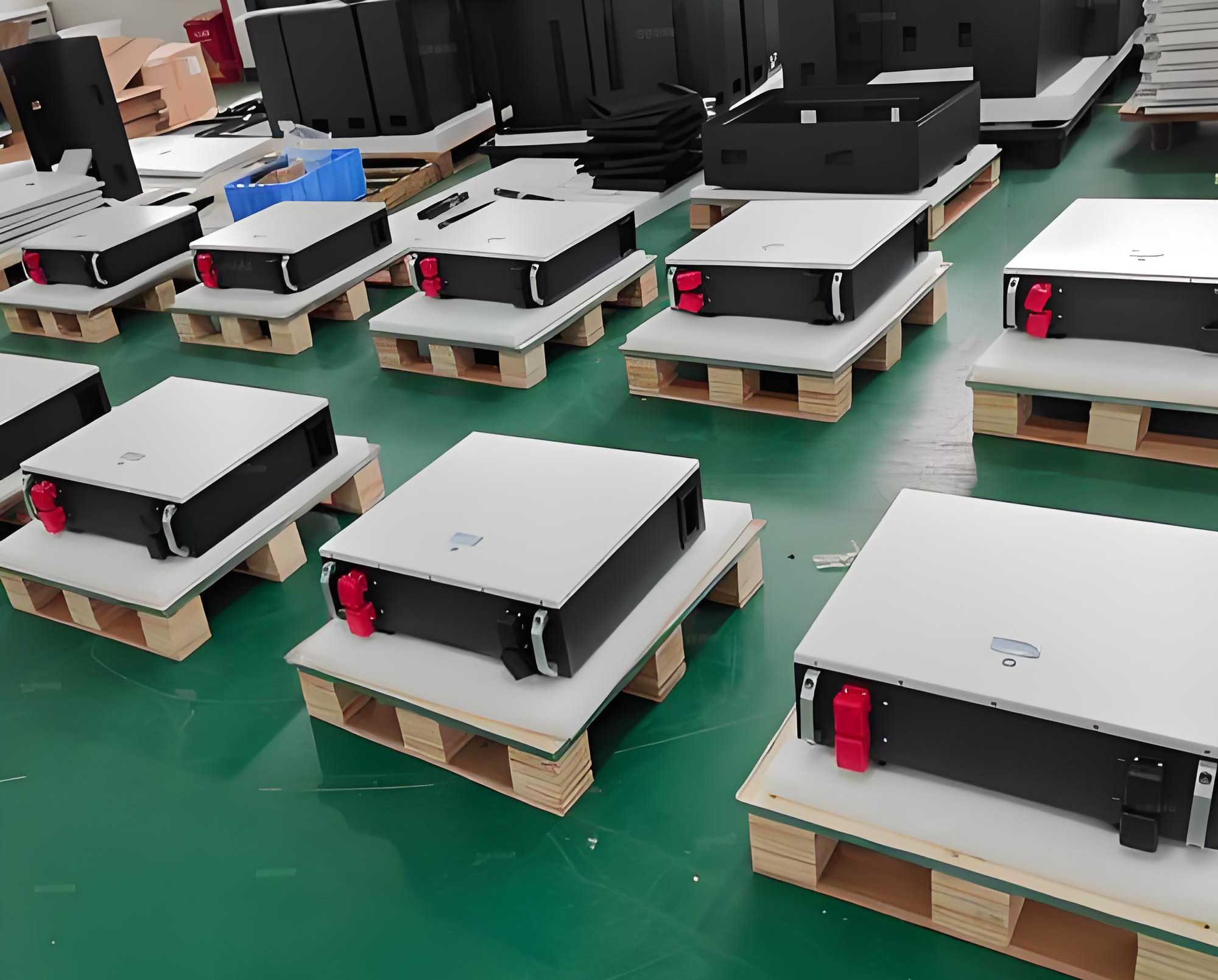
In energy storage lithium battery systems, the output voltage stability is crucial for downstream components like inverters. The system typically consists of multiple battery modules, power converters, and loads, such as linear motors. For instance, a common configuration involves N+1 level dynamic chopping (N+1-LDC) converters connected in series, where each converter includes battery groups and Buck converters. The equivalent circuit can be represented with parameters like battery voltage $V_{\text{Libat}}$, internal resistance $R_r$, filter inductance $L_f$, and bus capacitance $C_{\text{bus}}$. The state-space averaging method yields equations describing the system behavior during switching cycles. For example, the inductor current $i_L$ and bus voltage $V_{\text{bus}}$ dynamics are given by:
$$ L_f \frac{di_L}{dt} = D V_1 + V_2 – V_{\text{bus}} – R_\sigma i_L $$
$$ C_{\text{bus}} \frac{du_C}{dt} \cdot R_C + u_C = V_{\text{bus}} $$
$$ i_L – C_{\text{bus}} \frac{du_C}{dt} = \frac{V_{\text{bus}}}{R_{\text{load}}} + i_{\text{tr}} $$
Here, $D$ is the duty cycle, $R_\sigma$ represents total resistance, and $i_{\text{tr}}$ denotes the ripple current from inverter modulation. The transfer functions for voltage and current loops can be derived to facilitate controller design. For instance, the voltage transfer function $G_{vi}$ and current transfer function $G_{id}$ are expressed as:
$$ G_{vi} = \frac{v_{\text{bus}}}{i_L} = \frac{R_{\text{load}} (s C_{\text{bus}} R_C + 1)}{s C_{\text{bus}} (R_C + R_{\text{load}}) + 1} $$
$$ G_{id} = \frac{i_L}{d} = \frac{(s C_{\text{bus}} (R_C + R_{\text{load}}) + 1)(V_1 – I_L R_{r1})}{a_1 s^2 + a_2 s + a_3} $$
where $a_1$, $a_2$, and $a_3$ are coefficients dependent on system parameters. These models highlight the nonlinearities and disturbances in energy storage lithium battery systems, necessitating advanced control techniques like ADRC.
To address the limitations of conventional controllers, we design a VG-ADRC strategy that incorporates a variable-gain control law and NESO for disturbance estimation. The ADRC framework treats the system as a first-order model with total disturbances, allowing for model-independent control. For a system described by $\dot{y} = f(y, w) + b u$, where $y$ is the output, $w$ is disturbance, and $u$ is input, we define states $x_1 = y$ and $x_2 = f_{\text{sum}}$ (total disturbance). The NESO is designed as:
$$ \text{fal}(e_v, \alpha, \delta) = \begin{cases}
|e_v|^\alpha \text{sign}(e_v), & |e_v| > \delta \\
e_v / \delta^{1-\alpha}, & |e_v| \leq \delta
\end{cases} $$
$$ e_v = U_O – z_1 $$
$$ \dot{z}_1 = z_2 + b_0 u + q_1 \text{fal}(e_v, \alpha_1, \delta_1) $$
$$ \dot{z}_2 = q_2 \text{fal}(e_v, \alpha_2, \delta_1) $$
Here, $z_1$ and $z_2$ estimate $x_1$ and $x_2$, respectively, $q_1$ and $q_2$ are gains, and $\text{fal}(\cdot)$ is a nonlinear function that adjusts gain based on error $e_v$. The parameters $q_1$ and $q_2$ are configured using bandwidth methods or conjugate pole placement to enhance performance. For instance, setting $q_1 = 2\omega_o$ and $q_2 = \omega_o^2$ where $\omega_o$ is the observer bandwidth. The control law is then:
$$ e_r = V_{\text{ref}} – z_1 $$
$$ u_0 = k_p \text{fal}(e_r, \alpha_3, \delta_2) $$
$$ u = (u_0 – z_2) / b_0 $$
with $k_p = \omega_c$ as the controller bandwidth. To mitigate peak phenomena caused by initial errors, we introduce a variable-gain control law:
$$ k_m = 2(1 + e^{-k(t – t_0)})^{-1} $$
$$ u_0 = k_m k_p \text{fal}(e_r, \alpha_3, \delta_2) $$
This time-varying gain $k_m$ reduces initial observation errors and smooths the control action, improving the response of energy storage lithium battery systems.
Frequency domain analysis provides insights into the disturbance observation capabilities. The transfer function for total disturbance observation $z_2 / f_{\text{sum}}$ is derived as:
$$ \frac{z_2}{f_{\text{sum}}} = \frac{q_2 k_g(e_v)}{s^2 + q_1 k_g(e_v) s + q_2 k_g(e_v)} $$
where $k_g(e) = \text{fal}(e, \alpha, \delta) / e$ is the gain coefficient. Compared to linear ESO (LESO) and generalized ESO (GESO), NESO offers a balance between bandwidth and noise immunity. For example, with $\omega_o = 1000$ rad/s, the equivalent bandwidth follows NESO < LESO < GESO, but conjugate pole configuration can optimize this. The table below summarizes parameter settings for different observers:
| Observer Type | Parameters | Equivalent Bandwidth |
|---|---|---|
| NESO | $q_1 = 2\omega_o$, $q_2 = \omega_o^2$ | Lower |
| LESO | $q_1 = 2\omega_o$, $q_2 = \omega_o^2$ | Medium |
| GESO | $q_1 = 3\omega_o$, $q_2 = 3\omega_o^2$, $q_3 = \omega_o^3$ | Higher |
By adjusting $q_1$, such as setting $q_1 = 1.5\omega_o$ or $\omega_o$, we can increase the equivalent bandwidth without compromising high-frequency gain, thus enhancing disturbance observation for energy storage lithium battery systems.
Experimental validation was conducted on a pulsed high-power discharge platform to verify the VG-ADRC strategy. The system parameters for the energy storage lithium battery and controllers are listed below:
| Parameter | Value |
|---|---|
| Battery 1 Voltage $V_1$ | 268 V |
| Battery 2 Voltage $V_2$ | 1072 V |
| Battery 1 Internal Resistance $R_{r1}$ | 20 mΩ |
| Battery 2 Internal Resistance $R_{r2}$ | 190 mΩ |
| Filter Inductance $L_f$ | 0.3 mH |
| Bus Capacitance $C_{\text{bus}}$ | 44 mF |
| Switching Frequency $f_{s1}$ | 2 kHz |
| Controller Bandwidth $\omega_c$ | 250 rad/s |
| Observer Bandwidth $\omega_o$ | 1000 rad/s |
| Nonlinear Factors $\alpha_1, \alpha_2, \alpha_3$ | 0.9, 0.7, 0.6 |
In tests, the energy storage lithium battery system was subjected to transient loads with AC currents peaking at 5000 A. Results showed that VG-ADRC reduced the bus voltage drop from 215 V (with conventional ADRC) to lower values, and attenuated peak phenomena in total disturbance observation. The variable-gain law accelerated response times by 0.12 s compared to fixed-gain methods, demonstrating superior performance for energy storage lithium battery applications. The output voltage stabilized quickly with minimal ripple, confirming the efficacy of our approach in real-world scenarios.
In conclusion, the proposed VG-ADRC strategy with conjugate pole-configured NESO effectively addresses voltage regulation challenges in energy storage lithium battery systems. By reducing disturbance observation peaks and enhancing transient response, this method ensures stable operation under high-power pulsed conditions. Future work could explore adaptive parameter tuning and integration with other renewable energy sources to further optimize energy storage lithium battery systems for broader applications.