
In recent years, the energy storage lithium battery industry has experienced rapid growth, driven by the demand for efficient frequency regulation and peak shaving in power systems. Among various technologies, lithium iron phosphate (LiFePO4) batteries are widely adopted in energy storage power stations due to their long cycle life and high energy density. However, as energy storage lithium batteries evolve toward larger capacities and higher power, thermal runaway incidents have become a critical safety concern, leading to multiple accidents worldwide that threaten public safety. Thermal runaway in energy storage lithium batteries can propagate vertically in stacked configurations, where gas venting from lower-layer batteries ignites and induces fire spread to upper layers. Understanding the fire propagation characteristics and energy transfer mechanisms in such double-layer energy storage lithium battery systems is essential for developing effective safety measures.
Our study focuses on investigating the fire propagation behavior and energy transfer processes in double-layer modules of energy storage lithium batteries. We employed 100 Ah LiFePO4 batteries as the research object, conducting experiments with varying configurations to analyze temperature profiles, heating rates, and energy accumulation. The goal is to quantify the energy transferred from bottom to top batteries during fire propagation and decouple heat transfer paths, providing insights for safer design and fire suppression in energy storage systems.
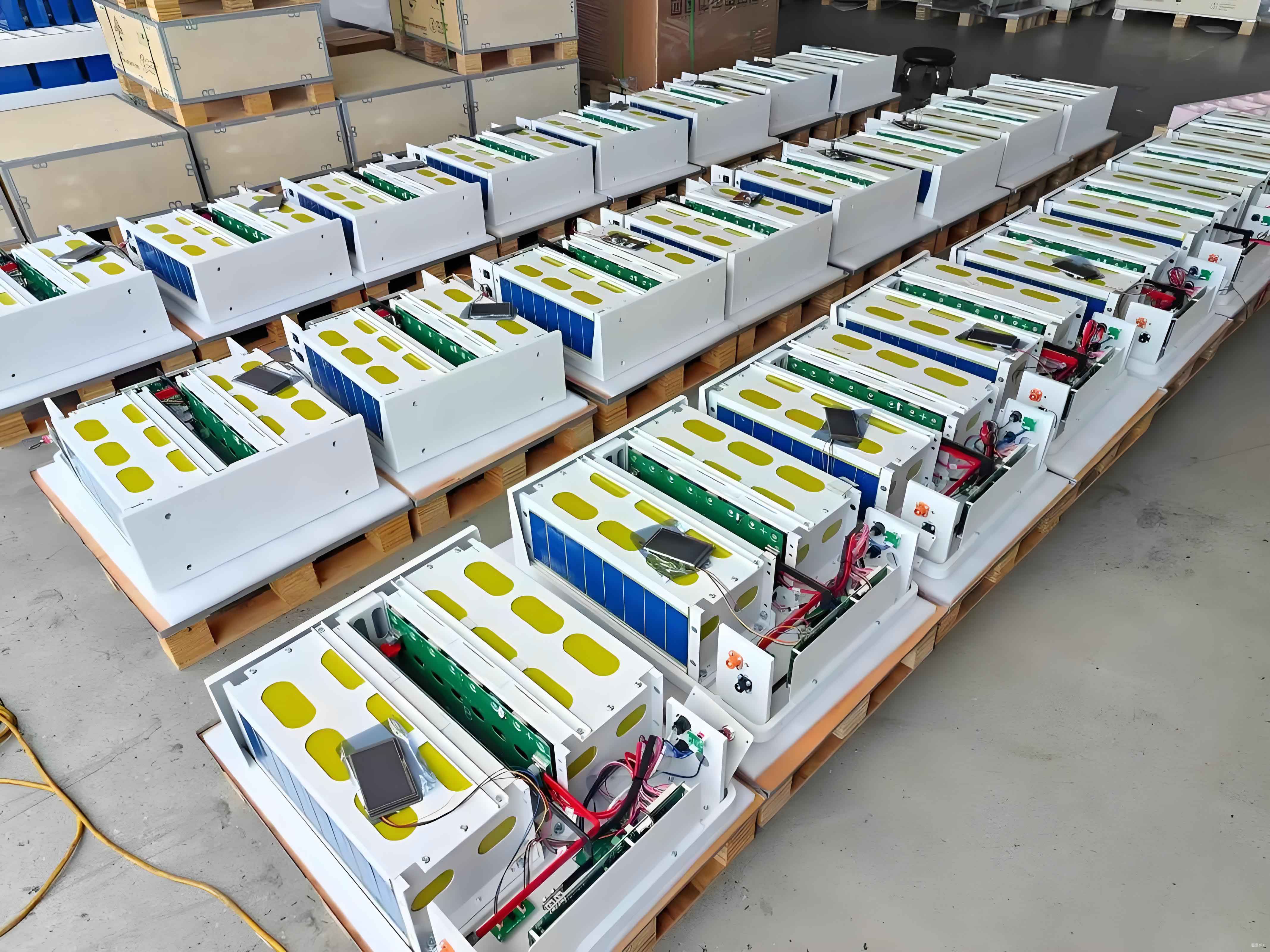
The energy storage lithium batteries used in our experiments are prismatic cells with a nominal capacity of 100 Ah, mass of approximately 2245 g, and dimensions of 130 mm × 36 mm × 211.8 mm (length × width × height). The positive electrode material is LiFePO4, and the negative electrode is graphite, with a nominal voltage of 3.2 V. All batteries were charged to 100% state of charge (SOC) using a standard protocol: discharging at 1C (100 A) to 2.5 V, resting for 1 hour, and then charging at 0.5C (50 A) to 3.65 V followed by constant voltage charging until the current dropped to 0.05C (5 A). The thermal conductivity of the battery’s large surface was measured as 21.24 W/(m·℃).
We designed three experimental groups to study fire propagation in double-layer energy storage lithium battery modules, as summarized in Table 1. Each group had different numbers of batteries per layer: Group 1 with one battery per layer, Group 2 with two batteries per layer, and Group 3 with three batteries per layer. The experiments were conducted in a combustion chamber compliant with safety standards, using a stainless steel platform and an exhaust fan. Batteries were arranged vertically with a 5 cm spacing between layers to simulate extreme conditions. Heating was applied to the first bottom battery using an 800 W heating sheet, and upon venting, the gases were ignited with a pulse igniter. Thermal runaway was identified when the battery’s back temperature exhibited a continuous rise rate exceeding 5 ℃/s for three consecutive readings and the voltage dropped below 1 V.
| Group | Configuration | Fire Propagation Occurred |
|---|---|---|
| 1 | 1 battery per layer | No |
| 2 | 2 batteries per layer | No |
| 3 | 3 batteries per layer | Yes |
Temperature and voltage data were recorded at 10 Hz using K-type thermocouples and a data acquisition system. Thermocouples were placed on the front (Tif), side (Tis), back (Tib), and vent (Tiv) of each battery, with additional sensors on the bottom surface of top batteries (Tibo) to monitor flame exposure. The batteries were clamped with aluminum fixtures at 2 N·m torque, and mica plates were used at the ends to minimize heat loss. This setup allowed us to capture detailed thermal behavior and energy dynamics in the energy storage lithium battery modules.
In Group 1 (non-propagation group), the bottom battery vented at 623 s, followed by ignition and thermal runaway at 930 s. The flame exhibited a stable baking state initially, transitioning to a jetting state during intense thermal runaway. The top battery’s average temperature, calculated as $$ T_{ave} = \frac{T_f + T_b}{2} $$, peaked at 120.9 ℃ without venting or thermal runaway. Similarly, in Group 2, the bottom batteries underwent sequential thermal runaway with a propagation interval of 325 s, and the top batteries reached a peak average temperature of 162.6 ℃, leading to venting but not thermal runaway. These results indicate that fire propagation in energy storage lithium batteries depends on the number of bottom batteries contributing energy.
Group 3, the fire propagation group, demonstrated complete vertical fire spread. The bottom batteries vented and underwent thermal runaway sequentially, with the top batteries experiencing three distinct temperature rise stages before simultaneous thermal runaway at 1598 s. The temperature profiles showed that top batteries reached a peak temperature of 640.2 ℃, which was 115.9 ℃ (22.1%) higher than the bottom batteries. The maximum temperature rise rate for top batteries was 14.0 ℃/s, exceeding the bottom batteries’ rate by 6.5 ℃/s (86.7%). This highlights the increased hazard associated with fire propagation in energy storage lithium batteries, where upper layers are subjected to combined heating from flames and internal reactions.
The temperature rise process in top batteries involved alternating flame baking and jetting stages, as illustrated in Table 2. Each stage corresponded to venting or thermal runaway events in bottom batteries, with the flame jetting stages having approximately twice the average heating rate of the baking stages. For instance, the first flame baking stage lasted 221 s with a temperature rise of 24.9 ℃ and an average rate of 6.8 ℃/min, while the subsequent jetting stage lasted 110 s with a rise of 25.5 ℃ at 13.9 ℃/min. This pattern repeated for subsequent events, emphasizing the role of flame dynamics in accelerating energy accumulation in energy storage lithium batteries.
| Stage | Event | Duration (s) | Temperature Rise (℃) | Average Rate (℃/min) |
|---|---|---|---|---|
| 1: Flame Baking | Bottom Battery 1 Venting | 221 | 24.9 | 6.8 |
| 1: Flame Jetting | Bottom Battery 1 Thermal Runaway | 110 | 25.5 | 13.9 |
| 2: Flame Baking | Bottom Battery 2 Venting | 295 | 31.5 | 6.4 |
| 2: Flame Jetting | Bottom Battery 2 Thermal Runaway | 123 | 31.1 | 15.2 |
| 3: Flame Baking | Bottom Battery 3 Venting | 195 | 24.7 | 7.6 |
| 3: Flame Jetting | Bottom Battery 3 Thermal Runaway | 117 | 34.4 | 17.6 |
To quantify the energy transfer, we calculated the cumulative energy accumulated in top batteries using the formula: $$ Q = c m \Delta T $$ where \( c \) is the specific heat capacity (985.3 J/(kg·℃)), \( m \) is the battery mass (2.24 kg), and \( \Delta T \) is the temperature rise. Based on data from Groups 1 and 2, we decoupled the energy contributions from each bottom battery in Group 3. The results, shown in Table 3, indicate that the first bottom battery contributed 249.1 kJ to the top battery, below the venting energy threshold of 294.3 kJ derived from adiabatic calorimetry. The second battery increased the cumulative energy to 334.3 kJ, within the range between venting and thermal runaway triggers (341.8 kJ). The third battery pushed the total to 379.7 kJ, exceeding the thermal runaway threshold and confirming fire propagation. This stepwise energy accumulation underscores the critical role of sequential events in fire spread for energy storage lithium batteries.
| Bottom Battery | Cumulative Energy to Top Battery (kJ) | Percentage of Thermal Runaway Trigger Energy |
|---|---|---|
| 1 | 249.1 | 84.6% (of venting energy) |
| 2 | 334.3 | 97.6% (of thermal runaway energy) |
| 3 | 379.7 | 111.1% (exceeds trigger) |
Further analysis focused on decoupling heat transfer paths to the top batteries. The total triggering energy \( Q_{trig} \) can be expressed as: $$ Q_{trig} = Q_{bo} + Q_{side} + Q_{self} + Q_{diss} $$ where \( Q_{bo} \) is heat from the bottom surface, \( Q_{side} \) from the sides, \( Q_{self} \) from self-heating, and \( Q_{diss} \) from dissipation. Given the short duration and flame environment, \( Q_{self} \) and \( Q_{diss} \) are negligible. The heat through the bottom surface was calculated using: $$ Q_{bo} = \frac{\lambda_1 A_{bo}}{\sigma_1} \int_{t_0}^{t_1} (T_{bo} – T_{ave}) dt $$ where \( \lambda_1 \) is the thermal conductivity (21.24 W/(m·℃)), \( A_{bo} \) is the bottom area (0.0047 m²), \( \sigma_1 \) is the distance to the battery center (0.106 m), and \( T_{bo} \) is the average bottom temperature. Using data from Group 3, we found that bottom surface heat transfer accounted for 180.5 kJ (47.5% of \( Q_{trig} \)), while side surface transfer contributed 199.2 kJ (52.5%). This near-equal distribution highlights both paths as significant in fire propagation for energy storage lithium batteries.
The energy transfer mechanism in double-layer energy storage lithium battery modules involves progressive accumulation from bottom batteries, driven by flame heating. Initially, one bottom battery supplies insufficient energy for top battery venting. With two batteries, energy reaches levels causing venting but not thermal runaway. Three batteries provide enough energy to trigger simultaneous thermal runaway in top units. Throughout this process, the top batteries experience repeated heating cycles, with flame jetting phases doubling the heating rates of baking phases. The balanced heat transfer via bottom and side surfaces suggests that protective measures should address both paths to mitigate fire risks in energy storage lithium battery systems.
Our findings have important implications for the safety design of energy storage lithium battery systems. To prevent fire propagation, thermal barriers should be installed between batteries to limit horizontal spread in lower layers, which fuels vertical escalation. Additionally, the extended duration before fire propagation (e.g., 1061 s in Group 3) offers a critical window for intervention, such as fire suppression systems. Design improvements could include insulating materials on battery bottoms and sides to block direct flame exposure, reducing energy transfer. Future work could explore variations in SOC, spacing, and battery chemistry to generalize these results for broader applications of energy storage lithium batteries.
In conclusion, our study reveals the fire propagation characteristics and energy transfer mechanisms in double-layer energy storage lithium battery modules. The number of bottom batteries directly influences whether fire spread occurs, with three batteries leading to simultaneous thermal runaway in top layers. Top batteries exhibit higher temperatures and heating rates due to combined effects, and energy accumulation follows a stepwise pattern with distinct flame stages. Heat transfer is nearly evenly split between bottom and side surfaces, emphasizing the need for comprehensive protection strategies. This research provides valuable insights for enhancing the safety of energy storage lithium battery systems, supporting the development of effective fire suppression and design guidelines.