
With the proposal of China’s dual-carbon goals, the installed capacity of new energy power generation, primarily wind and solar, has been increasing annually. However, due to local climate influences, the output power of new energy generation is prone to rapid surges or drops, posing challenges to the frequency regulation margin of power systems. The output power characteristics of new energy generation and complex grid impedance traits can lead to frequency oscillations in large-scale centralized or distributed grid connections, triggering stability issues and affecting load security. The integration of energy storage lithium battery systems enables peak shaving and valley filling for power system loads, alleviating the peak regulation pressure on thermal power units. Additionally, using energy storage lithium battery systems for primary frequency regulation can balance load fluctuations, ensuring system frequency remains within allowable limits.
Numerous studies have been conducted globally on energy storage lithium battery systems. For instance, some literature highlights the prospects and advantages of energy storage lithium battery systems, while others analyze the costs and benefits of storage on the generation and consumption sides. Research on control and management systems has improved stability, and designs for integrated solar-storage projects and offshore wind power with energy storage lithium battery systems have been explored to ease peak shaving pressure and enhance energy utilization. Hybrid energy storage lithium battery schemes have also been investigated for optimal configuration and complementary flexibility in new power systems.
To better mitigate the impact of new energy integration on power system stability, this article analyzes the application and role of energy storage lithium battery systems in grid-connected new energy power generation systems. Using an integrated photovoltaic-energy storage lithium battery microgrid project as a case study, the economic feasibility of energy storage lithium battery systems is examined.
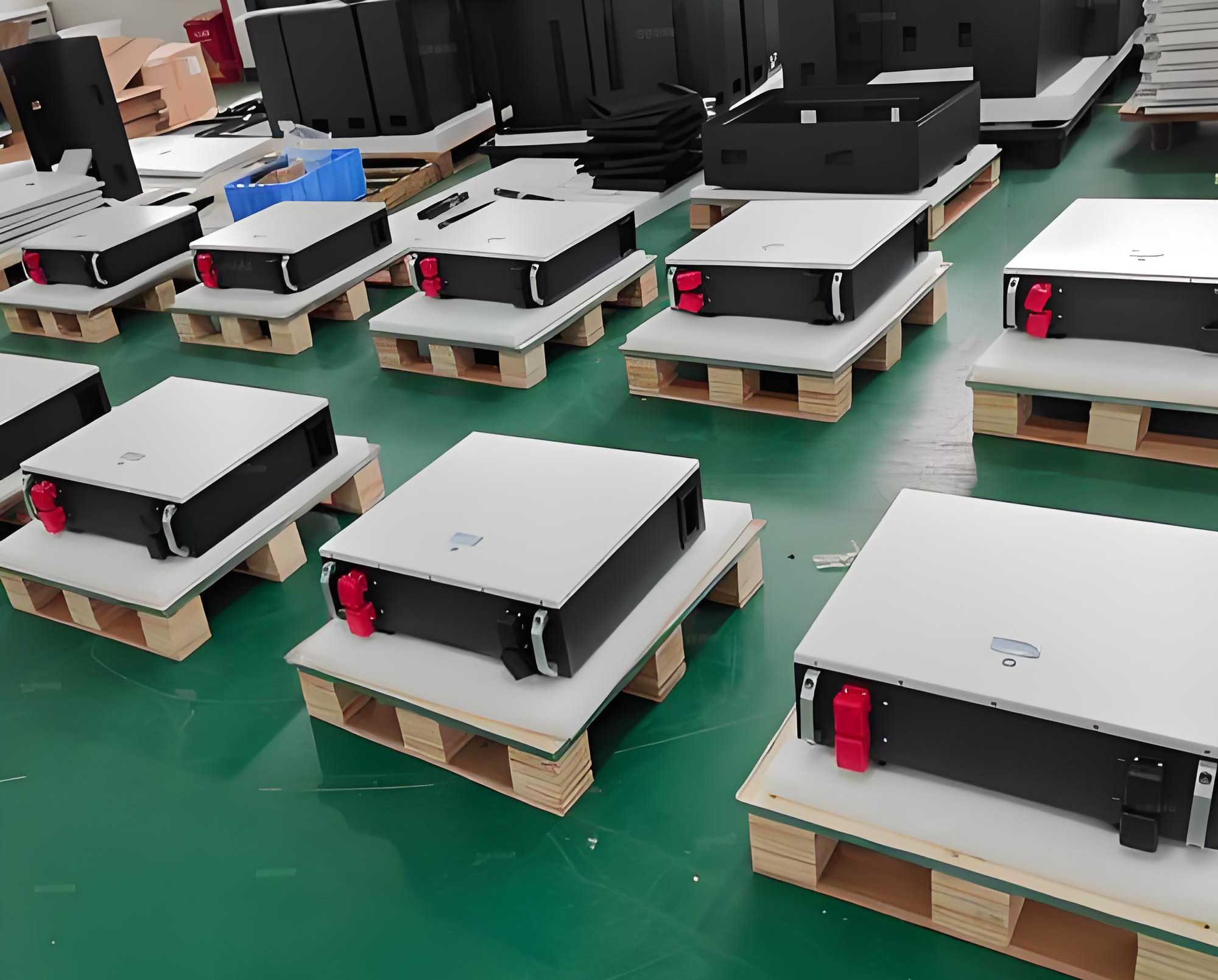
Role of Energy Storage Lithium Battery Systems in Grid-Connected New Energy Power Generation
This section focuses on new energy power generation systems, including wind and solar, to analyze the role of energy storage lithium battery systems in such grid-connected setups.
Peak Shaving and Valley Filling
The inherent volatility of new energy generation over daily cycles and its mismatch with load demand, known as anti-peak regulation characteristics, increase the need for upward and downward reserve capacity in power systems. During evening peak hours, solar power may have no output, while wind power might peak at times of lowest load, leading to curtailment due to transmission constraints. Energy storage lithium battery systems can store excess wind energy during low-load periods and release it during peak hours, shifting energy temporally to maximize transmission line utilization and reduce reliance on thermal units for peak regulation. This energy storage lithium battery approach enhances grid absorption capacity for new energy, lowers reserve requirements, and improves overall system efficiency.
By configuring energy storage lithium battery systems, the equivalent load can be constrained within the maximum and minimum effective power ranges of new energy generation, avoiding curtailment and load shedding. The energy storage lithium battery system’s ability to balance supply and demand is crucial for grid stability. For example, the power output of an energy storage lithium battery system can be modeled as:
$$ P_{\text{BES}} = \eta \cdot E_{\text{rated}} \cdot \text{SOC} $$
where \( P_{\text{BES}} \) is the output power, \( \eta \) is efficiency, \( E_{\text{rated}} \) is the rated energy capacity, and SOC is the state of charge. This equation highlights how energy storage lithium battery systems manage energy flow.
Stabilizing the Power System
New energy generation systems must comply with power system stability requirements for short-term power output variations. The allowable active power change limits for grid-connected systems are summarized in Table 1.
| Installed Capacity (MW) | Maximum 10-min Change (MW) | Maximum 1-min Change (MW) |
|---|---|---|
| < 30 | 10 | 3 |
| 30–150 | 10–50 | 3–15 |
| >150 | 50 | 15 |
Smoothing the volatility of new energy integration involves using energy storage lithium battery systems to control energy storage and release, suppressing minute-level active power fluctuations. The combined output \( P \) of the energy storage lithium battery system and new energy generation must satisfy the limits in Table 1. Two primary control algorithms for energy storage lithium battery systems are point-by-point limitation and low-pass filtering.
For point-by-point limitation, the allowable output power \( P_{\text{BES}}(j) \) at time \( j \) is given by:
$$ \max(\Delta P_{10}(j) – P_{y,10}, \Delta P_{1}(j) – P_{y,1}) < P_{\text{BES}}(j) < \min(\Delta P_{10}(j) – P_{y,10}, \Delta P_{1}(j) – P_{y,1}) $$
where \( \Delta P_{10}(j) \) and \( \Delta P_{1}(j) \) are the power changes over 10 minutes and 1 minute, respectively, and \( P_{y,10} \), \( P_{y,1} \) are the maximum allowable fluctuation powers. This ensures the energy storage lithium battery system operates within safe bounds.
For low-pass filtering, the output power is:
$$ P_{\text{BES}}(j) = \frac{\tau}{t} \left[ \sum P(j) – \sum P(j-1) \right] $$
with time constant \( \tau = \frac{1}{2\pi f_c} \), where \( f_c \) is the cutoff frequency. This method smooths the power output of the energy storage lithium battery system, reducing abrupt changes.
Primary Frequency Regulation
Primary frequency regulation addresses short-term load fluctuations by autonomously providing or absorbing active power when system frequency deviates beyond thresholds. Requirements vary by energy source: thermal power has a dead band of \( 50 \pm 0.033 \) Hz, hydropower \( 50 \pm 0.05 \) Hz, solar \( 50 \pm 0.06 \) Hz, and wind \( 50 \pm 0.10 \) Hz. Energy storage lithium battery systems excel in this area due to fast response and high precision, often outperforming thermal units. For instance, a 300 MW thermal unit has a primary frequency regulation limit of 8% rated capacity (24 MW), with adjustments of \( \pm 0.2\% \) per event. An energy storage lithium battery system sized at 600 kW/0.5 h can handle similar tasks with shallow charge-discharge cycles around 50% SOC, prolonging battery life.
The power support from an energy storage lithium battery system during frequency deviations can be expressed as:
$$ \Delta P_{\text{BES}} = K \cdot \Delta f $$
where \( K \) is the droop coefficient and \( \Delta f \) is the frequency deviation. This linear relationship underscores the responsiveness of energy storage lithium battery systems. Advanced algorithms, such as dual-boundary smoothing, optimize SOC management and reduce capacity needs for energy storage lithium battery systems.
Case Study: Integrated Photovoltaic-Energy Storage Lithium Battery Microgrid Project
This project involves an 800 kW photovoltaic system, a 250 kW/500 kWh lithium iron phosphate energy storage lithium battery system, and user loads. The energy storage lithium battery system operates at up to 10 kV, storing excess solar energy for grid supply during peak hours. Key equipment is listed in Table 2.
| Equipment | Specifications | Quantity |
|---|---|---|
| Photovoltaic Modules | 550 W monocrystalline silicon | 1455 units |
| Inverters | 33 kW rated power | 22 units |
| Lithium Iron Phosphate Batteries | 3.2 V/130 Ah per cell | 1224 units |
| Storage Converters | 250 kW capacity | 1 unit |
| 10 kV Step-Up Transformer | 10 kV/0.4 kV, 800 kVA | 1 unit |
Microgrid Operational Functions
The microgrid utilizes the energy storage lithium battery system for “black start” capabilities, allowing operation during grid outages without external power. In voltage-current dual-loop mode, the energy storage lithium battery system maintains stable charging and discharging, ensuring DC bus voltage balance. The energy management system (EMS) oversees data monitoring, fault protection, automation, and optimization, crucial for reliable energy storage lithium battery operation.
Economic Analysis of the Energy Storage Lithium Battery System
Operating in an economic mode for peak shaving and valley filling, the energy storage lithium battery system charges during off-peak hours and discharges during peaks. With a peak-valley price difference of 0.7 CNY/kWh and 90% discharge depth, annual revenue is calculated as:
$$ \text{Annual Revenue} = 0.7 \times 500 \times 0.9 \times 365 \approx 115,000 \text{ CNY} $$
Additionally, the energy storage lithium battery system reduces transformer capacity requirements, saving on equipment costs. This demonstrates the economic viability of energy storage lithium battery systems in grid applications.
Discussion
Supporting grid-connected new energy systems is a critical application for energy storage lithium battery systems, enhancing grid acceptance and reducing thermal unit reliance. However, under current business models, standalone use of energy storage lithium battery functions may not be economically sustainable, with seasonal variations affecting performance. Future research should focus on expanding the roles of energy storage lithium battery systems and improving battery performance across seasons to maximize benefits.
Conclusion
This analysis confirms that energy storage lithium battery systems play vital roles in peak shaving, stabilization, and primary frequency regulation for grid-connected new energy systems. The case study shows that an energy storage lithium battery system can generate approximately 115,000 CNY annually in economic mode, while also reducing infrastructure costs. Thus, energy storage lithium battery systems not only enhance grid reliability and stability but also offer significant economic advantages, underscoring their importance in the transition to sustainable energy.