
Solar photovoltaic power generation is one of the most promising renewable energy technologies in the world today, addressing global energy crises and environmental degradation. Solar photovoltaic systems can be categorized into various types of solar inverter based on their operational modes, including off-grid systems, grid-tied systems, and hybrid systems. Off-grid systems are particularly vital in remote areas or for standalone applications, and with the rapid adoption of photovoltaic systems, especially rooftop solar initiatives, the demand for efficient off-grid solar inverters has surged. These systems typically consist of photovoltaic arrays, controllers, inverters, and energy storage units. The inverter is a critical component, as its reliability and conversion efficiency significantly impact system performance and cost-effectiveness. Existing products often suffer from limitations such as poor real-time control due to microcontroller-based designs, bulkiness from transformer usage, and inadequate output voltage accuracy. In this paper, we present the design of a 5kW off-grid solar inverter that overcomes these drawbacks by leveraging digital signal processing (DSP) technology, resulting in a compact, lightweight solution with high precision, excellent waveform quality, and intelligent monitoring capabilities.
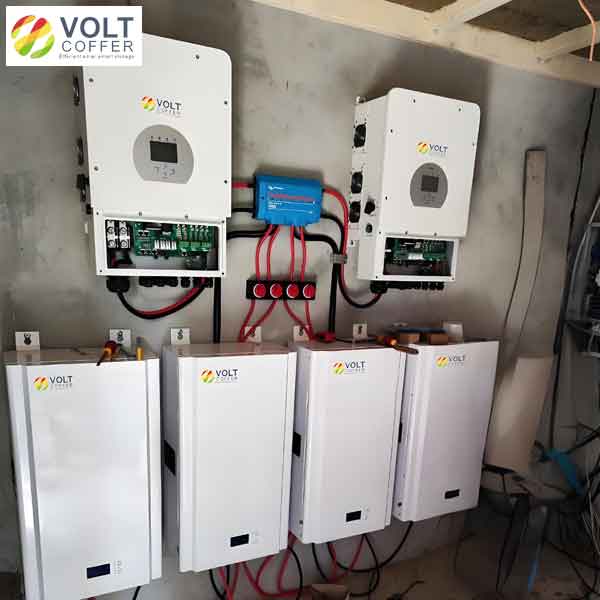
The structure of the 5kW off-grid solar inverter comprises two main parts: the primary circuit and the secondary circuit. The primary circuit includes the input filter circuit, Boost converter circuit, full-bridge inverter circuit, and output filter circuit, while the secondary circuit consists of the TMS320F2812 controller circuit, signal detection circuit, human-machine interface, and communication modules. This design employs a non-isolated two-stage inverter topology, also known as a Boost inverter, which is well-suited for photovoltaic applications due to its efficiency and simplicity. The input DC voltage from solar panels, typically 48V, is filtered, boosted to a higher DC level, inverted to AC via SPWM techniques, and finally filtered to produce a clean 50Hz sinusoidal output. The following figure illustrates a representative inverter system, though our focus is on the off-grid type of solar inverter.
In the hardware design, we meticulously selected components to ensure optimal performance for the 5kW off-grid solar inverter. The input filter circuit uses capacitors to minimize voltage ripple, with calculations based on energy requirements. For a maximum power $P_{\text{max}} = 5 \, \text{kW}$, efficiency $\eta = 0.95$, and switching frequency $f_r = 18 \, \text{kHz}$, the energy provided by the input filter capacitor in one cycle is:
$$ W_{in} = \frac{P_{\text{max}}}{\eta f_r} $$
Substituting the values, $W_{in} \approx 0.2924 \, \text{J}$. The energy per half-cycle is $W_{\text{half}} = W_{in} / 2 = 0.1462 \, \text{J}$. With a minimum input voltage $V_{\text{inmin}} = 38.4 \, \text{V}$ and a voltage ripple $\Delta V_{\text{inmin}} = 0.384 \, \text{V}$ (1% of $V_{\text{inmin}}$), the capacitance is derived from:
$$ W_{\text{half}} = \frac{1}{2} C V_{\text{inmin}} \Delta V_{\text{inmin}} $$
Solving for $C$:
$$ C = \frac{2 W_{\text{half}}}{V_{\text{inmin}} \Delta V_{\text{inmin}}} $$
This yields $C \approx 4960 \, \mu\text{F}$. We implemented this using five parallel 1000 μF electrolytic capacitors, each augmented with a 6 μF CBB capacitor to enhance high-frequency response. The Boost converter, essential for voltage elevation, operates in continuous conduction mode for stable output. The critical inductance for boundary operation is given by:
$$ L = \frac{V_{\text{in}}^2 (1 – D)^2}{2 P f_r} $$
where $D$ is the duty cycle. For $P = 5 \, \text{kW}$, $L = 20 \, \mu\text{H}$, but we chose $L = 1 \, \text{mH}$ for better performance at lower power levels. The output capacitor for the Boost stage is sized to limit voltage ripple, with the formula:
$$ C = \frac{P D}{\Delta V f_r V_{\text{out}}} $$
where $V_{\text{out}} = 420 \, \text{V}$ (to allow for 220V AC output after inversion), $\Delta V = 2.1 \, \text{V}$ (0.5% ripple), and $D = 0.9$. This gives $C \approx 1033 \, \mu\text{F}$, so we used three 470 μF capacitors in parallel (1410 μF total). The single-phase full-bridge inverter employs SPWM modulation synchronized at 50 Hz, and the LC low-pass filter, with a cutoff frequency of approximately 1 kHz, is designed to attenuate harmonics. The filter transfer function is:
$$ H(s) = \frac{1}{1 + s \frac{L}{R} + s^2 L C} $$
where the resonant angular frequency $\omega_L = 1 / \sqrt{L C}$ and damping factor $\epsilon = \frac{1}{2R} \sqrt{\frac{L}{C}}$. The cutoff frequency is:
$$ f_c = \frac{1}{2\pi \sqrt{L C}} $$
and the characteristic impedance $R = \sqrt{L / C}$. With $R = 6 \, \Omega$ (based on load considerations), and $L = 1 \, \text{mH}$, $C = 10 \, \mu\text{F}$, we get $f_c \approx 1592 \, \text{Hz}$, which is suitable for filtering 18 kHz switching noise.
| Component | Parameter | Value | Description |
|---|---|---|---|
| Input Filter | Capacitance | 5000 μF | Five 1000 μF electrolytic capacitors with 6 μF CBB bypass |
| Boost Converter | Inductance | 1 mH | Operates in continuous conduction mode |
| Boost Converter | Capacitance | 1410 μF | Three 470 μF electrolytic capacitors |
| Full-Bridge Inverter | Modulation | SPWM | Synchronized at 50 Hz with 18 kHz carrier |
| LC Filter | Inductance | 1 mH | Low-pass design for harmonic attenuation |
| LC Filter | Capacitance | 10 μF | Combined with inductor for 1 kHz cutoff |
The control strategy for the 5kW off-grid solar inverter integrates PID control with closed-loop negative feedback to enhance stability and accuracy. SPWM pulses are generated using the TMS320F2812 DSP, which offers high-speed processing for real-time adjustments. The event managers (EVA and EVB) produce complementary PWM signals with dead-time insertion to prevent shoot-through in the inverter bridge. The output frequency calculation involves determining the number of points in the sine table for SPWM generation. For a carrier frequency $f_c = 18 \, \text{kHz}$ and output frequency $f_s = 50 \, \text{Hz}$, the number of points $N$ is:
$$ N = \frac{f_c}{f_s} $$
which gives $N = 360$. The timer period register value for the DSP is computed as:
$$ T1PR = \frac{f_{\text{cpu}}}{2 \times \text{HISCP} \times \text{TPST1} \times f_{\text{spwm}}} $$
where $f_{\text{cpu}} = 150 \, \text{MHz}$, HISCP = 2, TPST1 = 1, and $f_{\text{spwm}} = 18 \, \text{kHz}$. Substituting, we get $T1PR \approx 4166$, resulting in an output frequency error of only 0.008 Hz, which is negligible. The closed-loop feedback system continuously monitors output voltage and current, adjusting PWM parameters via PI controllers to maintain regulation and protect against overcurrent conditions. This approach ensures robustness across various load conditions, making it suitable for diverse types of solar inverter applications.
Software design plays a crucial role in implementing the control algorithms for the 5kW off-grid solar inverter. The SPWM control program initializes the event manager, sets up variables, generates a sine table, and handles compare register reloads through interrupts. The sine table is created using a function that computes values based on the sine wave equation:
$$ \text{INPUT}[i] = \left( \sin\left( \frac{2\pi i}{N} \right) \times m + 1 \right) \times \frac{T1PR}{2} $$
for $i = 0$ to $N-1$, where $m$ is the modulation index. The compare interrupt service routine updates the PWM duty cycles in real-time. Additionally, the A/D conversion interrupt service routine processes sampled voltage and current data, applying digital filtering (e.g., arithmetic mean filtering) to compute RMS values and perform harmonic analysis. This data is displayed via the human-machine interface and used for adaptive control, enhancing the inverter’s intelligence and reliability compared to other types of solar inverter.
Testing and validation of the 5kW off-grid solar inverter involved assembling the primary and secondary circuits and evaluating performance under steady-state conditions. Using the CCS3.3 software environment, output waveforms were captured, showing stable operation with voltage RMS values between 216V and 226V and frequency variations within 49.6 Hz to 50.5 Hz. These results confirm that the design meets specifications for off-grid applications, demonstrating advantages in size, weight, and efficiency over traditional types of solar inverter. The integration of DSP-based control allows for precise regulation and future scalability, making it a viable solution for small-scale renewable energy systems.
In summary, the design of this 5kW off-grid solar inverter highlights the importance of advanced DSP technology in improving performance and reliability. By addressing common limitations such as size and accuracy, our approach offers a competitive alternative in the market for various types of solar inverter. Future work could focus on enhancing efficiency further, integrating maximum power point tracking (MPPT), and expanding compatibility with hybrid systems. The successful implementation underscores the potential of digital control in renewable energy applications, contributing to the broader adoption of solar power.