
In recent years, the global shift towards renewable energy sources has accelerated, driven by climate goals and technological advancements. Solar energy, in particular, has seen significant growth, with inverters playing a crucial role in converting DC power from solar panels to AC power for grid or off-grid use. Among the various types of solar inverter, such as grid-tied, off-grid, and hybrid inverters, off-grid inverters are essential for standalone systems where stability under varying load conditions is a major challenge. My research focuses on improving the performance of off-grid inverters under mixed loads—comprising balanced, unbalanced, and nonlinear elements—using an enhanced virtual oscillator control (VOC) strategy. This approach addresses frequency deviations and harmonic distortions that commonly plague traditional control methods, ensuring reliable power quality in distributed generation systems.
The proliferation of distributed energy resources has heightened the importance of advanced inverter control techniques. Traditional methods like droop control and virtual synchronous generator control have been widely adopted, but they exhibit limitations in transient response and synchronization. Virtual oscillator control, a relatively novel strategy, offers superior transient performance by emulating the behavior of nonlinear oscillators. However, when dealing with mixed loads—such as those combining resistive, inductive, and rectifier-based elements—standard VOC can lead to frequency instability and increased total harmonic distortion (THD). These issues are critical because they affect the overall efficiency and reliability of power systems, especially in remote or islanded microgrids where grid support is absent. In this article, I propose an improved VOC framework that integrates sequence separation and secondary frequency compensation to mitigate these problems. My approach leverages mathematical modeling and simulation to validate its effectiveness, providing a robust solution for modern energy systems.
To understand the context, it is essential to recognize the diversity of types of solar inverter. Grid-tied inverters synchronize with the utility grid, while off-grid inverters operate independently, often in remote locations. Hybrid inverters combine both functionalities, allowing for battery storage integration. Each type faces unique challenges; for off-grid inverters, maintaining voltage and frequency stability under dynamic loads is paramount. My work specifically targets off-grid scenarios where mixed loads—such as unbalanced three-phase systems and nonlinear loads like rectifiers—introduce negative-sequence components and harmonics. These distortions can cause equipment damage and reduce system lifespan. By refining VOC, I aim to enhance the adaptability of inverters to such conditions, contributing to the broader goal of sustainable energy integration.
The core of my methodology revolves around the VOC principle, which models an inverter as a nonlinear oscillator. In a standard VOC setup, the dynamics are governed by differential equations that relate capacitor voltage and inductor current. For a three-phase system in the stationary reference frame (αβ coordinates), the state variables are defined as follows: let \( \mathbf{x} = [v_{\alpha}, v_{\beta}]^T \) represent the capacitor voltage vector, and \( \mathbf{i} = [i_{\alpha}, i_{\beta}]^T \) denote the inductor current vector. The VOC equations can be expressed as:
$$ \frac{d\mathbf{x}}{dt} = \mathbf{A} \mathbf{x} + \mathbf{B} \mathbf{i} $$
where \( \mathbf{A} \) and \( \mathbf{B} \) are matrices derived from the oscillator parameters. For an Andronov-Hopf oscillator, which I employ in my design, the nonlinear terms ensure limit cycle behavior, enabling self-synchronization. The key parameters include the resonant frequency \( \omega_n \), damping factor \( \xi \), and scaling factors \( k_v \) and \( k_i \) for voltage and current, respectively. The power-frequency droop relationship inherent in VOC allows for decentralized control, but it becomes inadequate under mixed loads due to interactions between positive and negative sequence components.
To address this, I introduced a sequence separation block based on a double second-order generalized integrator (DSOGI). This component decomposes the measured voltages and currents into positive and negative sequences, isolating the fundamental components from harmonics. The DSOGI structure includes a frequency-locked loop (FLL) for accurate frequency tracking, which is vital under unbalanced conditions. For instance, the positive-sequence current \( \mathbf{i}^+ \) is used as the input to the VOC, while the negative-sequence voltage \( \mathbf{v}^- \) is fed back for compensation. This reduces the impact of asymmetries on the control loop. The transfer functions for the DSOGI are given by:
$$ H_d(s) = \frac{k_{\text{SOGI}} \omega s}{s^2 + k_{\text{SOGI}} \omega s + \omega^2} $$
and
$$ H_q(s) = \frac{k_{\text{SOGI}} \omega^2}{s^2 + k_{\text{SOGI}} \omega s + \omega^2} $$
where \( k_{\text{SOGI}} \) is the gain coefficient, and \( \omega \) is the system frequency. By implementing this, I ensure that the VOC operates primarily on balanced components, minimizing distortions.
Additionally, I designed a secondary frequency compensator to correct frequency deviations caused by active power imbalances. This compensator adjusts the active power reference based on the frequency error, using a proportional-integral (PI) structure. The compensation term \( \Delta P \) is computed as:
$$ \Delta P = \left( k_{p\omega} + \frac{k_{i\omega}}{s} \right) (\omega_{\text{ref}} – \omega) $$
where \( k_{p\omega} \) and \( k_{i\omega} \) are the proportional and integral gains, respectively, and \( \omega_{\text{ref}} \) is the nominal frequency. The gains are tuned based on system ratings to ensure fast response without overshoot. For example, \( k_{p\omega} \) can be derived as:
$$ k_{p\omega} = \frac{S_{\text{rated}} C_{\text{voc}} m}{V_n^2} $$
where \( S_{\text{rated}} \) is the rated apparent power, \( C_{\text{voc}} \) is the virtual capacitance, \( m \) is a gain coefficient, and \( V_n \) is the nominal voltage. Through root locus analysis, I determined optimal values for these parameters to achieve stability under various operating conditions.
The voltage and current double-loop control is another critical aspect of my improved VOC. I replaced the conventional PI controllers with quasi-proportional resonant (QPR) controllers in the stationary frame to handle AC signals without steady-state error. The QPR controller transfer function is:
$$ G_{\text{QPR}}(s) = k_p + \frac{2 k_r \omega_c s}{s^2 + 2 \omega_c s + \omega_n^2} $$
where \( k_p \) and \( k_r \) are the proportional and resonant gains, and \( \omega_c \) is the cutoff frequency. This design provides high gain at the fundamental frequency, effectively suppressing harmonics. I conducted a stability analysis using Bode plots and root loci to select parameters that ensure robust performance. For instance, with \( k_p = 0.7 \) and \( k_r = 100 \), the system exhibits minimal overshoot and rapid settling times.
To validate my approach, I developed a simulation model in Matlab/Simulink, representing a three-phase off-grid inverter system. The system parameters are summarized in Table 1, including filter components, load values, and control gains. The load scenarios involve step changes from balanced to unbalanced and mixed loads, mimicking real-world conditions. For example, a balanced resistive load is initially connected, followed by an unbalanced load with varying resistances per phase, and finally a nonlinear load comprising a rectifier with resistive elements.
| Parameter | Value | Parameter | Value |
|---|---|---|---|
| DC Voltage (U_dc) | 400 V | Switching Frequency (f_sw) | 10 kHz |
| Rated Power (S_rated) | 14.14 kW | Filter Inductance (L_f) | 3.8 mH |
| Filter Resistance (R_f) | 0.31 Ω | Filter Capacitance (C_f) | 1 mF |
| Line Inductance (L_g) | 1.9 mH | Line Resistance (R_g) | 0.31 Ω |
| Balanced Load (R_load1) | 20 Ω | Unbalanced Load (R_a’, R_b’, R_c’) | 10 Ω, 20 Ω, 30 Ω |
| Nonlinear Load (R_load2) | 10 Ω | VOC Voltage Gain (k_v) | 220 |
| VOC Current Gain (k_i) | 0.0467 | QPR Proportional Gain (k_p) | 0.7 |
| QPR Resonant Gain (k_r) | 100 | Secondary Comp. Gain (k_pω) | Calculated per Eq. |
The simulation results demonstrate the superiority of my improved VOC over the conventional approach. Under mixed loads, the traditional VOC exhibits a frequency deviation of up to 0.21 Hz and a voltage THD of 4.07%, which exceeds acceptable limits. In contrast, my method maintains frequency within ±0.05 Hz of the nominal 50 Hz and reduces THD to 0.45%. This significant improvement highlights the efficacy of the sequence separation and frequency compensation techniques. Furthermore, the voltage waveforms remain sinusoidal even during load transitions, ensuring high power quality. These findings are crucial for applications involving various types of solar inverter, as they underscore the importance of adaptive control in harsh environments.
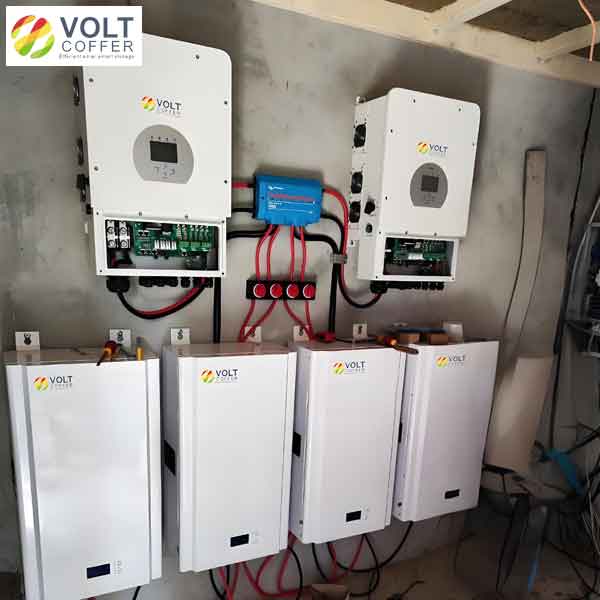
In terms of implementation, the improved VOC strategy can be applied to a wide range of types of solar inverter, including hybrid inverters that integrate battery storage. The modular design allows for easy adaptation to different system configurations. For instance, in a hybrid setup, the VOC can coordinate with energy management systems to optimize power flow, while the sequence separation handles grid imbalances. This versatility makes it suitable for both residential and commercial solar installations, where load profiles are often unpredictable. Additionally, the use of stationary frame control reduces computational complexity compared to synchronous reference frame methods, enabling cost-effective deployment on digital signal processors.
To further illustrate the control structure, I present a mathematical analysis of the power-frequency relationship in VOC. The steady-state equations derived from the oscillator dynamics show that frequency ω is linearly related to active power P, while voltage V has a nonlinear relationship with reactive power Q. Specifically:
$$ \omega = \omega_n – \frac{k_i k_v}{3 C_{\text{voc}} V_n^2} (P – P^*) $$
and
$$ V = \frac{V_n}{2} \left[ 1 + \sqrt{1 – \frac{8 k_i k_v}{3 \xi C_{\text{voc}} V_n^2} (Q – Q^*)} \right] $$
where \( P^* \) and \( Q^* \) are the reference active and reactive power. These relationships form the basis for the droop characteristics, which are enhanced by the secondary compensator to maintain frequency stability. The compensator’s gains are optimized through pole placement, ensuring that the system responds quickly to disturbances without oscillatory behavior.
In conclusion, my research presents a comprehensive solution for off-grid inverter control under mixed loads, leveraging advanced VOC techniques. The integration of sequence separation and frequency compensation addresses key challenges in power quality, making it applicable to various types of solar inverter. Future work will focus on extending this approach to multi-inverter systems and incorporating real-time optimization for adaptive gain tuning. By improving the robustness of inverters, I contribute to the reliability of renewable energy systems, supporting the global transition to clean power. The simulation outcomes confirm that the proposed strategy outperforms conventional methods, paving the way for wider adoption in industrial applications.