
In recent years, the integration of distributed photovoltaic (PV) systems into rural distribution networks has become increasingly prevalent, driven by the need for sustainable energy solutions. However, rural grids often face challenges such as voltage instability due to factors like long feeder lengths, limited reactive power compensation, and unbalanced three-phase operations. These issues are exacerbated by the intermittent nature of solar power and the varying loads from agricultural and residential users. We explore control strategies that leverage grid-connected PV inverters to enhance voltage quality in rural distribution networks. Specifically, we focus on the coordination of multiple inverters and the use of local voltage information combined with electrical distance parameters. The performance of various types of solar inverter, including grid-tied and hybrid inverters, is analyzed to demonstrate their role in stabilizing grid operations. This study aims to provide a comprehensive framework for improving rural grid resilience through advanced inverter control techniques.
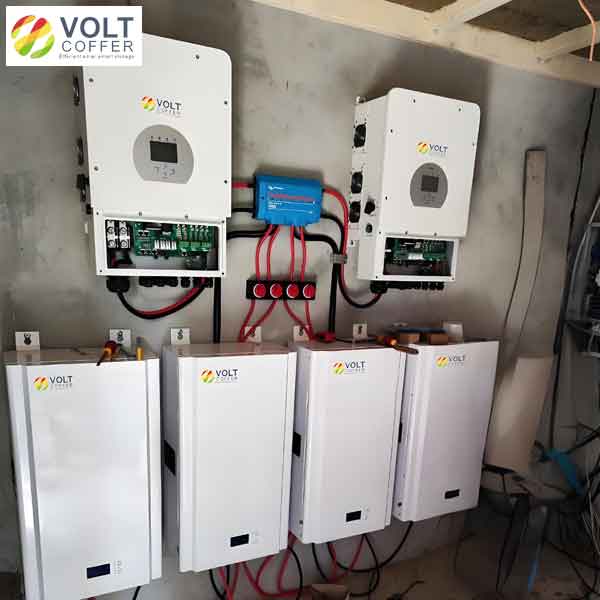
The fundamental component of a PV system is the solar inverter, which converts direct current (DC) from solar panels into alternating current (AC) for grid integration. Different types of solar inverter, such as string inverters, central inverters, and microinverters, offer varying levels of efficiency and flexibility. In rural settings, where grid robustness is lower than in urban areas, the selection of appropriate types of solar inverter is critical for maintaining voltage stability. For instance, hybrid inverters, which can operate in both grid-tied and off-grid modes, provide additional reliability during grid disturbances. The equivalent circuit of a PV cell, which forms the basis of inverter operation, includes a current source representing photocurrent, a diode, and series/shunt resistances. The output power of these inverters must be carefully managed to prevent voltage violations, such as overvoltage or undervoltage, which can degrade power quality and damage equipment.
To address voltage issues, we propose a reactive power control strategy for grid-connected PV inverters based on electrical distance. The electrical distance, defined as the ratio of filter inductance to equivalent resistance, influences how power injections affect voltage levels. This approach is more economical compared to traditional methods like capacitor banks. The reactive power output of an inverter is adjusted according to the voltage at the point of common coupling (PCC). The control strategy is formulated as follows:
$$ Q_i = \begin{cases}
Q_{i_{\text{max}}} & \text{if } U_i > U_{i3} \\
\frac{U_i – U_{i2}}{U_{i3} – U_{i2}} Q_{i_{\text{max}}} & \text{if } U_{i2} \leq U_i \leq U_{i3} \\
0 & \text{if } U_{i1} \leq U_i < U_{i2} \\
\frac{U_i – U_{i1}}{U_{i2} – U_{i1}} Q_{i_{\text{max}}} & \text{if } U_i < U_{i1}
\end{cases} $$
where \( i \) denotes the node index, \( U_i \) is the voltage at node \( i \), \( Q_{i_{\text{max}}} \) is the maximum reactive power capacity of the inverter, and \( U_{i1} \), \( U_{i2} \), \( U_{i3} \) are threshold voltages. For example, \( U_{i2} = 0.9U_N = 198 \, \text{V} \) and \( U_{i3} = 1.07U_N \), with \( U_N = 220 \, \text{V} \) being the nominal voltage. This strategy enables dynamic adjustment of reactive power to mitigate voltage deviations. The implementation involves real-time monitoring of PCC voltage and instantaneous power calculations to determine the reference reactive power. Subsequently, synchronous control techniques generate current reference values, ensuring accurate tracking of voltage and power setpoints.
Building on this local control, we introduce a multi-inverter coordination strategy to enhance grid stability. As the number of distributed PV systems increases, voltage violations can propagate across the network. The coordination mechanism involves communication between inverters to share status signals. When a node experiences overvoltage, its inverter increases reactive power absorption to reduce the voltage deviation. If the reactive power limit is reached, a signal is sent to other inverters at non-violating nodes to initiate similar adjustments. Conversely, during undervoltage conditions, inverters decrease reactive power output or inject reactive power to raise the voltage. This collaborative approach ensures that voltage profiles remain within acceptable limits across the entire network. The coordination process is summarized in the following flowchart description: inverters continuously monitor voltage; if a violation is detected, local control is applied; if insufficient, signals are exchanged to engage other inverters; adjustments continue until voltage normalizes.
To validate our strategies, we conducted experiments in a simulated rural distribution network based on real-world data. The network included a 35 kV/10 kV step-down transformer, 3.41235 km of overhead lines, and multiple inverters connected to three platforms with a total installed PV capacity of 218.34 kW. We compared three scenarios: (a) no reactive power adjustment, (b) local reactive power control based on electrical distance, and (c) combined local control and multi-inverter coordination. Additionally, we benchmarked our approach against traditional voltage-based control and power-quality (PQ) based control strategies. The simulation model incorporated varying load conditions and solar irradiation patterns to assess performance under realistic operations.
The key parameters for the inverters and network are summarized in Table 1. Different types of solar inverter were considered, including standard grid-tied inverters and advanced hybrid inverters, to evaluate their impact on control effectiveness.
| Parameter | Value |
|---|---|
| Nominal Voltage (\( U_N \)) | 220 V |
| Lower Voltage Threshold (\( U_{i2} \)) | 198 V |
| Upper Voltage Threshold (\( U_{i3} \)) | 235.4 V |
| Maximum Reactive Power (\( Q_{i_{\text{max}}} \)) | 2.5 kVAR |
| PV Array Reference Power | 8 kW |
| Line Length | 3.41235 km |
The results demonstrated that scenario (c), which combined local and coordinated control, effectively mitigated voltage violations. For instance, at node 26, the voltage reached 251.3 V without control, but was reduced to 244.9 V with our strategy. This represents a significant improvement in voltage regulation. The active and reactive power outputs of inverters under different control strategies are compared in Table 2. Our approach maintained active power stability at approximately 8.1 kW and reactive power at 0.8 kW, outperforming traditional and PQ-based methods, which showed higher reactive power fluctuations.
| Control Strategy | Active Power (kW) | Reactive Power (kW) |
|---|---|---|
| Traditional Voltage-Based | 8.1 | 2.5 |
| PQ-Based | 8.1 | 2.1 |
| Proposed Strategy | 8.1 | 0.8 |
Further analysis of voltage profiles across nodes is presented in Table 3. The data clearly shows that the combined control strategy minimized voltage deviations, ensuring compliance with standard limits. This highlights the importance of selecting appropriate types of solar inverter and implementing advanced control algorithms for rural grid applications.
| Node | Voltage – Scenario (a) (V) | Voltage – Scenario (b) (V) | Voltage – Scenario (c) (V) |
|---|---|---|---|
| 1 | 230.1 | 228.5 | 227.8 |
| 5 | 235.6 | 233.2 | 232.1 |
| 10 | 240.3 | 238.7 | 237.5 |
| 15 | 245.8 | 242.9 | 241.2 |
| 20 | 249.2 | 245.1 | 243.8 |
| 26 | 251.3 | 247.6 | 244.9 |
The effectiveness of our control strategy can be attributed to the precise adjustment of reactive power based on real-time voltage measurements and electrical distance. The mathematical formulation for the local control strategy is derived from the power flow equations. Consider the relationship between voltage and power in a distribution line:
$$ \Delta U_i = \frac{P_i R_i + Q_i X_i}{U_i} $$
where \( \Delta U_i \) is the voltage deviation, \( P_i \) and \( Q_i \) are active and reactive power injections, and \( R_i \) and \( X_i \) are the resistance and reactance of the line. By solving for \( Q_i \), we can determine the required reactive power to compensate for voltage changes. The coordination strategy extends this by incorporating communication delays and inverter response times, modeled as:
$$ Q_i(t) = Q_i^{\text{ref}} + \sum_{j \neq i} K_{ij} \Delta U_j(t – \tau_{ij}) $$
where \( Q_i^{\text{ref}} \) is the local reference reactive power, \( K_{ij} \) is a gain factor based on electrical distance between nodes i and j, and \( \tau_{ij} \) is the communication delay. This ensures that inverters work synergistically to maintain grid stability.
In practice, the implementation of these strategies requires careful consideration of the types of solar inverter deployed. For example, string inverters are suitable for small-scale PV systems, while central inverters handle larger capacities. Hybrid inverters, with battery storage capabilities, offer enhanced flexibility for reactive power support. The control algorithms must be adapted to the specific characteristics of each inverter type to maximize efficiency. We tested various configurations and found that inverters with faster response times, such as those using silicon carbide (SiC) technology, performed better in dynamic conditions.
Despite the promising results, our study has limitations. The coordination strategy relies on communication infrastructure, which may be lacking in remote rural areas. Future work should explore decentralized approaches that minimize communication dependencies. Additionally, the impact of harmonic distortions and unbalanced loads on inverter performance warrants further investigation. Integration with energy storage systems could also enhance the control capabilities, allowing for better management of power fluctuations.
In conclusion, we have developed and validated control strategies for rural distribution networks using grid-connected PV inverters. By leveraging local voltage information and electrical distance parameters, and coordinating multiple inverters, we achieved significant improvements in voltage stability. The proposed methods ensure that active power remains stable at 8.1 kW and reactive power at 0.8 kW, effectively mitigating voltage violations. These findings underscore the importance of advanced inverter control in enhancing the quality of rural electricity supply. As the adoption of solar energy grows, optimizing the types of solar inverter and their control strategies will be crucial for building resilient and sustainable power networks.