
In the context of renewable energy development, the efficient utilization of solar resources is paramount, particularly for off grid solar system applications. These systems operate independently of the main electrical grid, making them ideal for remote areas, rural communities, and specialized locations where grid connectivity is unavailable or unreliable. The core challenge in enhancing the performance of an off grid solar system lies in maximizing the energy capture efficiency of solar panels. By ensuring that solar panels continuously face the sun directly, the incident solar radiation can be optimized, leading to increased electricity generation. Traditional methods often rely on single-controller setups for solar panel orientation, but these approaches suffer from limitations such as low device utilization and maintenance difficulties. This paper explores the implementation of a centralized control strategy using EtherCAT bus technology to coordinate multiple controllers, thereby improving the overall efficiency and reliability of off grid solar system installations.
The fundamental principle behind solar energy harvesting involves the photovoltaic effect, where solar cells convert sunlight into electricity. The amount of electrical energy generated depends significantly on the angle at which solar panels are positioned relative to the sun. When panels are perpendicular to the sun’s rays, they receive the maximum irradiance, resulting in higher power output. Therefore, developing an automatic sun-tracking mechanism that adjusts the panel orientation throughout the day is crucial for optimizing the performance of an off grid solar system. Unlike grid-connected systems, off grid solar system setups rely solely on solar arrays and battery storage, necessitating robust control strategies to ensure consistent energy supply.
To achieve precise sun tracking, it is essential to accurately determine the sun’s position in the sky. The sun’s apparent motion is governed by the Earth’s rotation and orbital eccentricity, leading to variations in its position relative to a fixed point on Earth. In the horizontal coordinate system, the sun’s position can be defined by two angles: the altitude angle (α) and the azimuth angle (γ). The altitude angle represents the angle between the sun’s rays and the horizontal plane, while the azimuth angle indicates the direction of the sun relative to true north. The mathematical relationships for these angles are derived from spherical trigonometry and are given by:
$$ \sin \alpha = \sin \delta \sin \phi + \cos \delta \cos \phi \cos \omega $$
where α is the altitude angle, δ is the declination angle, φ is the local latitude, and ω is the hour angle. The altitude angle can be computed as:
$$ \alpha = \sin^{-1} (\sin \delta \sin \phi + \cos \delta \cos \phi \cos \omega) $$
The azimuth angle γ is calculated using:
$$ \cos \gamma = \frac{\sin \delta \cos \phi – \cos \delta \sin \phi \cos \omega}{\cos \alpha} $$
Alternatively, it can be expressed as:
$$ \gamma = \arccos \left( \frac{\sin \alpha \sin \phi – \sin \delta}{\cos \alpha \cos \phi} \right) $$
The declination angle δ, which accounts for the tilt of the Earth’s axis, varies throughout the year. Several algorithms exist for estimating δ, including the Cooper, Stine, Spencer, and Yu Hejun methods. The accuracy of these algorithms directly impacts the precision of the sun-tracking system in an off grid solar system. To evaluate their performance, we compared the errors of each algorithm against reference data from astronomical almanacs. The following table summarizes the maximum, minimum, and range of errors for each declination estimation algorithm:
| Declination Estimation Algorithm | Maximum Error (°) | Minimum Error (°) | Error Range (°) |
|---|---|---|---|
| Cooper Algorithm | 0.07085 | -1.2800 | 1.35085 |
| Stine Algorithm | 0.02824 | -0.7977 | 0.82954 |
| Spencer Algorithm | 0.14870 | -0.1110 | 0.25870 |
| Yu Hejun Algorithm | 0.42350 | -0.4355 | 0.85900 |
Based on the error analysis, the Spencer algorithm demonstrates the smallest error range, making it the most suitable for calculating the declination angle in an off grid solar system. This algorithm is expressed as:
$$ \delta = [0.006918 – 0.399912 \cos(\theta) + 0.070257 \sin(\theta) – 0.006758 \cos(2\theta) + 0.000907 \sin(2\theta) – 0.002697 \cos(3\theta) + 0.00148 \sin(3\theta)] \times \frac{180}{\pi} $$
where θ is the day angle given by:
$$ \theta = \frac{2\pi n}{365} $$
and n is the day number, ranging from 1 on January 1 to 365 on December 31. The hour angle ω, which represents the time of day, is calculated based on the local solar time and requires an accurate equation of time algorithm. By integrating the Spencer declination algorithm with a precise time difference estimation, we can compute the sun’s altitude and azimuth angles with high accuracy, enabling effective control of the off grid solar system.
The hardware architecture of the proposed off grid solar system is designed to facilitate centralized control and real-time adjustment of multiple solar panels. The system comprises an embedded PC, servo drives, servo motors, an information display module, and a real-time clock module. The embedded PC acts as the central controller, executing the sun-tracking algorithms and coordinating the movements of the servo motors via the EtherCAT bus. This bus protocol enables high-speed, deterministic communication between the controller and the drives, ensuring synchronized operation of all panels in the off grid solar system. The real-time clock module provides accurate timekeeping, which is essential for calculating the sun’s position, while the display module offers a user interface for monitoring system status.
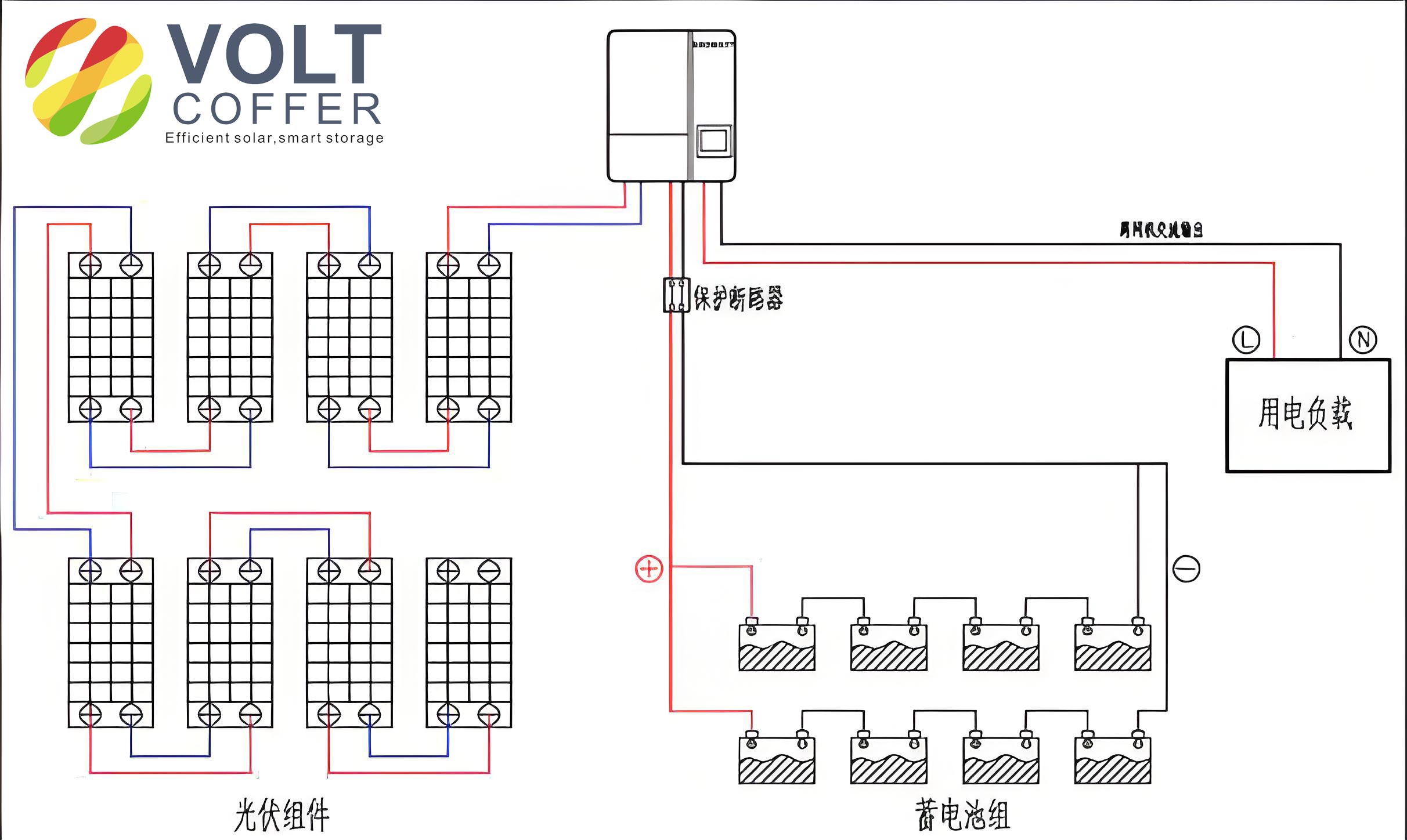
The operational workflow of the off grid solar system begins with the initialization of the system time. If the system time is incorrect, it is calibrated using the real-time clock module. Once the time is set, the embedded PC retrieves the local geographical coordinates (latitude and longitude) and computes the sunrise and sunset times, as well as the altitude and azimuth angles for the current time. The system then checks if the current time falls within the operational window between sunrise and sunset. If not, the system enters a waiting state. Upon confirmation, the servo motors are enabled, and the embedded PC sends command signals through the EtherCAT bus to the drives, instructing them to rotate the solar panels to the calculated angles. This ensures that the panels remain perpendicular to the sun’s rays throughout the day, maximizing energy capture in the off grid solar system.
The control program for the off grid solar system is implemented using a structured flowchart. The main program starts by verifying the system time and geographical data. It then calculates the sun’s position and determines the required rotation angles for the panels. The program checks for valid operational conditions, such as daylight hours and motor enable status, before issuing movement commands. The use of EtherCAT bus allows for simultaneous control of multiple axes, enabling coordinated tracking across all panels in the off grid solar system. To validate the control strategy, we conducted experiments using six servo motors, each representing an axis of control. The target trajectory for each motor was derived from the computed altitude angles, and the actual motor positions were recorded to evaluate tracking errors. The following table presents the maximum, minimum, and average errors for each axis:
| Axis Variable Name | Maximum Error (°) | Minimum Error (°) | Average Error (°) |
|---|---|---|---|
| Axis1 | 0.034982 | 0.00719 | 0.010954 |
| Axis2 | 0.034778 | 0.00767 | 0.012553 |
| Axis3 | 0.037222 | 0.00596 | 0.013674 |
| Axis4 | 0.034217 | 0.00748 | 0.012328 |
| Axis5 | 0.035061 | 0.00844 | 0.011567 |
| Axis6 | 0.034952 | 0.00760 | 0.011650 |
The results indicate that the maximum tracking error across all axes is only 0.037°, with an average error of approximately 0.012°. This level of precision meets the requirements for a high-performance off grid solar system, ensuring that the panels maintain optimal orientation. Moreover, the consistency in errors across all axes demonstrates the stability and reliability of the EtherCAT-based群控 system, which is essential for large-scale deployments of off grid solar system installations.
In addition to the positional accuracy, the energy efficiency of the off grid solar system was evaluated by comparing the power output of tracked panels versus fixed panels. The power generated by a solar panel can be modeled as:
$$ P = G \cdot A \cdot \eta \cdot \cos(\theta_i) $$
where P is the power output, G is the solar irradiance, A is the panel area, η is the conversion efficiency, and θ_i is the angle of incidence between the sun’s rays and the panel surface. For a fixed panel, θ_i varies throughout the day, reducing the effective irradiance. In contrast, a tracked panel minimizes θ_i, leading to higher energy harvest. The daily energy gain for an off grid solar system with tracking can be estimated as:
$$ E_{\text{tracked}} = \int_{t_{\text{sunrise}}}^{t_{\text{sunset}}} P_{\text{tracked}} \, dt $$
$$ E_{\text{fixed}} = \int_{t_{\text{sunrise}}}^{t_{\text{sunset}}} P_{\text{fixed}} \, dt $$
The percentage improvement in energy collection is given by:
$$ \text{Improvement} = \frac{E_{\text{tracked}} – E_{\text{fixed}}}{E_{\text{fixed}}} \times 100\% $$
Simulations based on typical meteorological data show that an off grid solar system with dual-axis tracking can achieve up to 30-40% more energy output compared to a fixed-tilt system. This enhancement is particularly beneficial for off grid applications, where every watt-hour of energy is critical for meeting load demands.
Furthermore, the control strategy incorporates fault tolerance mechanisms to handle scenarios such as cloudy weather or system failures. For instance, if the sun is obscured, the system can switch to a predefined safe mode or use historical data to estimate the sun’s position. The embedded PC continuously monitors the health of all components in the off grid solar system, including motor currents and communication status, to ensure reliable operation. The EtherCAT bus provides diagnostic capabilities, allowing for rapid detection and isolation of faults, which is vital for maintaining the off grid solar system in remote locations.
In conclusion, the integration of EtherCAT bus technology into the control architecture of an off grid solar system enables efficient and precise sun tracking across multiple panels. By employing the Spencer algorithm for declination calculation and a robust hardware design, the system achieves high accuracy in panel orientation, leading to significant improvements in energy capture. The experimental results confirm that the群控 approach minimizes tracking errors and ensures stable performance, making it suitable for large-scale off grid solar system deployments. Future work may focus on enhancing the algorithm with machine learning techniques for weather adaptation and optimizing the energy management system for battery storage in off grid solar system setups. This research contributes to the advancement of renewable energy technologies, particularly in expanding the capabilities of off grid solar system solutions for sustainable development.