
As we delve into the transformative potential of renewable energy, I find myself captivated by the rapid advancements in off-grid solar systems. These systems, which operate independently of the main power grid, are poised to redefine how we produce and utilize clean energy, particularly in the realm of hydrogen generation. In this article, I will explore the cutting-edge innovations, technical breakthroughs, and future prospects of off-grid solar systems, with a focus on their application in hydrogen production. Through detailed analyses, formulas, and tables, I aim to provide a comprehensive overview of how these systems are driving sustainable energy solutions globally.
The concept of an off-grid solar system revolves around harnessing solar energy without reliance on external electrical infrastructure. This independence is crucial for remote areas and specialized applications, such as green hydrogen production. Recently, a groundbreaking project has emerged, showcasing a novel “intrinsic off-grid, no energy storage” approach for photovoltaic hydrogen generation. This system eliminates traditional batteries, instead directly powering electrolyzers with solar arrays. The core innovation lies in flexible hydrogen production and purification processes that intelligently track maximum photovoltaic output, enabling “load-following-source” operation and optimized scheduling. This not only simplifies system architecture and reduces costs but also minimizes grid dependency, making it a pivotal step toward scalable, low-cost green hydrogen.
To understand the efficiency of such an off-grid solar system, we can model the photovoltaic output power. The power generated by a solar array can be expressed as: $$ P_{pv} = G \cdot A \cdot \eta_{pv} $$ where \( P_{pv} \) is the photovoltaic power output in watts, \( G \) is the solar irradiance in W/m², \( A \) is the surface area of the panels in m², and \( \eta_{pv} \) is the conversion efficiency of the panels. For hydrogen production, the electrolysis efficiency is critical. The hydrogen production rate can be derived from: $$ \dot{m}_{H_2} = \frac{P_{elec} \cdot \eta_{elec}}{LHV_{H_2}} $$ where \( \dot{m}_{H_2} \) is the mass flow rate of hydrogen in kg/s, \( P_{elec} \) is the electrical power input to the electrolyzer in watts, \( \eta_{elec} \) is the electrolyzer efficiency, and \( LHV_{H_2} \) is the lower heating value of hydrogen (approximately 120 MJ/kg). In an off-grid solar system, \( P_{elec} \) is directly supplied by \( P_{pv} \), emphasizing the need for high efficiency in both components.
The following table summarizes key parameters for a typical 5 MW off-grid solar system for hydrogen production, based on recent projects:
| Parameter | Value | Description |
|---|---|---|
| Photovoltaic Capacity | 5 MW | Rated power output of solar arrays |
| Hydrogen Output | Approx. 100 kg/day | Estimated daily production under optimal conditions |
| System Efficiency | 60-70% | Overall efficiency from solar to hydrogen |
| Key Innovation | No energy storage | Direct coupling of PV and electrolyzer |
Integrating such an off-grid solar system with hydrogen production requires robust control mechanisms to handle variability in solar irradiance. The power balance equation in a no-storage system is: $$ P_{pv}(t) = P_{load}(t) + P_{loss}(t) $$ where \( P_{pv}(t) \) is the time-varying photovoltaic power, \( P_{load}(t) \) is the power consumed by the electrolyzer and purification units, and \( P_{loss}(t) \) represents system losses. To maximize efficiency, advanced algorithms dynamically adjust the electrolyzer operation to match solar input, a concept known as “source-following-load.” This is particularly vital in off-grid solar systems, where energy must be utilized instantaneously.
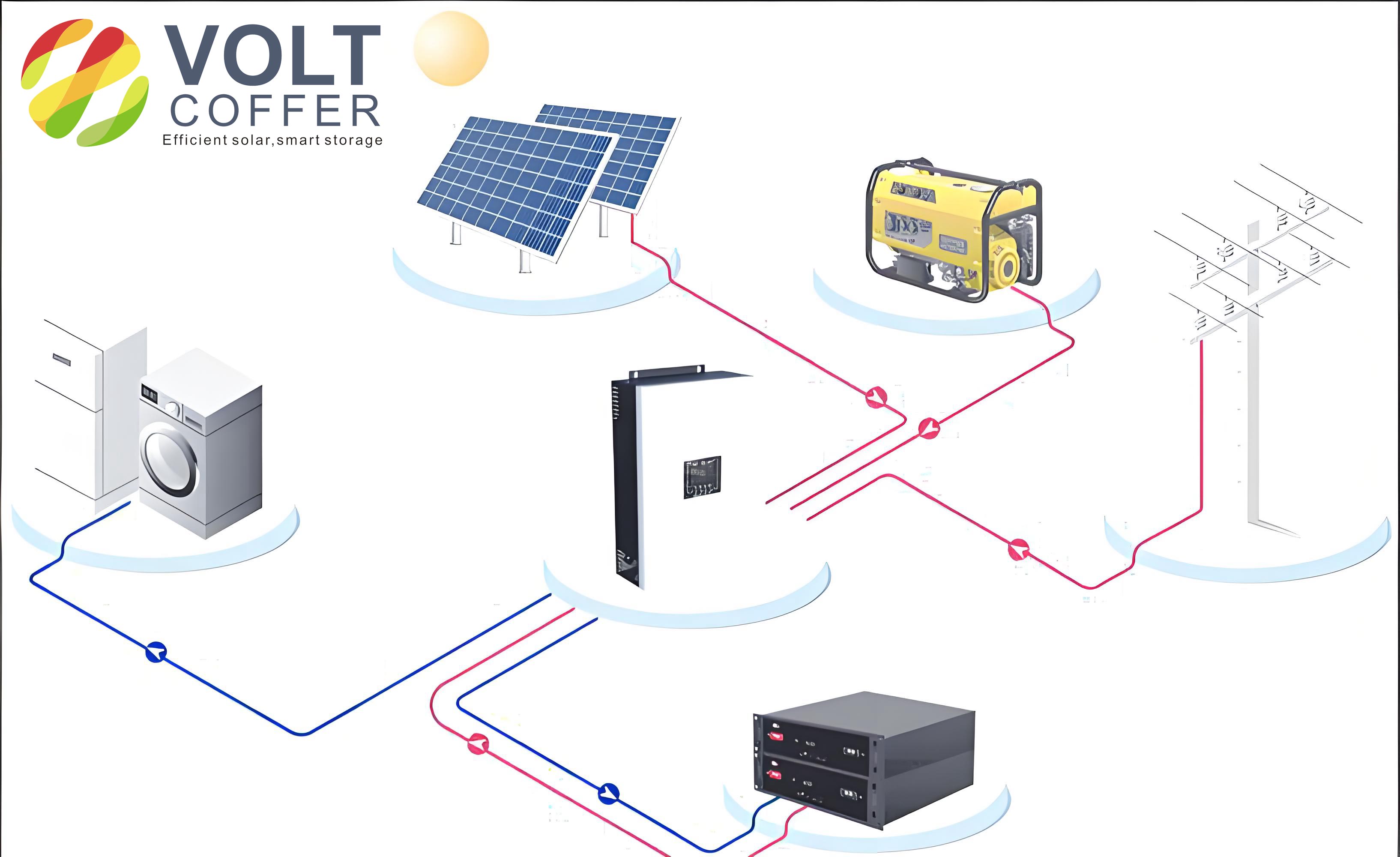
Beyond terrestrial applications, off-grid solar systems are extending to marine environments, where seawater electrolysis offers a vast, untapped resource for hydrogen production. A recent initiative aims to develop a modular seawater electrolysis system that operates without desalination, directly splitting seawater into hydrogen and oxygen. This approach leverages physical-mechanical processes combined with electrochemical reactions, overcoming long-standing challenges like corrosion and catalyst deactivation. For an off-grid solar system powering such electrolysis, the overall efficiency can be enhanced by optimizing the interface between solar modules and electrolyzers. The hydrogen yield from seawater electrolysis can be modeled as: $$ Y_{H_2} = \int_0^T \frac{P_{sol}(t) \cdot \eta_{sys}}{E_{H_2}} dt $$ where \( Y_{H_2} \) is the total hydrogen yield over time \( T \), \( P_{sol}(t) \) is the solar power input, \( \eta_{sys} \) is the system efficiency, and \( E_{H_2} \) is the energy required per kg of hydrogen (about 50 kWh/kg). This formula highlights the synergy between off-grid solar systems and advanced electrolysis techniques.
The economic viability of off-grid solar systems for hydrogen production depends on factors like capital costs, operational efficiency, and scalability. Below is a table comparing different aspects of off-grid solar hydrogen projects:
| Aspect | Traditional System with Storage | No-Storage Off-Grid System |
|---|---|---|
| Initial Investment | High (due to batteries) | Lower (simplified design) |
| Maintenance | Moderate to high | Low (fewer components) |
| Hydrogen Cost | $4-6/kg | $2-4/kg (projected) |
| Reliability | High with storage | Depends on solar consistency |
In the context of energy policy and innovation, artificial intelligence (AI) is playing an increasingly important role in optimizing off-grid solar systems. AI algorithms can predict solar irradiance, manage load distribution, and enhance electrolyzer performance. For instance, machine learning models can forecast power output based on weather data, allowing the off-grid solar system to pre-adjust hydrogen production rates. The optimization problem can be formulated as: $$ \min \sum_{t=1}^{T} \left( P_{pv}(t) – P_{demand}(t) \right)^2 $$ subject to constraints like \( P_{demand}(t) \leq P_{pv}(t) \) for no-storage systems. This minimizes the mismatch between supply and demand, crucial for efficient operation. Moreover, AI-driven diagnostics can detect faults in real-time, improving the reliability of off-grid solar systems in harsh environments.
Looking ahead, the integration of off-grid solar systems with other renewable sources, such as wind, can create hybrid energy systems that enhance stability and output. For example, a multi-energy协同 technology combines wind power electrolysis for green hydrogen with biomass gasification, producing synthesis gas for green methanol. In such setups, the off-grid solar system provides supplementary power, ensuring continuous operation. The overall energy balance can be expressed as: $$ E_{total} = E_{solar} + E_{wind} + E_{biomass} $$ where each component contributes to hydrogen or methanol synthesis. This hybrid approach reduces intermittency issues common in standalone off-grid solar systems.
To further illustrate the technical details, consider the performance metrics of a typical electrolyzer in an off-grid solar system. The voltage-current relationship in an electrolysis cell is given by: $$ V = V_0 + i \cdot R + A \cdot \log\left( \frac{i}{i_0} + 1 \right) $$ where \( V \) is the cell voltage, \( V_0 \) is the reversible voltage, \( i \) is the current density, \( R \) is the resistance, \( A \) is the Tafel slope, and \( i_0 \) is the exchange current density. In an off-grid solar system, the current input fluctuates with solar intensity, requiring electrolyzers with wide operating ranges. Advanced catalysts and membranes are being developed to maintain efficiency under variable conditions, a key focus in recent research.
The scalability of off-grid solar systems for hydrogen production is evident in large-scale projects aiming for tens of thousands of tons annually. These initiatives often employ phased construction, with initial phases validating the technology before expansion. The levelized cost of hydrogen (LCOH) for such systems can be calculated as: $$ LCOH = \frac{C_{cap} + \sum_{t=1}^{n} \frac{C_{op}(t)}{(1+r)^t}}{\sum_{t=1}^{n} \frac{m_{H_2}(t)}{(1+r)^t}} $$ where \( C_{cap} \) is the capital cost, \( C_{op}(t) \) is the operational cost in year \( t \), \( m_{H_2}(t) \) is the hydrogen production in year \( t \), \( r \) is the discount rate, and \( n \) is the system lifetime. For off-grid solar systems, \( C_{cap} \) is lower due to the absence of grid connection and storage, while \( C_{op} \) benefits from minimal fuel costs.
In marine applications, the corrosion resistance of off-grid solar systems is paramount. Seawater electrolysis systems must withstand harsh conditions, and materials science innovations are critical. The corrosion rate can be modeled using Faraday’s law: $$ \text{Corrosion Rate} = \frac{i_{corr} \cdot M}{z \cdot F \cdot \rho} $$ where \( i_{corr} \) is the corrosion current density, \( M \) is the molar mass, \( z \) is the charge number, \( F \) is Faraday’s constant, and \( \rho \) is the density. By integrating durable materials and protective coatings, off-grid solar systems can achieve long-term stability in oceanic environments, enabling sustainable hydrogen production from abundant seawater resources.
As we push the boundaries of off-grid solar systems, regulatory frameworks and funding mechanisms are evolving to support their deployment. For instance, specialized funds are being allocated to infrastructure projects that demonstrate high potential for innovation and scalability. These financial instruments often prioritize systems that reduce carbon emissions and enhance energy security. The evaluation criteria for such support can include technical maturity, economic impact, and environmental benefits, all of which are strengths of advanced off-grid solar systems.
In conclusion, the evolution of off-grid solar systems is revolutionizing the energy landscape, particularly in green hydrogen production. From intrinsic no-storage designs to AI-enhanced optimization, these systems offer a path toward decarbonization and energy independence. As research and development accelerate, we can expect further reductions in costs and improvements in efficiency, solidifying the role of off-grid solar systems in a sustainable future. The journey from laboratory validations to full-scale implementations underscores the transformative potential of this technology, and I am excited to witness its continued growth and adoption across the globe.