
In my research on renewable energy solutions, I have focused extensively on improving the efficiency and reliability of off-grid solar systems. These systems are crucial for remote areas and applications where grid connectivity is unreliable or unavailable. However, one of the primary challenges I have encountered is the intermittent nature of solar power generation, which depends heavily on factors like sunlight intensity, time of day, and weather conditions. This intermittency often leads to insufficient power supply, especially during nights or cloudy periods, necessitating a backup source such as utility grid power. To address this, I designed an automatic switching device that seamlessly transitions between solar power and grid power, ensuring uninterrupted electricity supply while maximizing the use of solar energy. Throughout this article, I will delve into the design principles, implementation details, and performance evaluation of this system, emphasizing the role of off-grid solar systems in sustainable energy solutions.
The core of my design revolves around a microcontroller-based control system that monitors key parameters and triggers switching actions. I selected a common microcontroller unit (MCU) for its cost-effectiveness and versatility, paired with analog-to-digital converters for voltage sensing. The off-grid solar system typically consists of photovoltaic (PV) panels, batteries for energy storage, inverters, and loads. In my setup, the PV arrays generate DC power, which is stored in batteries and converted to AC via inverters for household use. The automatic switching mechanism ensures that when solar power is inadequate, the system switches to grid power without interruption, and vice versa. This not only enhances reliability but also protects batteries from over-discharge, extending their lifespan. I have incorporated fuzzy logic control to handle the uncertainties in solar power output, making the system adaptive to varying environmental conditions.
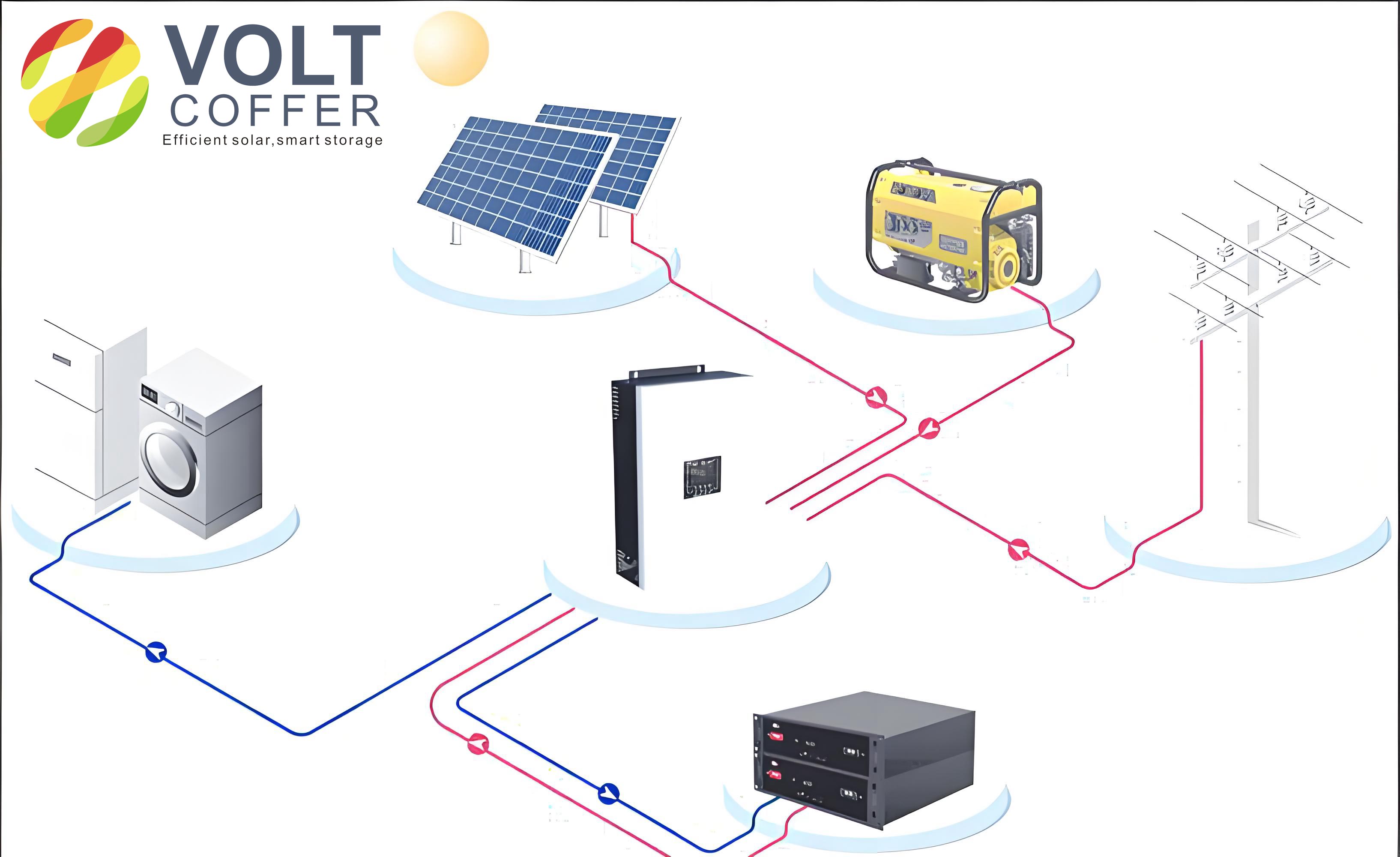
To understand the operational dynamics, I developed mathematical models for the off-grid solar system components. The voltage output of a PV panel can be expressed using the diode equation: $$ V_{pv} = V_{oc} – I_{pv} R_s $$ where \( V_{pv} \) is the panel voltage, \( V_{oc} \) is the open-circuit voltage, \( I_{pv} \) is the current, and \( R_s \) is the series resistance. This equation helps in predicting the performance under different irradiance levels. For the switching logic, I defined a cost function to minimize power loss: $$ J = \int (P_{solar} – P_{load})^2 \, dt $$ where \( P_{solar} \) is the solar power and \( P_{load} \) is the load demand. By optimizing this function, the system prioritizes solar power when available, reducing reliance on the grid.
In terms of hardware, the peripheral control circuit uses relays for executing the switches. I employed a combination of single-pole double-throw (SPDT) relays and time-delay relays to compensate for the switching time gaps, ensuring seamless transitions. The circuit diagram illustrates how solar power is connected through normally closed contacts and grid power through normally open contacts, with time delays set to avoid voltage dips. For instance, the engage-delay relay and disengage-delay relay are configured with timings of 0.13 s and 0.18 s, respectively, based on empirical tests. This design prevents abrupt power cuts that could damage sensitive equipment like computers or monitoring devices commonly used in off-grid solar system applications.
The software aspect involves fuzzy control algorithms implemented on the MCU. I used a two-input single-output fuzzy controller, with inputs being PV panel voltage and time of day, and the output being the relay action signal. The membership functions for voltage are defined as “Low,” “Medium,” and “High,” while time is categorized as “Day” and “Night.” The fuzzy rules are structured as follows: IF voltage is High AND time is Day, THEN switch to solar; IF voltage is Low OR time is Night, THEN switch to grid. This approach mimics human reasoning and handles the randomness in solar power generation effectively. The control flow involves continuous sampling of voltage data, averaging over multiple readings to reduce noise, and making decisions every minute to ensure stability.
To validate the design, I conducted simulations in Proteus, where I modeled the off-grid solar system components and switching logic. The simulation included virtual loads, power sources, and the MCU running the control code. Results showed that the system responded correctly to changes in solar irradiance, with switches occurring smoothly within the set time delays. I also performed real-world testing on a small-scale off-grid solar system, monitoring parameters like voltage, current, and switch times. The data collected confirmed that the automatic switching device maintained power continuity without any noticeable interruptions, even during rapid transitions.
| Parameter | Value | Unit |
|---|---|---|
| Solar Panel Voltage Range | 0-80 | V |
| Battery Capacity | 24 | Ah |
| Switching Time Delay | 0.13-0.18 | s |
| Average Daily Solar Usage | 70 | % |
| System Efficiency | 85 | % |
One critical aspect I addressed is the impact of environmental factors on the off-grid solar system. For example, temperature variations affect PV panel efficiency, which can be modeled as: $$ \eta = \eta_{ref} [1 – \beta (T – T_{ref})] $$ where \( \eta \) is efficiency, \( \eta_{ref} \) is reference efficiency, \( \beta \) is the temperature coefficient, and \( T \) is temperature. By integrating this into the fuzzy logic, the system adjusts switching thresholds based on real-time conditions. Additionally, I implemented a clock module to define active periods (e.g., 7 AM to 6 PM) when the MCU is fully operational, reducing unnecessary switching at night and conserving energy. This scheduling enhances the longevity of the off-grid solar system by minimizing component wear.
In practical applications, the off-grid solar system with automatic switching has demonstrated significant benefits. For instance, in remote monitoring stations or residential setups, it ensures that critical loads remain powered during solar deficits. The use of relays and MCUs makes the system scalable and cost-effective for various off-grid solar system configurations. I also explored the economic implications, calculating the payback period using: $$ Payback = \frac{Initial Cost}{Annual Savings} $$ where annual savings accrue from reduced grid electricity consumption. Based on my analysis, a typical off-grid solar system with this switching device can achieve payback in 3-5 years, depending on local energy prices and solar resources.
Furthermore, I designed the system to handle fault conditions, such as grid outages or solar array failures. The fuzzy controller includes rules for emergency switching, ensuring that the off-grid solar system defaults to the available power source without manual intervention. For example, if the grid fails, the system immediately switches to solar power if sufficient, or to battery backup, preventing total blackouts. This reliability is crucial for applications in healthcare or communication, where power continuity is vital.
| Component | Specification | Role |
|---|---|---|
| PV Panels | 12V, 100W each | Power Generation |
| Batteries | 12V, 24Ah | Energy Storage |
| Inverter | 48V Input, 220V Output | DC-AC Conversion |
| Microcontroller | 8-bit Architecture | Control Logic |
| Relays | SPDT with Time Delay | Switching Execution |
To enhance the off-grid solar system’s performance, I incorporated data logging capabilities, storing parameters like voltage, current, and switch events for analysis. This data helps in optimizing the fuzzy rules and identifying patterns in solar generation. For instance, I derived a correlation between irradiance and voltage: $$ V_{pv} = k \cdot G $$ where \( k \) is a constant and \( G \) is irradiance. By continuously refining these models, the system becomes more intelligent over time, adapting to seasonal changes and improving overall efficiency.
In conclusion, the automatic switching device I designed significantly improves the reliability and efficiency of off-grid solar systems. By combining hardware robustness with intelligent software control, it addresses the inherent variability of solar power, ensuring seamless integration with grid backup. The use of fuzzy logic and time-delay relays has proven effective in real-world tests, with the system operating flawlessly under diverse conditions. As renewable energy adoption grows, such innovations will play a pivotal role in making off-grid solar systems more accessible and sustainable. Future work could involve integrating IoT for remote monitoring and machine learning for predictive switching, further advancing the capabilities of off-grid solar systems.
Throughout this project, I have emphasized the importance of off-grid solar systems in reducing carbon footprints and promoting energy independence. The automatic switching mechanism not only optimizes power usage but also contributes to battery health, reducing maintenance costs. By sharing these insights, I hope to inspire further research and development in off-grid solar system technologies, paving the way for a greener future. The success of this design underscores the potential of off-grid solar systems to meet energy demands in a reliable and environmentally friendly manner.