
In this paper, I explore the application of LCL and LLCL filters in single-phase off-grid solar systems to mitigate harmonics generated during the switching of inductive loads. Off-grid solar systems are increasingly deployed in remote areas where grid connectivity is unavailable, and ensuring high power quality is crucial for reliable operation. Harmonics, primarily introduced by pulse-width modulation (PWM) in voltage-source full-bridge inverters, can lead to system instability and reduced efficiency. Passive filters, such as LCL and LLCL types, offer a cost-effective solution due to their simplicity and robustness. I focus on deriving mathematical models, designing parameters based on load characteristics, and simulating output waveforms under varying conditions. Through detailed analysis, I aim to provide insights into optimizing filter performance for off-grid solar systems, enhancing overall system reliability.
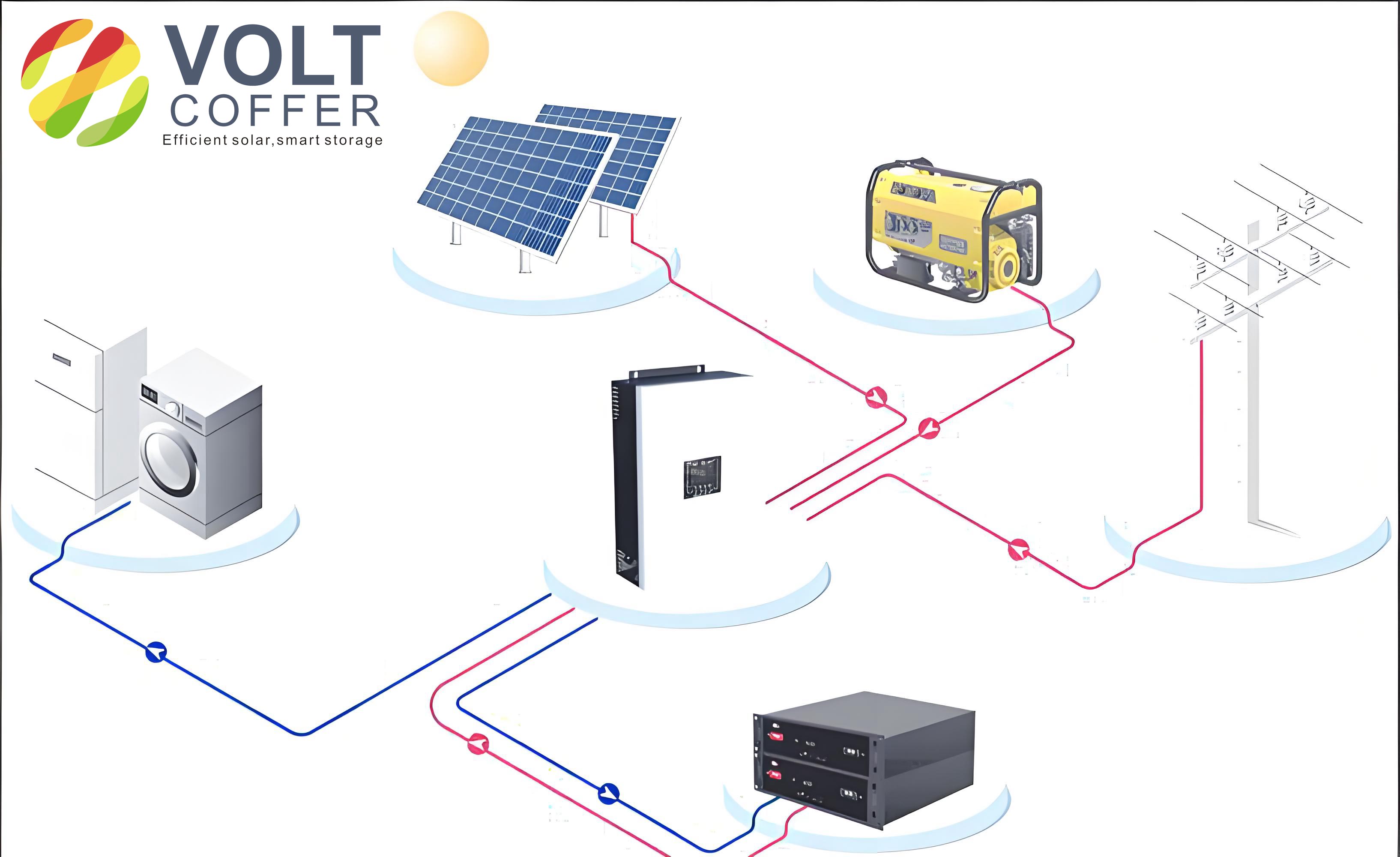
The structure of an off-grid solar system typically includes photovoltaic (PV) panels, a maximum power point tracking (MPPT) controller, a battery storage unit, and an inverter system. During daylight, PV panels generate DC electricity, which is partially stored in batteries and partially converted to AC via the inverter for AC loads. At night or during cloudy conditions, the battery supplies power. The inverter, often a voltage-source full-bridge type, produces PWM signals that introduce harmonics. These harmonics can distort voltage and current waveforms, leading to issues like overheating and equipment failure. Therefore, integrating filters is essential to suppress harmonics and maintain power quality in off-grid solar systems.
To address harmonic distortion, I consider two filter topologies: LCL and LLCL. The LCL filter consists of two inductors (L1 and L2) and a capacitor (Cf), while the LLCL filter adds an additional inductor (Lf) in series with Cf to form a resonant branch. The mathematical models for these filters are derived based on the system’s impedance characteristics. For an off-grid solar system driving an inductive load with impedance Z = r + sL0, where r is the resistance and L0 is the load inductance, the transfer functions are critical for analyzing harmonic suppression. The LCL filter transfer function is given by:
$$G_{\text{LCL}}(s) = \frac{1}{L_1(L_2 + L_0)C_f s^3 + (L_1 + L_2 + L_0)s}$$
Similarly, the LLCL filter transfer function is:
$$G_{\text{LLCL}}(s) = \frac{L_f C_f s^2 + 1}{[L_1(L_2 + L_0) + L_f(L_1 + L_2 + L_0)]C_f s^3 + (L_1 + L_2 + L_0)s}$$
These functions help in understanding how each filter attenuates harmonics across different frequencies. The design of filter parameters must consider constraints such as total inductance, capacitor size, and resonant frequencies to ensure effective harmonic suppression without compromising system stability. For instance, the total inductance L = L1 + L2 must satisfy:
$$L \leq \frac{\sqrt{U_{dc}^2 – U_{o,\text{max}}^2}}{\omega I_{L,\text{max}}}$$
and
$$L \leq \frac{0.1 \times U_o}{\omega I}$$
where Udc is the DC input voltage, Uo is the output voltage, ω is the angular frequency, and I is the rated current. The lower bound for inductance is:
$$L \geq \frac{U_{dc}}{4 \Delta I_{\text{max}} f_s}$$
with fs as the switching frequency and ΔImax as the maximum ripple current (typically 20% of rated current). The filter capacitor Cf is limited by reactive power constraints:
$$C_f = \frac{0.05 P_o}{2\pi f_o U_c^2}$$
where Po is the rated power, fo is the fundamental frequency, and Uc is the capacitor voltage. For the LLCL filter, the resonant branch inductor Lf is designed to resonate at the switching frequency:
$$f_{\text{sw}} = \frac{1}{2\pi \sqrt{L_f C_f}}$$
and the resonant frequency fres should lie within:
$$10f_o \leq f_{\text{res}} \leq \frac{1}{2} f_{\text{sw}}$$
where
$$f_{\text{res}} = \frac{1}{2\pi \sqrt{\left(\frac{L_1 L_2}{L_1 + L_2} + L_f\right) C_f}}$$
These equations guide the parameter selection to achieve optimal performance in off-grid solar systems.
To validate the design, I simulated the system using MATLAB/Simulink with parameters typical for off-grid solar applications. The base parameters are summarized in Table 1.
| Parameter | Symbol | Value |
|---|---|---|
| DC Input Voltage | Udc | 350 V |
| Output Voltage | Uo | 220 V |
| Rated Power | Po | 3000 W |
| Rated Current | I | 13.637 A |
| Fundamental Frequency | fo | 50 Hz |
| Switching Frequency | fsw | 10 kHz |
Based on these, I calculated filter parameters as shown in Table 2. The design ensures that the total inductance ranges between 3.21 mH and 5.15 mH, with L2 ≥ 0.89 mH and Cf ≤ 9.87 μF. For simulation, I selected L1 = 2.1 mH, L2 = 1.2 mH, Cf = 9.87 μF, and for the LLCL filter, Lf = 25.47 μH. The load resistance r = 16.132 Ω and load inductance L0 = 0.479 mH were used to represent a typical inductive load in off-grid solar systems.
| Filter Type | L1 (mH) | L2 (mH) | Cf (μF) | Lf (mH) |
|---|---|---|---|---|
| LCL | 2.1 | 1.2 | 9.87 | – |
| LLCL | 2.1 | 1.2 | 9.87 | 25.47 |
The Bode plots of the transfer functions reveal the frequency response characteristics. For the LCL filter, the magnitude response is -18.6 dB/decade below the switching frequency, with a resonance peak near the resonant frequency. The LLCL filter exhibits a similar response but with a notch at the switching frequency, providing superior attenuation for harmonics around fsw. Above fsw, the LCL filter shows a steeper roll-off of -63 dB/decade compared to -24 dB/decade for the LLCL filter. This indicates that the LLCL filter is more effective for harmonics near the switching frequency, while the LCL filter performs better for higher-order harmonics. This trade-off is crucial when selecting filters for off-grid solar systems, where harmonic content varies with load conditions.
Simulations were conducted under nonlinear load switching scenarios to assess voltage and current waveforms. For the LCL filter, the output voltage total harmonic distortion (THD) was 2.10%, with waveforms showing improved sinusoidal shape but significant lower-order harmonics (below 35th order). The LLCL filter achieved a slightly lower THD of 2.08%, with better suppression of switching-frequency harmonics. However, both filters struggled with lower-order harmonics, highlighting a limitation in passive designs for off-grid solar systems. To further analyze performance, I varied the load inductance L0 while keeping other parameters constant. The THD values for different L0 are summarized in Table 3.
| Load Inductance L0 (mH) | LCL Filter THD (%) | LLCL Filter THD (%) |
|---|---|---|
| 0.479 | 2.10 | 2.08 |
| 1.79 | 3.97 | 3.97 |
| 8.12 | 13.82 | 13.82 |
| 10.01 | 17.70 | 17.70 |
| 13.28 | 18.86 | 19.50 |
| 14.58 | 32.25 | 35.10 |
As observed, for L0 < 1.79 mH and between 8.12 mH and 10.01 mH, both filters yield similar THD, consistent with their comparable low-frequency responses. However, for L0 > 14.58 mH, the LCL filter becomes unstable due to the dominance of L0 over L2, leading to a sharp increase in THD. In contrast, the LLCL filter maintains relatively better stability but still experiences degradation. This underscores the importance of matching filter parameters to load characteristics in off-grid solar systems. To enhance performance, additional techniques such as active damping or hybrid filters could be explored, but passive filters remain attractive for their cost-effectiveness in off-grid applications.
In conclusion, this study demonstrates that both LCL and LLCL filters effectively reduce harmonics in off-grid solar systems, with the LLCL filter offering marginal improvements in THD and better suppression of switching-frequency harmonics. However, limitations in attenuating lower-order harmonics suggest the need for complementary approaches. Future work could focus on optimizing filter parameters for dynamic load conditions and integrating advanced control strategies to further enhance power quality in off-grid solar systems.
The mathematical models and simulation approaches presented here provide a foundation for designing robust filtering solutions. By carefully selecting parameters based on system constraints, engineers can ensure reliable operation of off-grid solar systems in diverse environments. The repeated emphasis on off-grid solar systems throughout this analysis highlights their growing importance in renewable energy deployments, and the insights gained can guide practical implementations for harmonic mitigation.