
In this study, we explore the application of off-grid solar systems in African agricultural parks, focusing on a case study that demonstrates how photovoltaic technology can address energy shortages in remote farming areas. Agriculture is a critical pillar of Africa’s economy, contributing significantly to GDP and employment. However, unreliable electricity access remains a major constraint. With abundant solar resources, Africa holds immense potential for off-grid solar system deployments, which can power agricultural operations efficiently and sustainably. This paper presents a comprehensive design and economic evaluation of off-grid solar solutions, including recent and long-term schemes, to enhance energy reliability and reduce costs. We incorporate detailed financial models, sensitivity analyses, and environmental assessments to highlight the benefits of off-grid solar system implementations. By leveraging solar energy, these systems not only improve agricultural productivity but also support sustainable development goals in line with global initiatives like the Belt and Road. Throughout this work, we emphasize the versatility and economic viability of off-grid solar systems, showcasing their role in transforming Africa’s agricultural landscape.
The importance of off-grid solar systems in Africa cannot be overstated, particularly in rural areas where grid connectivity is limited. According to recent data, over 50% of the workforce in sub-Saharan Africa is engaged in agriculture, yet energy deficits hinder growth. Solar power, with its decentralized nature, offers a practical solution for off-grid applications. In this context, we examine a specific agricultural park as a model for off-grid solar system integration. The park currently relies on a mix of grid power and diesel generators, leading to high operational costs and environmental concerns. By designing tailored off-grid solar systems, we aim to provide a blueprint for similar projects. Our approach involves a phased strategy, starting with a recent scheme to meet immediate energy needs and progressing to a long-term plan that incorporates advanced technologies like combined cooling, heating, and power (CCHP) systems. This iterative design ensures scalability and adaptability, making off-grid solar systems a cornerstone of modern agricultural development in Africa.
To begin, we outline the project background, detailing the park’s energy profile and the rationale for adopting off-grid solar systems. The agricultural park in question is located in a remote area with limited access to the main grid, making it an ideal candidate for off-grid solutions. Current energy consumption patterns reveal a heavy reliance on diesel, which has become increasingly expensive due to rising fuel prices. For instance, diesel costs have surged by over 260% in recent years, imposing financial strain on operations. The park’s daily electricity demand is approximately 911.2 kWh, with peaks during daytime hours. This scenario underscores the urgency of transitioning to renewable sources like solar power. Our design philosophy follows a “overall planning, phased implementation, and benefit prioritization” approach, ensuring that the off-grid solar system is both cost-effective and sustainable. In the following sections, we delve into the technical specifications, financial evaluations, and broader impacts of our proposed off-grid solar system designs.
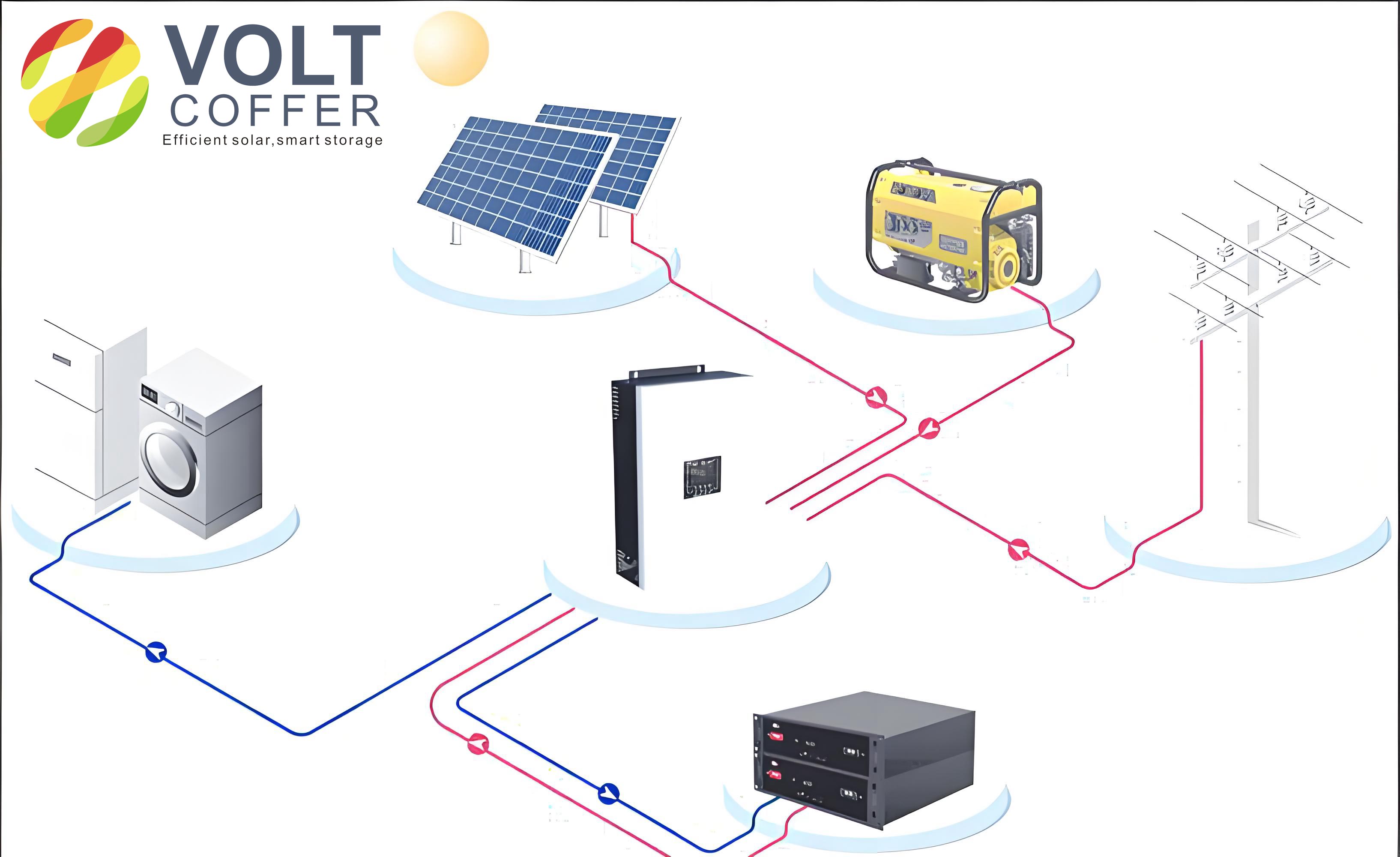
The recent scheme for the off-grid solar system focuses on addressing the park’s current energy requirements. Based on solar resource assessments, the area receives an average of 4 hours of equivalent sunlight per day, with an annual solar radiation level between 1600 and 2200 kWh/m². This makes solar energy highly viable for off-grid applications. The recent off-grid solar system design includes a 250 kW photovoltaic generation unit and a 140 kW/280 kWh energy storage unit. This configuration ensures a reliable power supply, balancing daily energy production and consumption. The components and costs are summarized in Table 1. The off-grid solar system is designed to operate independently of the main grid, reducing dependence on diesel and minimizing operational expenses. By integrating this off-grid solar system, the park can achieve significant cost savings and enhance energy security. The financial analysis later in this paper will demonstrate the economic advantages of this off-grid solar system approach.
| Item | Technical Specification | Quantity | Total Cost (10,000 yuan) |
|---|---|---|---|
| Photovoltaic Generation Unit | 250 kW | 1 set | 100 |
| Energy Storage Unit | 140 kW/280 kWh | 1 set | 46.2 |
| Power Distribution Unit | Low-voltage distribution cabinet | 1 set | 5 |
| International Freight | 1 item | 1 | 10 |
| Construction Costs | 1 item | 1 | 10 |
| Project Management Fees | 1 item | 1 | 10 |
| Total | 181.2 |
For the long-term scheme, we propose an advanced off-grid solar system that incorporates a combined cooling, heating, and power (CCHP) system. This integrated approach enhances energy efficiency by utilizing waste heat from photovoltaic units for heating and cooling purposes. The long-term off-grid solar system includes photovoltaic generation units of 170 kW for the living and office area and 590 kW for the technical demonstration center, along with an 85 kW/170 kWh energy storage unit. The CCHP system comprises components like chillers, heat pumps, and thermal storage, enabling energy cascade utilization. This off-grid solar system design not only meets the park’s expanded energy needs but also optimizes resource use. The configuration details and associated costs are provided in Table 2. By adopting this comprehensive off-grid solar system, the park can achieve higher energy independence and reduce its carbon footprint. The long-term plan also includes additional off-grid solar products, such as solar water pumping for irrigation and solar cold storage, which further demonstrate the versatility of off-grid solar systems in agricultural settings.
| Item | Technical Specification | Quantity | Total Cost (10,000 yuan) |
|---|---|---|---|
| Photovoltaic Generation Unit | 170 kW (living area), 590 kW (demo center) | 1 set | 380 |
| Energy Storage Unit | 85 kW/170 kWh | 1 set | 36 |
| Cooling Unit | Chillers and graded cold storage | 1 set | 33.45 |
| Heating Unit | Hot water tanks and air-source heat pumps | 1 set | 0.85 |
| Power Distribution Unit | Low-voltage distribution cabinet | 1 set | 5 |
| International Freight | 1 item | 1 | 30 |
| Construction Costs | 1 item | 1 | 80 |
| Project Management Fees | 1 item | 1 | 30 |
| Total | 595.3 |
In the long-term scheme, we also introduce specialized off-grid solar products to enhance agricultural operations. For example, a solar water pumping system for irrigation utilizes photovoltaic arrays and inverters to power pumps, enabling efficient water management without grid connection. This off-grid solar system reduces operational costs and environmental impact compared to traditional methods. Similarly, a solar agricultural processing system powers equipment like mills and dryers, leveraging solar energy to support value-added activities. A solar cold storage unit, based on adsorption refrigeration, provides cooling for perishable goods, further illustrating the adaptability of off-grid solar systems. These products are integral to the long-term vision, promoting “new energy + agriculture” integration. The incremental investment for these off-grid solar additions is approximately 125,000 yuan, but they yield substantial benefits in terms of productivity and sustainability. By embedding these off-grid solar solutions, the park can serve as a model for renewable energy adoption in African agriculture.
To evaluate the economic viability of the off-grid solar systems, we conduct a financial analysis based on a 10-year operational period. The project is assumed to be funded by a third party, with no loans or taxes considered. The baseline electricity price is set at 1.088 yuan/kWh, reflecting local grid rates. Key financial metrics include the internal rate of return (IRR) and payback period, calculated using the following formulas:
The IRR is determined by solving the equation: $$ \sum_{t=1}^{n} (CI – CO)_t (1 + IRR)^{-t} = 0 $$ where \( CI \) represents cash inflows (e.g., electricity revenue), \( CO \) denotes cash outflows (e.g., investment and maintenance costs), \( (CI – CO)_t \) is the net cash flow in period \( t \), and \( n \) is the project lifespan in years.
The payback period \( P_t \) is calculated as: $$ P_t = (T – 1) + \frac{|NCF_{T-1}|}{NCF_T} $$ where \( T \) is the year when cumulative discounted cash flows turn positive, \( NCF_{T-1} \) is the net cash flow in the previous year, and \( NCF_T \) is the net cash flow in year \( T \).
For the recent off-grid solar system scheme, the financial results are summarized in Table 3. The project shows an IRR of 15.32% and a payback period of 6.70 years, indicating strong profitability. Similarly, the long-term off-grid solar system scheme achieves an IRR of 17.53% and a payback period of 6.16 years, further affirming the economic attractiveness of off-grid solar investments. These outcomes highlight how off-grid solar systems can deliver reliable returns while addressing energy challenges.
| Item | Recent Scheme | Long-term Scheme |
|---|---|---|
| Installed Capacity (MW) | 0.25 | 0.76 |
| Construction Period (months) | 3 | 4 |
| Operational Period (years) | 10 | 10 |
| Annual Electricity Generation (MWh) | 379.49 | 1153.65 |
| Baseline Electricity Price (yuan/kWh) | 1.088 | 1.088 |
| Annual Utilization Hours (h) | 1580.7 | 1580.7 |
| Construction Costs (10,000 yuan) | 10 | 80 |
| Depreciation Costs (10,000 yuan) | 68.86 | 225.53 |
| Maintenance Costs (10,000 yuan) | 2.92 | 9.56 |
| Insurance Costs (10,000 yuan) | 5.44 | 17.80 |
| Capital Investment (10,000 yuan) | 181.2 | 595.3 |
| Working Capital (10,000 yuan) | 0.75 | 2.28 |
| Cash Inflow (10,000 yuan) | 525.98 | 1625.42 |
| Operating Revenue (10,000 yuan) | 412.89 | 1255.17 |
| Residual Value Recovery (10,000 yuan) | 112.34 | 367.97 |
| Working Capital Recovery (10,000 yuan) | 0.75 | 2.28 |
| Cash Outflow (10,000 yuan) | 290.92 | 725.56 |
| Project Investment (10,000 yuan) | 181.2 | 595.3 |
| Working Capital (10,000 yuan) | 0.75 | 2.28 |
| Operating Costs (10,000 yuan) | 108.97 | 127.98 |
| Net Cash Flow (10,000 yuan) | 235.06 | 899.86 |
| Net Present Value (10,000 yuan) | 118.45 | 481.52 |
| Payback Period (years) | 6.70 | 6.16 |
| Internal Rate of Return (IRR, %) | 15.32 | 17.53 |
We further perform a sensitivity analysis to assess the impact of electricity price variations on the off-grid solar system projects. By adjusting the baseline price from 0% to -30%, we observe changes in the payback period and IRR, as shown in Table 4. For the recent off-grid solar system scheme, the payback period ranges from 6 to 11 years, and the IRR from 7.42% to 15.32%. For the long-term off-grid solar system, the payback period varies between 6 and 9 years, and the IRR from 10.41% to 17.53%. These results indicate that the off-grid solar systems remain economically feasible even under adverse conditions, underscoring their resilience. This analysis reinforces the value of off-grid solar systems as a robust investment for agricultural energy needs.
| Price Change (%) | Payback Period (years) – Recent | Payback Period (years) – Long-term | IRR (%) – Recent | IRR (%) – Long-term |
|---|---|---|---|---|
| -30 | 10.13 | 8.82 | 7.42 | 10.41 |
| -25 | 9.90 | 8.20 | 8.76 | 11.61 |
| -20 | 8.97 | 7.67 | 10.09 | 12.81 |
| -15 | 8.23 | 7.21 | 11.41 | 14.00 |
| -10 | 7.63 | 6.81 | 12.72 | 15.18 |
| -5 | 7.13 | 6.47 | 14.02 | 16.36 |
| 0 | 6.70 | 6.16 | 15.32 | 17.53 |
Beyond economic benefits, the off-grid solar systems deliver significant environmental and social advantages. As summarized in Table 5, the recent off-grid solar system reduces annual electricity costs by approximately 139,104 yuan and cuts CO2 emissions by 144.6 tons. The long-term off-grid solar system achieves even greater savings, with a reduction of 359,510 yuan in electricity expenses and 438.4 tons of CO2 emissions annually. These reductions translate to equivalent savings in standard coal consumption, promoting cleaner energy use. Socially, the off-grid solar systems serve as demonstration projects, encouraging the adoption of renewable energy in agriculture. By integrating off-grid solar systems, we not only enhance energy access but also support sustainable development, making them a key enabler for “new energy + agriculture” initiatives in Africa.
| Benefit Type | Recent Scheme | Long-term Scheme |
|---|---|---|
| Economic Benefit | Annual cost reduction of 139,104 yuan | Annual cost reduction of 359,510 yuan |
| Environmental Benefit | Reduction of 45.2 t standard coal and 144.6 t CO2 annually | Reduction of 137 t standard coal and 438.4 t CO2 annually |
| Social Benefit | Promotes off-grid solar system demonstrations | Advances “new energy + agriculture” applications |
In conclusion, this case study demonstrates the transformative potential of off-grid solar systems in African agricultural parks. Through detailed design and economic analysis, we show that both recent and long-term off-grid solar system schemes are profitable and sustainable. The recent scheme, with a 250 kW photovoltaic unit and 140 kW/280 kWh storage, effectively meets current energy demands, while the long-term scheme, incorporating CCHP and additional off-grid solar products, addresses future needs with enhanced efficiency. Financial evaluations confirm attractive returns, with IRRs exceeding 15% and payback periods under 7 years. Sensitivity analyses further validate the robustness of these off-grid solar systems under varying conditions. Environmentally, the off-grid solar systems significantly reduce carbon emissions and reliance fossil fuels. By adopting off-grid solar systems, agricultural parks can achieve energy independence, lower operational costs, and contribute to global sustainability efforts. This work provides a valuable reference for similar projects, highlighting the critical role of off-grid solar systems in advancing Africa’s agricultural sector.
Looking ahead, the scalability of off-grid solar systems offers opportunities for broader implementation across Africa. Future research could explore hybrid systems combining solar with other renewables, or innovative financing models to accelerate adoption. As technology advances, the efficiency and affordability of off-grid solar systems will continue to improve, making them an even more compelling solution. We encourage policymakers and investors to support off-grid solar initiatives, as they align with both economic and environmental goals. Ultimately, the success of this case study underscores the importance of tailored off-grid solar solutions in driving agricultural modernization and energy access in remote regions. By continuing to innovate and deploy off-grid solar systems, we can unlock the full potential of Africa’s agricultural economy while fostering a sustainable future.