
In the pursuit of renewable energy alternatives, photovoltaic power generation has emerged as a pivotal method for converting solar radiation into electricity, offering abundant resources and environmental benefits. However, the integration of distributed photovoltaic systems into the grid presents challenges, particularly in maintaining voltage stability of solar inverters. Voltage imbalances in solar inverters can adversely affect power quality and grid reliability, necessitating advanced control strategies. This study focuses on designing a voltage balance control method for grid-connected solar inverters in distributed photovoltaic systems, aiming to enhance control efficiency and ensure output voltage stability. We propose a comprehensive approach involving steady-state voltage design, phase error computation, and DC bus energy exchange, validated through comparative experiments.
The steady-state design of grid-connected solar inverters is crucial for analyzing how inverters control output voltage under stable conditions to synchronize with the grid. Assuming the photovoltaic array outputs a stable DC voltage source, and the grid is treated as an infinite system with constant voltage and frequency, we neglect internal switching losses and line impedances. Solar inverters typically employ voltage source control strategies to match the grid’s voltage amplitude and phase. The output voltage of a solar inverter can be expressed as:
$$ V = D \times V_{dc} $$
where \( V \) is the inverter output voltage, \( D \) is the duty cycle, and \( V_{dc} \) is the DC input voltage. Under steady-state conditions, voltage and current rates of change are zero, and dynamic terms vanish. By setting voltage error to zero, the output of the PI controller is solved to obtain the PWM duty cycle in steady state:
$$ G = K_p + \frac{K_i}{s} $$
where \( G \) is the PWM duty cycle in steady state, \( K_p \) is the proportional coefficient, \( K_i \) is the integral coefficient, and \( s \) is the Laplace variable. The steady-state voltage of the distributed photovoltaic grid-connected solar inverter is then calculated based on linearization assumptions:
$$ M = (G \times G_j) \times \frac{f}{V_0} $$
where \( M \) is the steady-state voltage of the solar inverter, \( G_j \) represents switching losses, \( f \) is the frequency, and \( V_0 \) is the voltage phase value. This formulation ensures that the solar inverter operates within defined boundaries, facilitating reliable grid integration.
Following the steady-state design, the phase error of the solar inverter voltage fundamental component is computed to understand the phase difference between the inverter output voltage and the grid voltage. The grid voltage fundamental component is derived as:
$$ u_g = P \times \sin(\omega t + \phi) $$
where \( u_g \) is the grid voltage fundamental component, \( P \) is the amplitude of the grid voltage fundamental, \( \omega \) is the angular frequency, and \( \phi \) is the phase angle. In ideal synchronization, the phase error \( \Delta \phi = 0 \), but in practice, factors like control errors and delays cause non-zero phase errors. Assuming the inverter output and grid voltages share the same frequency, the phase error is calculated as:
$$ \Delta \phi = \phi_{\text{inv}} – \phi_g $$
where \( \phi_{\text{inv}} \) is the phase of the inverter output voltage fundamental. This phase error is critical for adjusting the solar inverter control to minimize discrepancies and enhance synchronization.
To achieve voltage balance control, we leverage the computed phase error to regulate the DC bus energy exchange. The DC bus, connecting the photovoltaic array and the inverter circuit, is vital for maintaining voltage stability. By adjusting the power injected from the photovoltaic array into the DC bus and the power output from the DC bus to the grid, the bus voltage is kept within permissible limits. When the phase error is significant, it can cause power fluctuations, affecting DC bus voltage. To mitigate this, the PWM duty cycle or other parameters are modified to alter the power drawn or injected by the solar inverter. The adjustment quantity is given by:
$$ \Delta D = k \times \Delta P $$
where \( \Delta D \) is the adjustment in duty cycle, \( k \) is a gain factor, and \( \Delta P \) is the range of inverter output power fluctuation. A voltage feedback loop is designed to monitor the inverter output voltage fundamental and compare it with the grid voltage fundamental. By computing the phase error and adjusting the inverter output voltage phase, synchronization is achieved, enabling effective DC bus energy exchange and voltage balance control for solar inverters.
Comparative experiments were conducted to evaluate the proposed voltage balance control method for solar inverters. A large-scale distributed photovoltaic grid-connected system was selected, with key parameters summarized in the table below. The system included multiple solar inverters, and tests were performed under varying conditions, such as motor speed jumps, to assess voltage stability.
| Parameter | Value |
|---|---|
| Number of Solar Inverters | 200 |
| Daily Average Generation Hours | 6 |
| Inverter Voltage Control Accuracy | ±0.5% |
| Grid Voltage Fluctuation Range | 380 V ± 10 V |
| Power Generation Efficiency Improvement | 3% |
The results demonstrated that the proposed method maintained voltage stability within 2-3 seconds after disturbances, outperforming existing approaches that exhibited significant fluctuations. This highlights the efficacy of the voltage balance control in enhancing the performance of solar inverters in distributed photovoltaic systems.
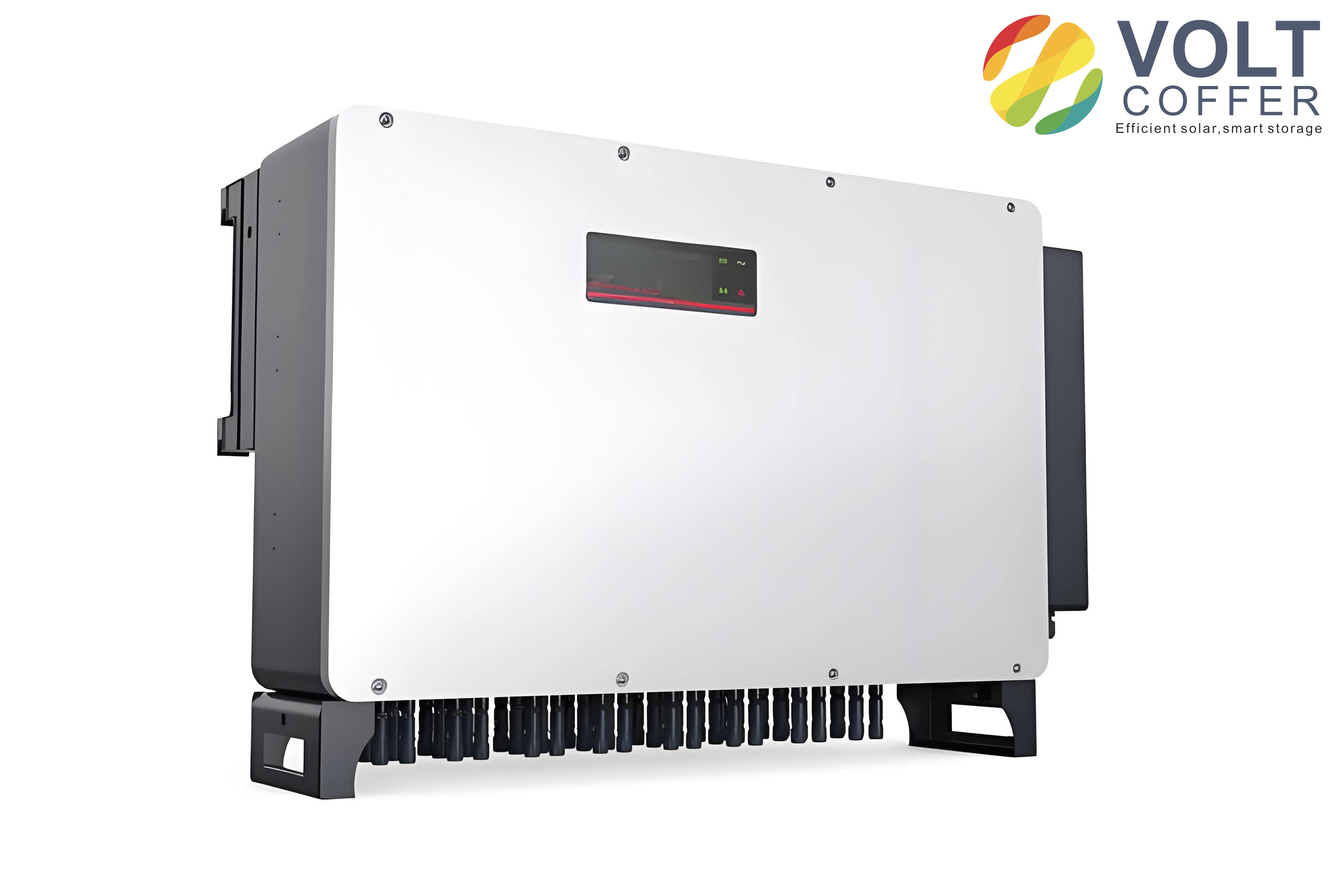
In conclusion, voltage balance control is essential for the reliable operation of grid-connected solar inverters in distributed photovoltaic systems. The proposed method, incorporating steady-state voltage design, phase error computation, and DC bus energy exchange, effectively addresses voltage imbalances and improves system stability. Experimental validation confirms its high efficiency and robustness, making it a valuable contribution to the advancement of solar inverter technologies. Future work could explore adaptive control strategies to further enhance the resilience of solar inverters under dynamic grid conditions.
The integration of solar inverters into modern power systems requires continuous innovation to handle complexities such as varying loads and environmental factors. By focusing on voltage balance control, this study provides a framework for optimizing the performance of solar inverters, ensuring efficient energy conversion and grid compatibility. The use of mathematical models and real-time adjustments underscores the importance of precision in controlling solar inverters, paving the way for more sustainable and reliable photovoltaic systems.