
In the context of increasing global energy demands and environmental concerns, the integration of renewable energy sources, particularly solar power, has become a critical focus. Solar inverters play a pivotal role in converting direct current (DC) from photovoltaic (PV) arrays into alternating current (AC) for grid integration. However, existing control methods often struggle with precise power tracking and dynamic response, leading to inefficiencies such as excessive power outputs beyond 3600 W at various nodes. This paper addresses these challenges by proposing a fast power control method for solar inverters under new energy integration scenarios. The approach involves establishing an optimized mathematical model for inverter arrays, incorporating constraints, determining switch duty cycles based on operational periods, and assessing power losses across different power levels. By employing an improved particle swarm optimization algorithm for maximum power point tracking (MPPT) and a modified PI controller for fuzzy real-time adjustment, the method enables rapid power control through current decoupling and active power distribution. Experimental validation demonstrates effective convergence to global maximum power points and stable power outputs within the 3500–3600 W range, highlighting the method’s superiority in enhancing solar inverter performance and grid stability.
The rapid expansion of solar energy systems necessitates advanced control strategies for solar inverters to ensure efficient power conversion and grid compatibility. Solar inverters are essential components that not only convert DC to AC but also manage power flow to maximize energy harvest and minimize losses. Traditional control methods, such as those relying on fixed parameters or simplistic algorithms, often fail to adapt to dynamic environmental conditions, resulting in suboptimal performance. For instance, in scenarios with partial shading or fluctuating irradiance, conventional MPPT techniques may converge to local maxima rather than the global maximum power point, reducing overall system efficiency. This paper introduces a comprehensive fast power control method that leverages mathematical modeling, optimization algorithms, and real-time adjustments to address these limitations. By focusing on solar inverters, the method aims to improve power quality, reduce harmonic distortions, and facilitate seamless integration of new energy sources into the grid.
To begin, an optimized mathematical model for solar inverter arrays is developed to represent the power conversion process accurately. The model accounts for various operational parameters, including voltage, current, temperature, and switching behavior. The output current of a solar inverter array can be expressed as:
$$ I_i = \frac{q \times U}{T} $$
where \( I_i \) is the output current, \( U \) is the voltage, \( T \) is the inverter temperature, and \( q \) is the charge. This equation forms the basis for analyzing the inverter’s performance under different conditions. Constraints are added to ensure practical applicability, such as limiting the power output to a maximum value under optimal光照 conditions:
$$ 0 \leq p \leq p_{\text{max}} $$
Here, \( p \) represents the power output, and \( p_{\text{max}} \) is the maximum power achievable under ideal circumstances. These constraints help maintain system stability and prevent overloading. Additionally, the model incorporates the impact of multiple solar inverters operating in parallel, where each inverter contributes to the overall power output based on its capacity and operational state. By assigning uniform weight coefficients to all inverters at integration points, the model ensures equitable participation in power regulation, enhancing the robustness of the control strategy.
The duty cycle of the switches in solar inverters is critical for controlling power flow and minimizing losses. Based on the operational period of the inverter, the duty cycle \( E \) is determined using the formula:
$$ E = \frac{e}{n \times U + |e|} $$
where \( e \) is the grid voltage, and \( n \) is the number of switches. This equation helps in regulating the energy output during each switching cycle, particularly when the inverter operates in discontinuous conduction mode (DCM). By categorizing power levels, the power losses in the circuit can be assessed, enabling more efficient energy management. For example, higher power levels may correspond to increased losses due to switching frequency and thermal effects. The following table summarizes typical power loss characteristics across different levels for solar inverters:
| Power Level (W) | Switching Loss (W) | Conduction Loss (W) | Total Loss (W) |
|---|---|---|---|
| 1000 | 50 | 30 | 80 |
| 2000 | 100 | 60 | 160 |
| 3000 | 150 | 90 | 240 |
| 3600 | 180 | 110 | 290 |
This tabular representation aids in identifying optimal operating points for solar inverters, thereby reducing unnecessary energy dissipation. Furthermore, the duty cycle calculation facilitates real-time adjustments, allowing the inverter to respond swiftly to changes in grid conditions or load demands.
Maximum power point tracking (MPPT) is a cornerstone of efficient solar inverter operation, as it ensures that the PV array operates at its peak power output regardless of environmental variations. The improved particle swarm optimization (PSO) algorithm is employed to achieve rapid and accurate MPPT. This algorithm iteratively adjusts the voltage of the solar inverter to locate the global maximum power point, even under partial shading conditions. The equivalent load resistance \( R \) is given by:
$$ R = \frac{V}{I} $$
where \( V \) is the open-circuit voltage, and \( I \) is the short-circuit current of the PV array. By analyzing the intersection points of the load resistance and the PV curve, the MPPT algorithm identifies the optimal operating voltage. When shadows affect the array, the output voltage is modified as:
$$ C = R \times I(n) $$
Here, \( C \) is a predefined voltage value, and \( I(n) \) is the short-circuit current under shaded conditions. The PSO algorithm initializes multiple particles representing potential solutions and updates their positions based on fitness evaluations, ultimately converging to the global optimum. The update process for particle velocity and position can be expressed as:
$$ v_{i}(t+1) = \omega v_{i}(t) + c_1 r_1 (p_{\text{best}} – x_{i}(t)) + c_2 r_2 (g_{\text{best}} – x_{i}(t)) $$
$$ x_{i}(t+1) = x_{i}(t) + v_{i}(t+1) $$
where \( v_{i}(t) \) is the velocity of particle \( i \) at time \( t \), \( x_{i}(t) \) is its position, \( \omega \) is the inertia weight, \( c_1 \) and \( c_2 \) are acceleration coefficients, \( r_1 \) and \( r_2 \) are random numbers, \( p_{\text{best}} \) is the personal best position, and \( g_{\text{best}} \) is the global best position. This iterative process enables solar inverters to quickly adapt to changing conditions, minimizing power oscillations and enhancing tracking accuracy.
To complement the MPPT algorithm, a modified PI controller is integrated for fuzzy real-time adjustment of power parameters. This controller decouples the current components and distributes the active power from new energy sources efficiently. The control signal \( s \) for the PI controller is defined as:
$$ s = \omega \times \Delta U \times C $$
where \( \Delta U \) is the voltage deviation, and \( \omega \) and \( C \) are tuning parameters. The fuzzy logic component allows for adaptive adjustment of controller gains based on real-time inputs, such as variations in irradiance or temperature. For instance, if the voltage exceeds a threshold, the controller reduces the power output to prevent overvoltage conditions. This approach ensures that solar inverters maintain stable operation while facilitating rapid power control. The following table outlines the fuzzy rules used for adjusting the PI parameters in solar inverters:
| Voltage Error | Power Change | PI Gain Adjustment |
|---|---|---|
| Negative Large | Decrease | Increase Proportional Gain |
| Negative Small | Slight Decrease | Maintain Integral Gain |
| Zero | No Change | No Adjustment |
| Positive Small | Slight Increase | Decrease Integral Gain |
| Positive Large | Increase | Decrease Proportional Gain |
By implementing this fuzzy-PI control strategy, solar inverters can achieve precise power regulation, improving overall system responsiveness and reliability.
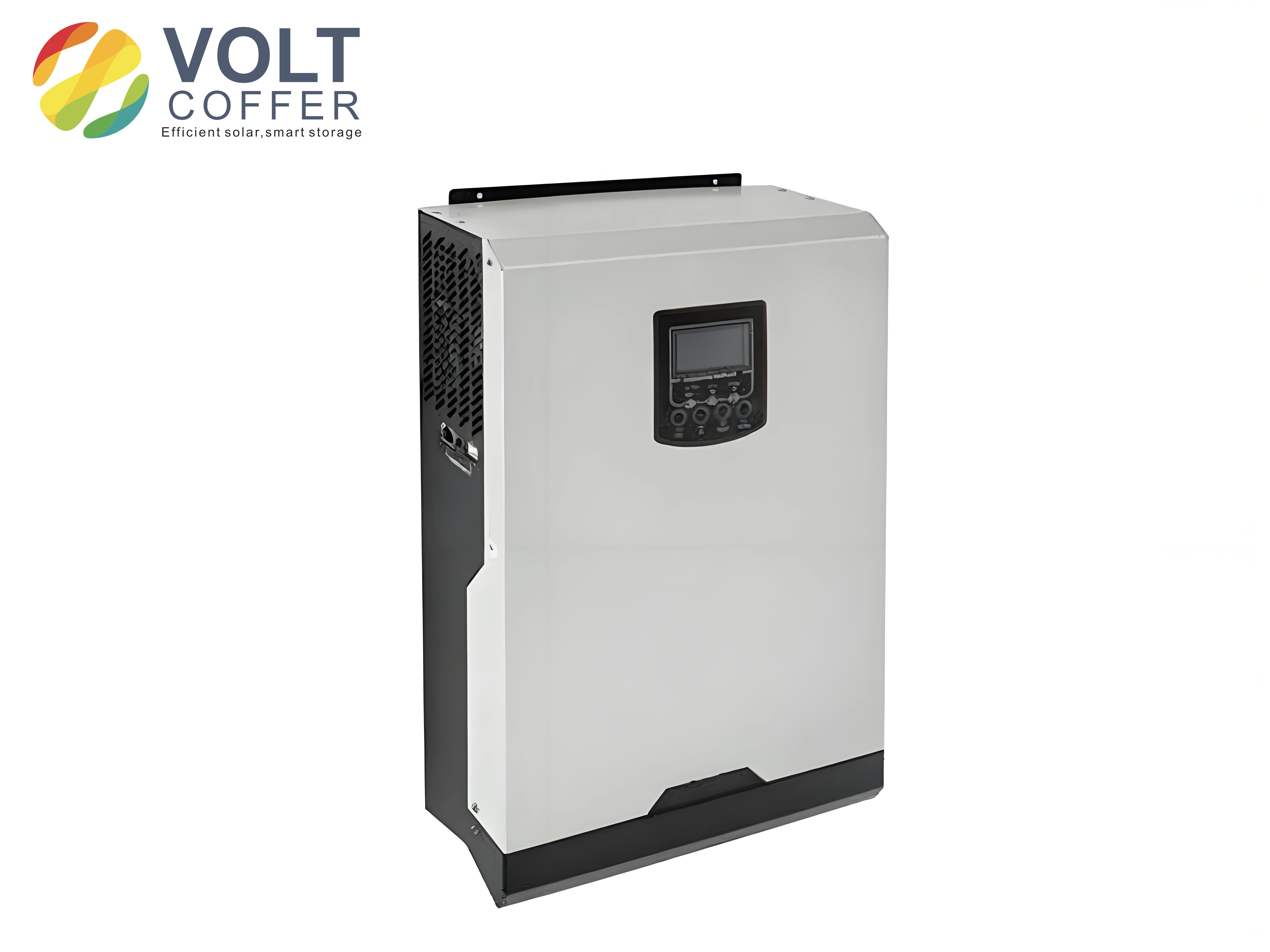
Experimental validation was conducted using a MATLAB-based simulation environment to evaluate the proposed fast power control method for solar inverters. A 25 kW photovoltaic发电 model was constructed, with key parameters as follows: DC link capacitance of 1000 μF, DC side voltage of 820 V, grid line voltage of 350 V, voltage frequency of 20 Hz, and an inverter switching frequency of 32 kHz. The PV array configuration involved series and parallel combinations of solar cells, denoted as \( M \times N \), where \( M \) represents the number of series cells and \( N \) the parallel groups. Under uniform irradiance, the global maximum power point voltage was set to 100 V. The proposed method (experimental group) was compared against two existing approaches: a下垂 control method with MPPT functionality (control group A) and a direct power model predictive control method for single-phase cascaded H-bridge solar inverters without DC-side voltage sensors (control group B). A typical voltage overshoot scenario was simulated to assess performance under dynamic conditions.
The results demonstrated that the proposed method consistently converged to the global maximum power point, whereas the control groups exhibited deviations and failed in accurate tracking. For instance, during partial shading at 0.2 seconds, the output power characteristics showed that control groups A and B converged to local maxima, leading to suboptimal power extraction. In contrast, the experimental group maintained stable convergence, as illustrated by the power-voltage curves. This highlights the effectiveness of the improved PSO algorithm in enhancing MPPT accuracy for solar inverters. Additionally, power outputs at various nodes were monitored to evaluate stability. In scenario A, where each PV array operated at a maximum active power of 0.25 MW, the power levels across eight nodes were controlled using the proposed method. The following table presents the regulated voltage and power values:
| Node Number | Regulated Voltage (p.u.) | PV Power (W) |
|---|---|---|
| 1 | 1.05 | 3500 |
| 2 | 1.05 | 3570 |
| 3 | 1.05 | 3562 |
| 4 | 1.05 | 3541 |
| 5 | 1.05 | 3598 |
| 6 | 1.05 | 3562 |
| 7 | 1.05 | 3520 |
| 8 | 1.05 | 3524 |
As shown, the power outputs remained within the desired range of 3500–3600 W, confirming the method’s ability to maintain stability and address voltage issues effectively. The integration of both active and reactive power control allowed solar inverters to adjust outputs based on capacity constraints, ensuring compliance with grid requirements. Moreover, during periods of high irradiance, voltage fluctuations were managed without exceeding limits, underscoring the practicality of the approach for real-world applications.
In conclusion, the proposed fast power control method for solar inverters under new energy integration offers significant improvements in efficiency, stability, and adaptability. By combining optimized mathematical modeling, advanced MPPT algorithms, and fuzzy-PI control, the method addresses key challenges such as power tracking failures and voltage overshoots. Experimental results validate its superiority over existing techniques, with consistent convergence to global power points and stable operation within specified ranges. However, limitations remain, including the impact of multi-level converter configurations, output power stress, and time-delay effects on control parameters. Future work should focus on refining computational models, incorporating neural networks for real-time monitoring, and enhancing filtering techniques to further optimize solar inverter performance. Ultimately, this research contributes to the advancement of renewable energy systems by enabling more reliable and efficient power control in solar inverters.