
In modern power systems, the integration of distributed photovoltaic (PV) systems has introduced challenges such as voltage instability due to the inherent randomness and intermittency of solar power generation. This paper addresses the overvoltage issues in low-voltage distribution areas by leveraging the capabilities of distributed solar inverters. These inverters, which are integral to PV systems, can regulate both active and reactive power to maintain voltage stability. We propose an automated control strategy that combines solar inverters with On-Load Tap Changers (OLTC) to mitigate overvoltage conditions. The method dynamically adjusts reactive power output based on real-time voltage measurements and optimizes control actions to minimize network losses and enhance voltage profiles. Extensive testing demonstrates the effectiveness of our approach, with voltage control deviations below 1.45% and network losses under 15 kWh, ensuring reliable operation of distribution networks.
The structure of a typical grid-connected PV system, including solar arrays, DC/DC converters, and DC/AC solar inverters, is illustrated below. Solar inverters play a critical role in converting DC power from PV panels to AC power for grid integration, while also providing reactive power support to regulate voltage levels.
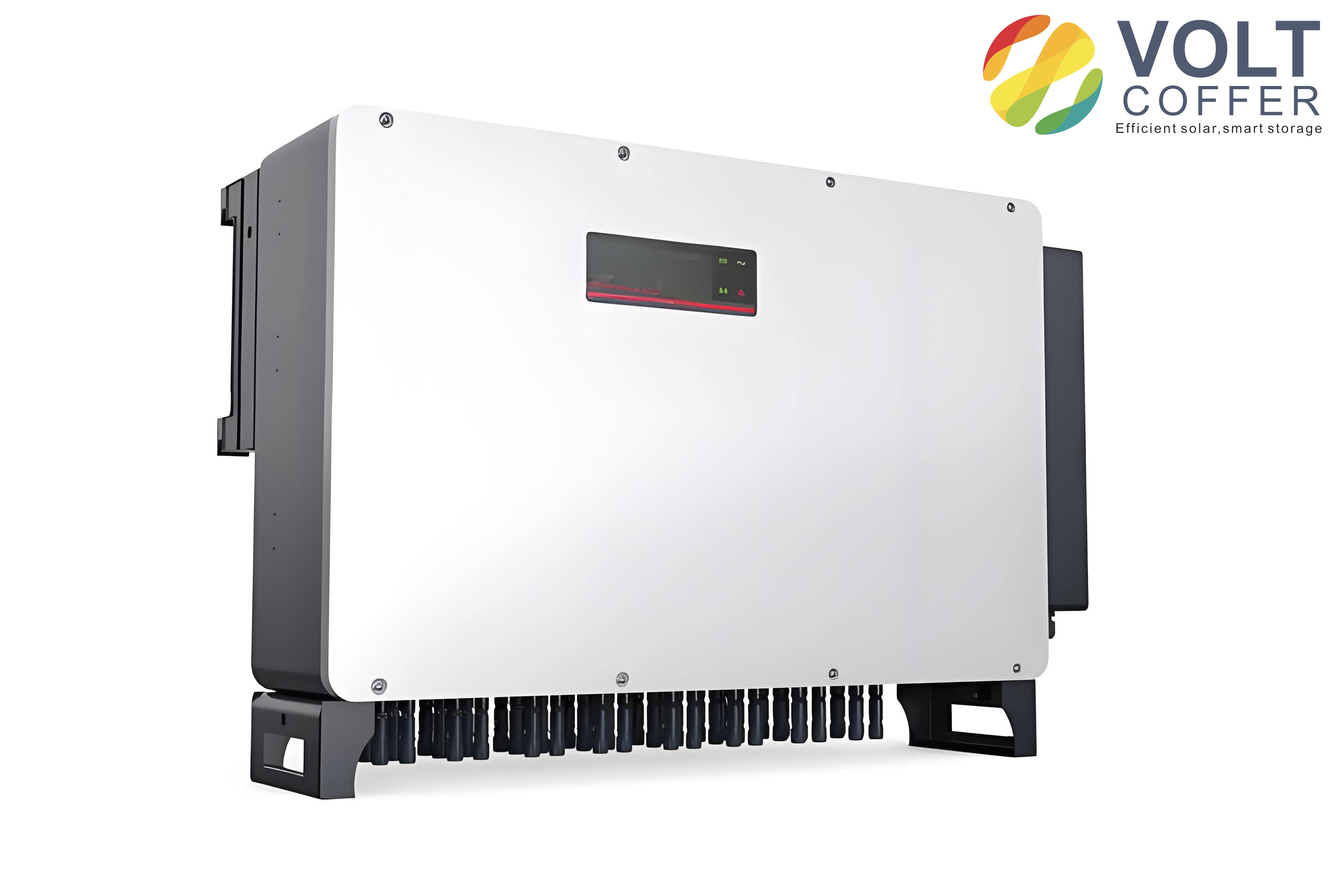
Solar inverters are designed to operate below their rated capacity, allowing them to utilize surplus capacity for reactive power control. This capability enables solar inverters to participate in voltage regulation by absorbing or injecting reactive power as needed. The active and reactive power outputs of a solar inverter are governed by the following equations, which describe the power flow in the system:
$$P_i = U_i \sum_{j \in H} U_j (G_{ij} \cos \theta_{ij} + B_{ij} \sin \theta_{ij})$$
$$Q_i = U_i \sum_{j \in H} U_j (G_{ij} \cos \theta_{ij} – B_{ij} \sin \theta_{ij})$$
where \(P_i\) and \(Q_i\) represent the active and reactive power at node \(i\), \(U_i\) and \(U_j\) are the voltage magnitudes at nodes \(i\) and \(j\), \(G_{ij}\) and \(B_{ij}\) are the conductance and susceptance of the line between nodes \(i\) and \(j\), \(\theta_{ij}\) is the phase angle difference, and \(H\) denotes the set of nodes connected to node \(i\). The reactive power capacity of a solar inverter is constrained by its apparent power rating \(S_i\) and active power output \(P_i\), as given by:
$$- \sqrt{S_i^2 – P_i^2} \leq Q_{i,t}’ \leq \sqrt{S_i^2 – P_i^2}$$
Here, \(Q_{i,t}’\) is the reactive power output of the solar inverter at node \(i\) and time \(t\). To determine the appropriate control device—solar inverter or OLTC—we calculate the reactive power sufficiency \(\delta_{OV}\) for the low-voltage distribution area during overvoltage conditions:
$$\delta_{OV} = \frac{1}{\sum_{j \in \{\text{PV}\}} R_{i,j,U-Q}} \cdot \frac{Q_i^{\text{max}}}{(U_{\text{PV},\text{max}} – U_{\text{PV},\text{th}})}$$
where \(U_{\text{PV},\text{max}}\) and \(U_{\text{PV},\text{th}}\) are the maximum PV node voltage and the upper voltage threshold, respectively, \(\sum_{j \in \{\text{PV}\}} R_{i,j,U-Q}\) is the sum of reactive power sensitivities, and \(Q_i^{\text{max}}\) is the maximum reactive power capacity of the solar inverter. If \(\delta_{OV} < 1\), the reactive power capacity is sufficient for solar inverter-based control; otherwise, coordination with OLTC is required.
Our control strategy involves three modes based on the voltage conditions and reactive power sufficiency. First, if the solar inverter alone can handle the overvoltage, the reactive power output is adjusted locally using:
$$Q_{i,t}’ =
\begin{cases}
-Q_i^{\text{max}}, & U_{i,t} \geq U_{\text{cr},2+} \\
-Q_i^{\text{max}} \frac{U_{i,t} – U_{\text{cr},1+}}{U_{\text{cr},2+} – U_{\text{cr},1+}}, & U_{\text{cr},1+} \leq U_{i,t} \leq U_{\text{cr},2+} \\
0, & U_{\text{cr},1-} \leq U_{i,t} \leq U_{\text{cr},1+} \\
Q_i^{\text{min}} \frac{U_{i,t} – U_{\text{cr},1-}}{U_{\text{cr},2-} – U_{\text{cr},1-}}, & U_{\text{cr},2-} \leq U_{i,t} \leq U_{\text{cr},1-} \\
Q_i^{\text{min}}, & U_{i,t} \leq U_{\text{cr},2-}
\end{cases}$$
Here, \(U_{\text{cr},1+}\) and \(U_{\text{cr},1-}\) are the upper and lower thresholds for initiating reactive power control, and \(U_{\text{cr},2+}\) and \(U_{\text{cr},2-}\) are the thresholds for maximum reactive power adjustment. Solar inverters absorb reactive power when voltage exceeds \(U_{\text{cr},1+}\) and inject reactive power when voltage falls below \(U_{\text{cr},1-}\), ensuring voltage stability.
Second, if solar inverters lack sufficient capacity, OLTC is activated first to bring voltages within the controllable range of solar inverters. The OLTC tap position \(T_t\) is adjusted based on:
$$F_t = T_t \quad \text{if} \quad U_{\text{oltc},n+} \leq U_{t,\text{max}} \leq U_{\text{oltc},m+} \quad \text{or} \quad U_{\text{oltc},m-} \leq U_{t,\text{min}} \leq U_{\text{oltc},n-}$$
where \(U_{t,\text{max}}\) and \(U_{t,\text{min}}\) are the maximum and minimum node voltages, and \(U_{\text{oltc},n+}\), \(U_{\text{oltc},m+}\), \(U_{\text{oltc},m-}\), and \(U_{\text{oltc},n-}\) are the OLTC voltage boundaries. After OLTC adjustment, solar inverters perform local control as per Equation (4).
Third, if voltage violations vary across lines, solar inverters first execute local control to reduce voltage disparities, followed by OLTC coordination. The OLTC action is determined by the direction and severity of voltage violations:
$$F_{t+\Delta t} =
\begin{cases}
\phi\left(\sum_{i \in O} \Delta U_i\right), & \text{if} \sum_{i \in O} \Delta U_i \geq \sum_{j \in D} \Delta U_j \quad \text{and} \quad U_{\text{oltc},n+} \leq U_{t,\text{max}} \leq U_{\text{oltc},m+} \\
\phi\left(\sum_{j \in D} \Delta U_j\right), & \text{if} \sum_{i \in O} \Delta U_i < \sum_{j \in D} \Delta U_j \quad \text{and} \quad U_{\text{oltc},m-} \leq U_{t,\text{min}} \leq U_{\text{oltc},n-}
\end{cases}$$
where \(O\) and \(D\) are sets of nodes with overvoltage and undervoltage, respectively, \(\Delta U_i\) and \(\Delta U_j\) are the voltage deviations, and \(\phi(\cdot)\) is the OLTC control function.
To optimize the control performance, we formulate a multi-objective function that minimizes the total reactive power output of solar inverters and brings PV node voltages close to the nominal value:
$$f_1 = \min \sum_{i=1}^n |Q_{i,t}’|$$
$$f_2 = \min \sum_{i=1}^n \left( \frac{U_{\text{PV}} – U_N}{U_{\text{max}}’ – U_{\text{min}}’} \right)^2$$
where \(f_1\) aims to reduce reactive power waste, and \(f_2\) focuses on voltage stability. The constraints include power flow equations, solar inverter capacity limits, and reactive power bounds. Using a weighted sum approach, the combined objective is:
$$\min F = \omega_1 f_1 + \omega_2 f_2$$
with \(\omega_1 + \omega_2 = 1\). We solve this optimization using an improved particle swarm algorithm to determine the optimal settings for solar inverters.
For validation, we tested our method on a low-voltage distribution area with multiple nodes and varying overvoltage scenarios. The system parameters are summarized in Table 1.
| Parameter | Value |
|---|---|
| Voltage Level (V) | 220 |
| Line Resistance (Ω/km) | 0.50 |
| Line Inductance (H) | 0.315 |
| Upper Voltage Limit (V) | 230 |
| Lower Voltage Limit (V) | 210 |
| Solar Inverter Rated Capacity (MW) | 3 |
We evaluated the voltage instability severity index (VSI) to assess control performance under different numbers of overvoltage nodes. The VSI is defined as:
$$\text{VSI} = \frac{1}{N(T – T_c)} \sum_{i=1}^N \sum_{t=T_c}^T \text{VDI}_{i,t}$$
where \(N\) is the number of lines, \(T\) and \(T_c\) are the fault occurrence and clearance times, and \(\text{VDI}_{i,t}\) is the voltage deviation index. Results in Table 2 show that VSI values remain below acceptable standards, confirming the effectiveness of our method.
| Operation Time (h) | VSI (%) for 5 Nodes | VSI (%) for 10 Nodes | VSI (%) for 15 Nodes |
|---|---|---|---|
| 2 | 0.44 | 0.64 | 0.80 |
| 4 | 0.58 | 0.70 | 0.82 |
| 6 | 0.30 | 0.42 | 0.58 |
| 8 | 0.68 | 0.70 | 0.84 |
| 10 | 0.38 | 0.40 | 0.59 |
| 12 | 0.64 | 0.76 | 0.84 |
| 14 | 0.30 | 0.58 | 0.78 |
| 16 | 0.64 | 0.76 | 0.82 |
| 18 | 0.40 | 0.60 | 0.96 |
| 20 | 0.42 | 0.68 | 0.90 |
Table 3 presents the overvoltage control results for scenarios with uniform and non-uniform voltage violation demands. Our method successfully maintains voltages within allowable limits (210–230 V) in both cases, demonstrating robust performance.
| Voltage Violation Ratio (%) | Control Result (V) for Uniform Demand | Control Result (V) for Non-Uniform Demand |
|---|---|---|
| 2 | 222.20 | 220.00 |
| 4 | 220.00 | 221.00 |
| 6 | 228.10 | 224.60 |
| 8 | 222.00 | 225.50 |
| 10 | 225.00 | 227.00 |
| 12 | 220.00 | 230.00 |
| 14 | 228.60 | 222.00 |
| 16 | 227.40 | 220.00 |
| 18 | 221.00 | 224.20 |
| 20 | 224.10 | 223.00 |
We further assessed the method under three operational conditions: normal, load-varying, and heavy-load. The voltage control deviations across different nodes are listed in Table 4. In all cases, deviations are below 1.45%, highlighting the precision of our solar inverter-based control.
| Operation Time (h) | Deviation (%) in Normal Condition | Deviation (%) in Load-Varying Condition | Deviation (%) in Heavy-Load Condition |
|---|---|---|---|
| 2 | 1.18 | 1.00 | 0.79 |
| 4 | 0.53 | 0.74 | 1.35 |
| 6 | 0.45 | 1.09 | 0.51 |
| 8 | 1.27 | 0.77 | 0.90 |
| 10 | 0.92 | 1.45 | 0.50 |
| 12 | 0.71 | 0.97 | 1.15 |
| 14 | 0.54 | 1.24 | 0.65 |
| 16 | 1.23 | 0.76 | 0.70 |
| 18 | 1.38 | 1.18 | 0.55 |
| 20 | 0.51 | 1.08 | 0.89 |
Table 5 shows the application performance metrics, including network loss, PV curtailment, and power factor. The power factor index \(\psi\) is calculated as:
$$\psi = \frac{\zeta}{M} \times 100\%$$
where \(\zeta\) is the number of time samples with power factor within \(-0.95\) to \(+0.95\), and \(M\) is the total samples. Our method keeps network losses below 15 kWh, curtailment under 10.6%, and power factor above 60%, proving its practicality.
| Voltage Violation Ratio (%) | Network Loss (kWh) | PV Curtailment (%) | Power Factor Index (%) |
|---|---|---|---|
| 2 | 4.40 | 5.50 | 62.60 |
| 4 | 6.20 | 7.60 | 63.10 |
| 6 | 3.70 | 10.10 | 61.70 |
| 8 | 5.60 | 9.50 | 63.30 |
| 10 | 9.40 | 10.00 | 64.20 |
| 12 | 11.20 | 9.00 | 61.90 |
| 14 | 9.50 | 8.50 | 62.90 |
| 16 | 10.70 | 7.60 | 61.80 |
| 18 | 12.60 | 10.50 | 60.90 |
| 20 | 13.70 | 8.00 | 63.00 |
In conclusion, our automated overvoltage control method, which leverages distributed solar inverters and OLTC coordination, effectively addresses voltage instability in low-voltage distribution areas. By optimizing reactive power output and adapting to varying grid conditions, solar inverters play a pivotal role in maintaining voltage profiles, reducing losses, and minimizing PV curtailment. Future work will focus on enhancing the scalability of this approach for larger networks with high PV penetration.