
In recent years, distributed solar power generation systems have emerged as a pivotal direction for future energy systems, leveraging renewable solar energy to produce electricity with environmental benefits such as sustainability and low carbon emissions. The core component of these systems, the solar inverter, plays a critical role in converting DC power from photovoltaic arrays into AC power suitable for grid integration. However, as the penetration of distributed solar inverters increases, ensuring stable grid-connected operation and high efficiency becomes increasingly challenging. The output current of solar inverters must accurately track reference values to maintain grid stability and power quality. Existing control methods, such as those based on neural networks or proportional-integral controllers, often struggle with issues like high tracking errors, poor performance under load disturbances, and elevated total harmonic distortion (THD). To address these limitations, this article proposes a novel control strategy based on adaptive backstepping sliding mode control for distributed solar inverters. By integrating Lyapunov stability theory and sliding mode techniques, the method ensures robust current tracking under various operating conditions, enhancing the dynamic performance of solar inverters in grid-connected applications.
The structure of a typical distributed solar power generation system includes components like solar inverters, DC loads, photovoltaic arrays, energy storage systems, AC loads, and Boost converters. The Boost converter elevates the voltage from the photovoltaic array and maximizes power extraction, while the energy storage system, comprising batteries and supercapacitors, manages bidirectional energy flow via DC/DC converters. The DC bus aggregates energy, which is then supplied to DC loads, AC loads, and the grid through solar inverters. The grid can also power local AC loads when necessary. The grid-connected solar inverter’s topology is crucial for understanding its operation. For instance, a common configuration involves AC-side filtering inductors, switches, and DC-link capacitors, where the switching states determine the inverter’s output behavior. The mathematical model of the solar inverter in the d-q rotating coordinate system can be expressed as follows:
$$ \frac{di_{ind}}{dt} L_{in} = – \omega i_{inq} L_{in} + U_d – U_{gd} – i_{ind} R_{in} $$
$$ \frac{di_{inq}}{dt} L_{in} = \omega i_{ind} L_{in} + U_q – U_{gq} – i_{inq} R_{in} $$
$$ \frac{dU_{in}}{dt} C_{in} = – I_{Un} + 1.5 \left( i_{ind} u_{d} / U_{in} \right) $$
Here, \( i_{ind} \) and \( i_{inq} \) represent the d and q-axis current components of the solar inverter’s AC side, \( U_{gd} \) and \( U_{gq} \) denote the grid voltage components, \( \omega \) is the angular frequency, \( U_d \) and \( U_q \) are the switching function components, and \( R_{in} \), \( L_{in} \), and \( C_{in} \) are the inverter parameters. This model forms the basis for designing the control strategy, as it captures the nonlinear dynamics and coupling effects inherent in solar inverters.
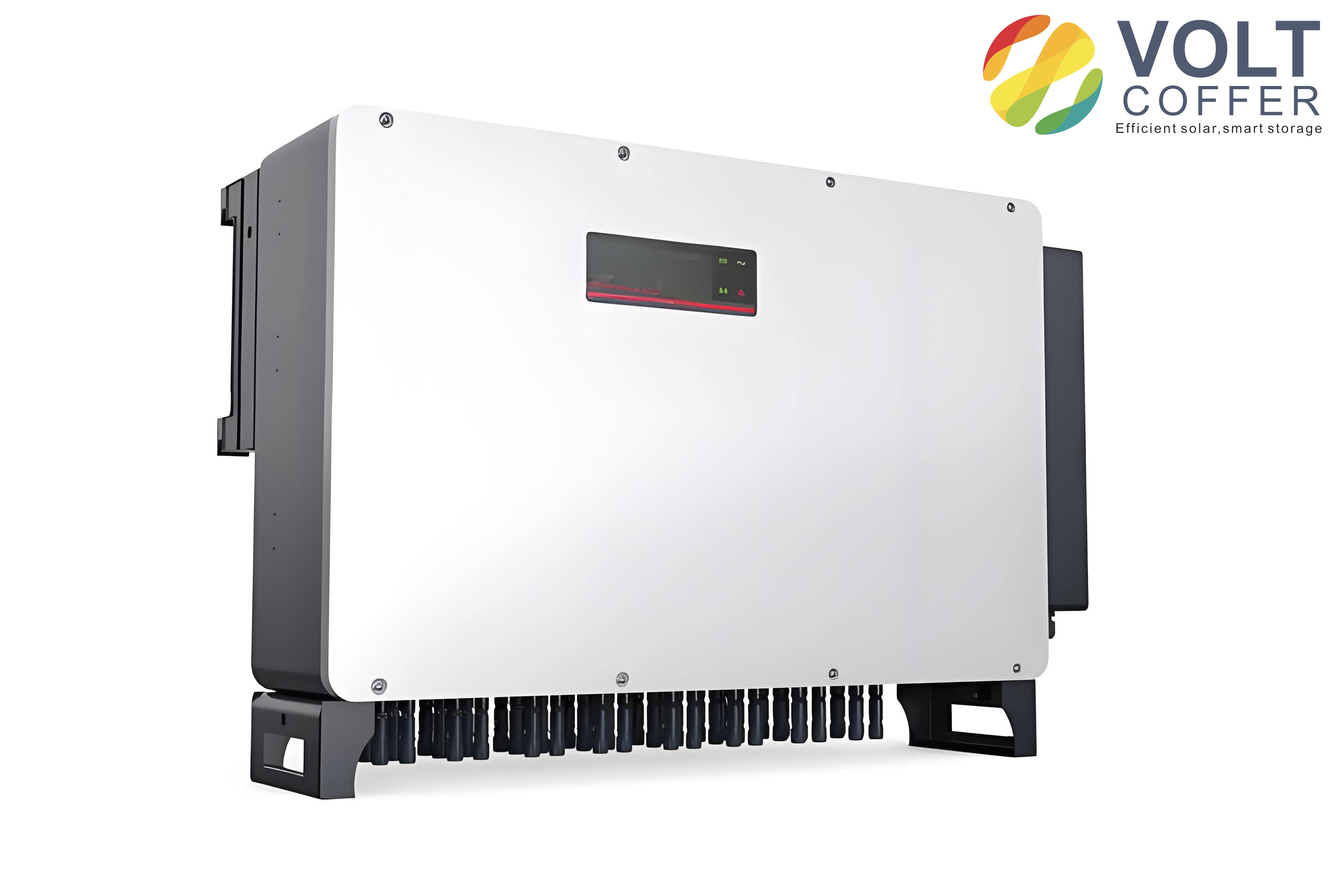
To achieve precise current control, an adaptive backstepping sliding mode controller is designed. This approach combines the systematic design of backstepping with the robustness of sliding mode control, making it ideal for handling uncertainties and disturbances in solar inverter systems. The controller design begins by defining error variables and intermediate stabilization terms. Let \( y_1 \) and \( y_2 \) represent the state variables, such as inverter output current and grid voltage, with \( y_1 = [U_{in}]^T \) and \( y_2 = [u_g, i_{in}]^T \). The state equation is given by:
$$ \frac{dy_1}{dt} = y_1 A + y_2 B + y(t) y_1 G $$
where A, B, and G are matrices derived from the system dynamics. The error variables are defined as \( x_1 = y_1 \) and \( x_2 = y_2 – \alpha_1 \), where \( \alpha_1 \) is a virtual control term. The first-stage Lyapunov function is chosen as \( W_1(t) = x_1^2 / 2 \), leading to:
$$ \dot{W_1}(t) = -x_1^2 s + x_1 x_2 $$
with \( s > 0 \). By setting \( \alpha_1 = -y_p – x_1 s \), the system progresses to the sliding surface design. The sliding surface is defined as:
$$ S = x_1 k_1 + x_2 k_2 $$
where \( k_1 \) and \( k_2 \) are positive constants. The overall Lyapunov function incorporates adaptive elements to handle parameter uncertainties:
$$ W(t) = \frac{S^2}{2} + \frac{\tilde{P}^2}{2\gamma} + W_1(t) $$
Here, \( \tilde{P} \) is the estimation error for uncertain parameters, and \( \gamma \) is the adaptive gain. An exponential reaching law is employed to enhance convergence:
$$ \dot{S} = -\rho_p \text{sign}(S) – \rho S $$
where \( \rho_p \) and \( \rho \) are positive constants. The adaptive sliding mode control law is derived as:
$$ u = x_2 (k_1 – k_2 – 2) – x_1 (k_1 + k_2 + 2) \frac{h(y)}{\rho_p \text{sign}(S) + \rho S + f(y) + \hat{P} \phi(y)} $$
In this expression, \( f(y) \), \( h(y) \), and \( \phi(y) \) are nonlinear functions of the system state \( y = [y_1, y_2]^T \). By selecting appropriate gains, the matrix V in the Lyapunov analysis remains positive definite, ensuring stability. This controller enables solar inverters to maintain accurate current tracking despite disturbances, such as load variations or changes in solar irradiation.
Experimental validation of the proposed method was conducted using a simulation model built in Simulink. The distributed solar inverter system was tested under various grid-connected scenarios, including normal operation, load disturbances, and natural power fluctuations. Key parameters for the solar inverter and controller are summarized in the table below:
| Parameter Category | Parameter Name and Unit | Parameter Value |
|---|---|---|
| Backstepping Sliding Mode Controller Parameters | s | 1 |
| γ | 2 | |
| ρ_p | 10 | |
| ρ | 20 | |
| Grid-Connected Solar Inverter Parameters | U_g (V) | 220 |
| C_in (μF) | 200 | |
| U_in (V) | 400 | |
| R_in (Ω) | 0.1 | |
| L_in (mH) | 3 |
Under normal grid-connected conditions, the solar inverter’s output current closely tracked the reference current with a convergence time of 0.025 seconds and a tracking error of 0.012. The THD of the output current was measured at 0.46%, indicating high power quality. The current waveform and its harmonic spectrum are described by the equation:
$$ i_{out}(t) = I_m \sin(\omega t) + \sum_{n=2}^{\infty} I_n \sin(n \omega t + \phi_n) $$
where \( I_m \) is the fundamental amplitude, and \( I_n \) represents harmonic components. The low THD value confirms that the solar inverter meets grid standards, minimizing harmonic distortion and ensuring stable operation.
To evaluate robustness, a load disturbance was introduced at 0.1 seconds. The solar inverter’s output current exhibited minor fluctuations but rapidly reverted to tracking the reference within 0.02 seconds. The THD under disturbance was 0.57%, demonstrating the controller’s ability to maintain performance under transient conditions. The dynamics can be modeled as:
$$ \frac{di_{out}}{dt} = \frac{1}{L_{in}} (U_{in} – U_g – i_{out} R_{in}) $$
This equation highlights the inverter’s response to voltage changes, with the controller ensuring minimal deviation. In scenarios with natural power variations, such as changes in solar irradiance from 300 lx to 600 lx over time, the solar inverter adapted seamlessly. The output current tracked the varying reference current with a THD of 0.56%, and the response time remained under 0.03 seconds. The adaptive mechanism in the controller adjusted parameters in real-time, as described by the update law:
$$ \dot{\hat{P}} = \gamma S \phi(y) $$
This ensures that the solar inverter compensates for environmental changes, maintaining efficiency and stability. The following table summarizes the performance metrics across different operating conditions for solar inverters:
| Operating Condition | Tracking Error | Convergence Time (s) | THD (%) |
|---|---|---|---|
| Normal Grid-Connected | 0.012 | 0.025 | 0.46 |
| Load Disturbance | 0.015 | 0.02 | 0.57 |
| Natural Power Variation | 0.018 | 0.03 | 0.56 |
The superior performance of the adaptive backstepping sliding mode control for solar inverters stems from its integration of Lyapunov-based stability and sliding mode robustness. Unlike traditional methods, this approach does not rely on precise system models, making it suitable for real-world applications where parameters may vary. For instance, the control law continuously adapts to changes in grid impedance or solar input, ensuring that solar inverters operate efficiently under diverse conditions. The mathematical formulation of the controller ensures that the sliding surface S converges to zero exponentially, as per:
$$ \dot{S} = -\rho_p \text{sign}(S) – \rho S $$
This guarantees that the solar inverter’s output current remains locked onto the reference, even in the presence of uncertainties. Additionally, the use of adaptive gains minimizes chattering, a common issue in sliding mode control, thereby reducing stress on the solar inverter components and extending their lifespan.
In conclusion, the proposed adaptive backstepping sliding mode control method offers a robust solution for grid-connected distributed solar inverters. By leveraging Lyapunov stability and adaptive techniques, it ensures accurate current tracking, low THD, and resilience to disturbances. Experimental results confirm its effectiveness across various scenarios, highlighting its potential to enhance the reliability and efficiency of solar power systems. Future work could focus on extending this approach to multi-inverter networks or integrating it with energy management systems for broader applications. The continuous advancement of control strategies for solar inverters is essential for maximizing the benefits of renewable energy integration into the grid.