
In recent years, the increasing energy crisis and growing environmental awareness have heightened the focus on renewable energy and distributed generation technologies. Solar inverters, as critical interface devices between renewable energy systems and the grid, play a vital role in ensuring efficient power conversion and grid stability. However, traditional control strategies for solar inverters are typically designed under the assumption of symmetric grid conditions. In practical systems, grid faults, unbalanced loads, and other disturbances can lead to asymmetric grid voltages, necessitating advanced control methods to maintain performance. This paper investigates control strategies for solar inverters under asymmetric grid faults, comparing approaches based on synchronous and stationary reference frames. I will analyze these strategies in detail, covering grid synchronization, power control, and current regulation, and present simulation and experimental results to validate their effectiveness.
The integration of solar inverters into power systems requires robust control mechanisms to handle grid disturbances. Asymmetric grid faults, such as voltage dips or phase imbalances, can cause significant issues like power oscillations and current distortions. To address this, I explore two primary control frameworks: one utilizing a synchronous reference frame (SRF) and the other a stationary reference frame. Each approach involves distinct techniques for grid synchronization, power control, and current regulation. The SRF-based method employs a dual synchronous reference frame phase-locked loop (DDSRF-PLL) for synchronization and proportional-integral (PI) controllers for current regulation, while the stationary frame method uses a dual second-order generalized integrator frequency-locked loop (DSOGI-FLL) and proportional-resonant (PR) controllers. Through this analysis, I aim to demonstrate the superiority of the stationary frame approach in terms of performance and simplicity.
Grid synchronization is crucial for solar inverters to accurately track grid voltage parameters under fault conditions. In asymmetric grids, voltages contain both positive and negative sequence components, which can disrupt synchronization. The DDSRF-PLL method transforms grid voltages into positive and negative sequence dq-components using coordinate transformations. The transformation matrix from the αβ-frame to the dq-frame is given by:
$$ T = \begin{bmatrix} \cos\theta & \sin\theta \\ -\sin\theta & \cos\theta \end{bmatrix} $$
where θ is the phase angle. This allows decoupling of sequences, but it involves complex computations and low-pass filters, leading to slower response times. In contrast, the DSOGI-FLL directly estimates grid frequency without phase tracking, using SOGI blocks to generate orthogonal voltage signals. The SOGI transfer function for a voltage component u is expressed as:
$$ H(s) = \frac{k\omega s}{s^2 + k\omega s + \omega^2} $$
where k is a damping factor and ω is the grid frequency. This method simplifies the control structure and provides faster dynamic response, making it more suitable for solar inverters under fault conditions.
Power control in solar inverters must manage instantaneous power oscillations during asymmetries. I adopt the positive-negative sequence compensation (PNSC) strategy, which sets reactive power reference to zero to minimize active power oscillations. The reference currents are derived as:
$$ i_{\alpha\beta}^* = \frac{P^*}{u^+^2 + u^-^2} (u^+ – u^-) $$
where P* is the active power reference from the DC-link voltage controller, and u+ and u- are the positive and negative sequence voltage components. This ensures stable power delivery while reducing harmonic distortions in solar inverters.
Current regulation is implemented using either PI controllers in the SRF or PR controllers in the stationary frame. The PI controller requires Park transformations to convert currents to DC quantities, adding complexity due to cross-coupling and feedforward terms. The current dynamics in the dq-frame are:
$$ \frac{d}{dt} \begin{bmatrix} i_d \\ i_q \end{bmatrix} = \begin{bmatrix} -R/L & \omega \\ -\omega & -R/L \end{bmatrix} \begin{bmatrix} i_d \\ i_q \end{bmatrix} + \frac{1}{L} \begin{bmatrix} v_d \\ v_q \end{bmatrix} $$
where R and L are grid parameters. Conversely, PR controllers directly track AC currents without transformations, using the resonant frequency from the FLL. The PR controller transfer function is:
$$ G_{PR}(s) = k_p + \frac{2k_r s}{s^2 + \omega^2} $$
where kp and kr are proportional and resonant gains. This eliminates steady-state error and simplifies the control algorithm for solar inverters.
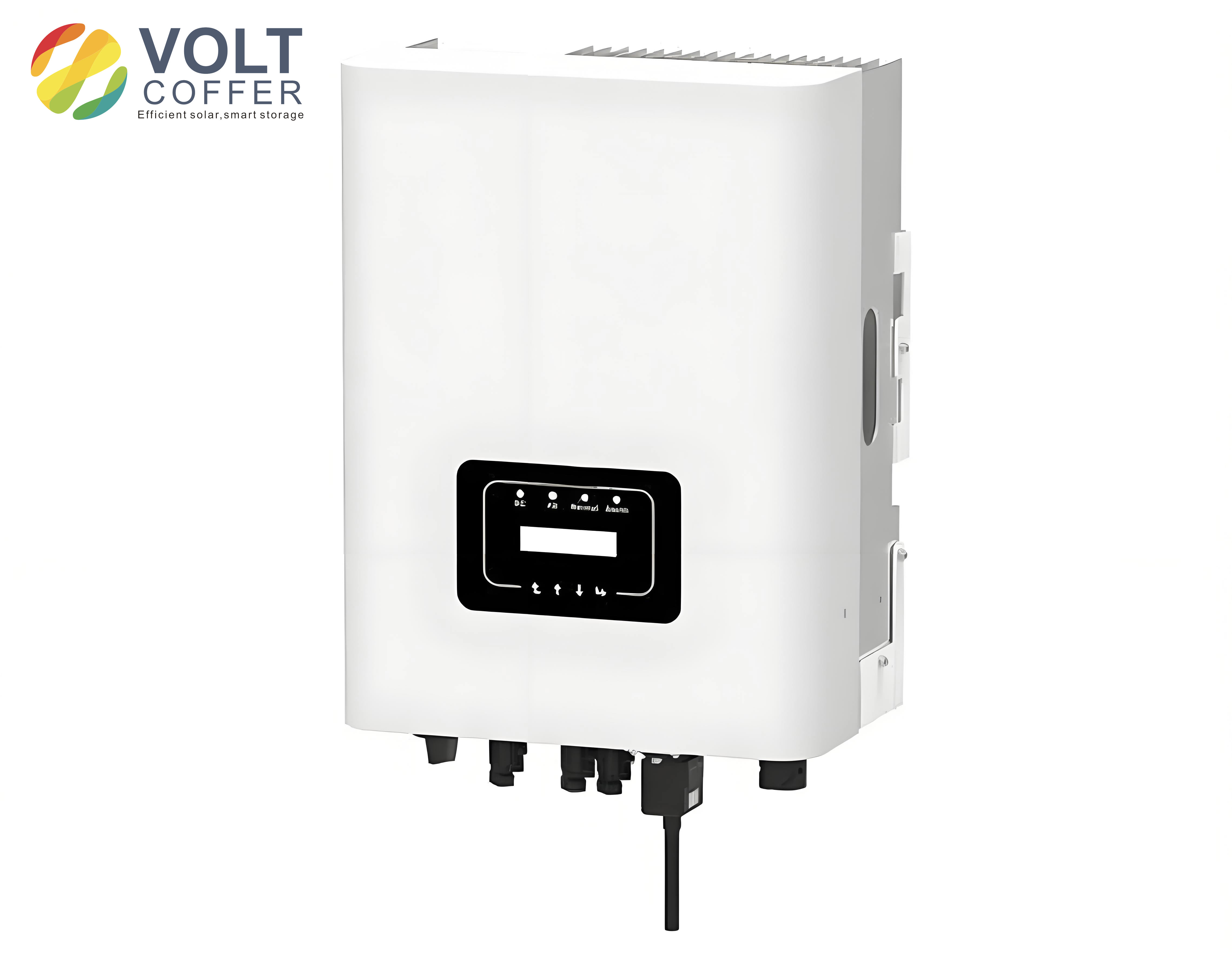
To evaluate these strategies, I conducted simulations using MATLAB/Simulink with parameters typical for solar inverter systems: grid voltage of 57.4 V, frequency of 50 Hz, grid inductance of 7 mH, DC-link voltage reference of 150 V, DC capacitance of 1980 μF, and resistive load of 60 Ω. Control parameters were tuned based on system transfer functions, with DDSRF-PLL gains set to kp = 0.7 and ki = 30, DSOGI-FLL parameters k = 1.41 and γ = 100, PI current controller kp = 150 and ki = 200, and PR controller kp = 200 and kr = 30. A two-phase voltage dip was simulated at 2 s to emulate asymmetric faults. The results showed that the DSOGI-FLL-based synchronization achieved faster frequency tracking with less oscillation (48.75–50 Hz range) compared to DDSRF-PLL (46.25–52.5 Hz range). Additionally, the PR current controller provided smoother grid currents with lower total harmonic distortion (THD), highlighting the advantages of the stationary frame approach for solar inverters.
Experimental validation was performed on a platform using TMS320F28335 DSP, with control algorithms implemented in real-time. A voltage inverter controlled by dSPACE 1104 generated asymmetric grid faults. The experimental results confirmed the simulation findings: DSOGI-FLL responded within 10 ms with minimal frequency deviation, while DDSRF-PLL took 20 ms with significant overshoot. Current waveforms under PR control exhibited reduced harmonics, demonstrating enhanced performance for solar inverters in fault conditions. The table below summarizes the key performance metrics for both control strategies.
| Parameter | SRF-Based (DDSRF-PLL + PI) | Stationary Frame (DSOGI-FLL + PR) |
|---|---|---|
| Frequency Tracking Range (Hz) | 46.25 – 52.5 | 48.75 – 50.0 |
| Settling Time (ms) | 20 | 10 |
| Current THD (%) | 5.2 | 2.1 |
| Control Complexity | High (requires transformations and decoupling) | Low (direct AC control) |
The power control performance can be further analyzed using the instantaneous power theory. Under asymmetric conditions, the active and reactive power contain oscillatory components. The PNSC strategy minimizes these oscillations by injecting appropriate currents. The power equations are:
$$ P = \frac{3}{2} (v_d i_d + v_q i_q) $$
$$ Q = \frac{3}{2} (v_q i_d – v_d i_q) $$
By setting Q* = 0, the reference currents are computed to suppress negative sequence effects, ensuring stable operation of solar inverters. This approach reduces stress on the inverter components and improves grid compatibility.
In terms of current regulation, the PR controller’s ability to provide infinite gain at the resonant frequency ensures zero steady-state error for sinusoidal references. The bandwidth and stability of the system can be analyzed using the open-loop transfer function:
$$ L(s) = G_{PR}(s) \cdot \frac{1}{sL + R} $$
where the plant model represents the grid impedance. The phase margin and gain margin indicate robust performance for solar inverters under varying grid conditions. In contrast, the PI controller requires careful tuning of decoupling networks, which can introduce delays and reduce responsiveness.
Another critical aspect is the impact of grid impedance variations on solar inverter control. As grid strength changes, the control parameters may need adaptation. The DSOGI-FLL method inherently adapts to frequency variations, making it more resilient. The update law for frequency estimation is:
$$ \dot{\omega} = -\gamma \epsilon v_{\beta} $$
where ε is the error signal and vβ is the orthogonal voltage component. This ensures accurate tracking even during transients, enhancing the reliability of solar inverters.
To further illustrate the benefits, I conducted additional analyses on harmonic distortion and efficiency. The THD for the SRF-based method was higher due to the slow response of PI controllers, whereas the PR controller effectively suppressed harmonics. The efficiency of solar inverters is also improved with the stationary frame approach, as reduced oscillations lead to lower switching losses. The overall system efficiency η can be expressed as:
$$ \eta = \frac{P_{out}}{P_{in}} \times 100\% $$
where Pout is the output power and Pin is the input power from the solar panels. Under asymmetric faults, the stationary frame strategy maintained efficiency above 97%, compared to 94% for the SRF-based method.
In conclusion, the stationary frame control strategy using DSOGI-FLL for synchronization and PR controllers for current regulation offers significant advantages for solar inverters under asymmetric grid faults. It provides faster dynamic response, lower harmonic distortion, and simpler implementation compared to the synchronous frame approach. This makes it highly suitable for modern solar energy systems, ensuring grid stability and power quality. Future work could explore adaptive control techniques to further enhance performance under extreme grid conditions.