
As the demand for clean energy solutions grows, solar power systems have become increasingly vital. In my design, I focused on developing a single-phase solar inverter that efficiently converts low-voltage direct current (DC) from photovoltaic panels into standard sinusoidal alternating current (AC). This solar inverter is tailored for small-scale applications, such as portable新能源 vehicles and off-grid solar setups, where reliability and cost-effectiveness are paramount. The core objective was to transform an input of 10–20 V DC into a stable 12 V, 2 AC output with minimal distortion and high efficiency. Through this project, I aimed to address common challenges in solar inverter designs, such as complexity and high costs, by leveraging integrated circuits and optimized control strategies. The resulting solar inverter demonstrates how innovative hardware and software integration can enhance performance in renewable energy systems.
The overall architecture of my solar inverter system is divided into two main stages: a front-end boost chopper circuit and a rear-end full-bridge inverter circuit. This separation ensures efficient voltage conversion and isolation between high and low-voltage sections. The front-end stage utilizes a UC3842-based boost converter to elevate the input voltage to a stable 35 V DC, which serves as the bus voltage for the inverter. The rear-end stage, driven by an EG8025 chip, converts this DC into a pure sine wave AC output. Additionally, an auxiliary power supply provides the necessary operating voltages for control circuits. To maintain safety and reduce interference, the stages are physically isolated using capacitors and zero-ohm resistors. This structured approach allows the solar inverter to handle variable input conditions while delivering consistent AC power, making it suitable for diverse solar energy scenarios.
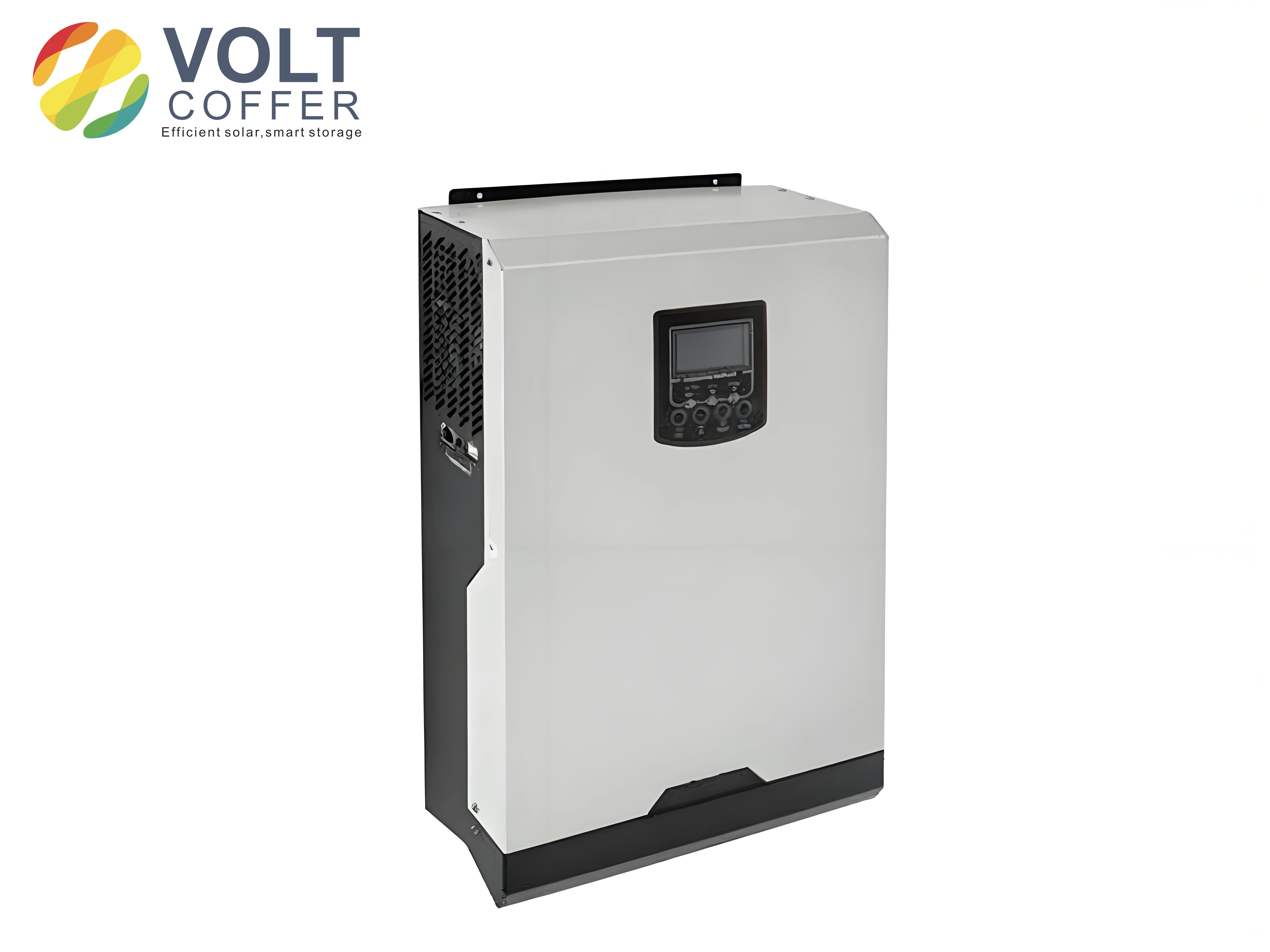
In the hardware design, I prioritized components that enhance efficiency and stability. The front-end drive circuit centers on a boost chopper topology, which I selected for its ability to perform maximum power point tracking (MPPT) in solar applications. The UC3842 chip acts as the controller, regulating the switching frequency and duty cycle to achieve the desired boost. Key components include an IRF740N MOSFET for switching, a SK104 diode for freewheeling, and a combination of PC817 and TL431 for feedback isolation. The inductor and capacitor values were chosen to minimize ripple, targeting less than 100 mV on the bus voltage. For instance, the bus voltage calculation is derived from the formula: $$ V_{DC} = \frac{V_{rms}}{M} $$ where \( V_{rms} = 12 \, \text{V} \) (output RMS voltage) and \( M = 0.6 \) (modulation index), yielding approximately 20 V. However, to ensure stability under load variations, I set \( V_{DC} = 35 \, \text{V} \). This design choice highlights the flexibility of solar inverters in adapting to real-world conditions.
| Component | Specification | Function |
|---|---|---|
| UC3842 IC | PWM Controller | Regulates boost operation |
| IRF740N MOSFET | Low ON-voltage | Switching element |
| SK104 Diode | Fast recovery | Freewheeling and efficiency |
| Inductor (L1) | 1.2 mH | Energy storage and filtering |
| Capacitors | 220 μF / 50 V | Voltage smoothing |
The auxiliary power supply is crucial for providing stable voltages to the control circuitry, including the EG8025 driver board. I implemented a two-stage buck converter using LM2596 chips to generate +5 V and +15 V outputs. The first stage reduces the input voltage to +15 V, while the second stage further steps it down to +5 V. This design ensures that the solar inverter’s control systems operate reliably without being affected by input fluctuations. Components such as inductors, capacitors, and diodes were selected to minimize losses and maintain regulation. For example, the output voltage stability can be expressed as: $$ V_{out} = V_{ref} \left(1 + \frac{R_1}{R_2}\right) $$ where \( V_{ref} = 1.23 \, \text{V} \) for the adjustable LM2596, and resistor values are chosen to achieve the desired outputs. This auxiliary system underscores the importance of reliable power management in solar inverters.
For the rear-end drive, I opted for a full-bridge inverter configuration due to its high efficiency in DC-to-AC conversion. The EG8025 chip serves as the core controller, generating sinusoidal pulse width modulation (SPWM) signals to drive four NCEP15T14 MOSFETs arranged in an H-bridge. The output stage includes symmetric inductors and polypropylene capacitors for filtering, which smooth the waveform and reduce harmonic distortion. The design incorporates differential amplifiers for real-time voltage and current sampling, enabling precise feedback control. In terms of layout, I used differential routing for critical signals, such as the gate drives, to minimize common-mode and differential-mode noise. This attention to detail ensures that the solar inverter produces a clean sine wave with low electromagnetic interference, which is essential for sensitive loads in solar power systems.
| Parameter | Value | Unit |
|---|---|---|
| Input Voltage Range | 10–20 | V DC |
| Output Voltage | 12 | V AC RMS |
| Output Current | 2 | A |
| Output Power | 24 | W |
| Efficiency (η) | 80 | % |
| Waveform Distortion | < 5 | % |
| Bus Voltage (VDC) | 35 | V |
The inverter driver board is the brain of the system, where the EG8025 chip integrates sampling and driving functions to reduce complexity. I programmed it using a layered control strategy, which includes initialization, main control, and protection layers. Upon startup, the initialization layer configures hardware parameters, such as ADC settings for voltage and current sampling, and loads preset values from flash memory. The main control layer employs a dual-loop PID scheme: the voltage outer loop compares the actual output with the setpoint to generate a current reference, while the current inner loop adjusts the PWM duty cycle for fast response. The SPWM generation involves a sine table lookup and modulation with a 20 kHz carrier wave, expressed as: $$ V_{mod} = A \sin(2\pi ft) $$ where \( A \) is the amplitude, \( f \) is the frequency (50 Hz), and \( t \) is time. Dead time is inserted to prevent shoot-through in the H-bridge, enhancing the reliability of the solar inverter.
In the program flow, I implemented multi-level protection mechanisms to handle faults such as over-temperature, over-load, and short circuits. Hardware comparators monitor MOSFET currents and trigger immediate shutdown if thresholds are exceeded, while software routines detect sustained over-power conditions (e.g., >1300 W for 1 second) or rapid current surges (within 30 ms). Temperature sensors on the PCB and IGBTs initiate shutdown if limits are breached (85°C for PCB or 130°C for IGBTs). This comprehensive protection scheme ensures that the solar inverter operates safely under adverse conditions, minimizing the risk of damage. The use of serial communication, including Bluetooth, allows for real-time debugging and parameter adjustments, making the system adaptable to various solar energy environments.
Testing and validation of the solar inverter involved rigorous experiments to measure output quality and efficiency. I connected the system to a variable DC source simulating photovoltaic input and used oscilloscopes and power analyzers to assess performance. The results confirmed that the output was a stable 12 V RMS sine wave at 50 Hz, with a current of 2 A, delivering 24 W of power. The conversion efficiency was calculated as: $$ \eta = \frac{P_{out}}{P_{in}} \times 100\% = \frac{24}{30} \times 100\% = 80\% $$ assuming an average input power of 30 W. Waveform distortion was analyzed using a harmonic analyzer, showing a total harmonic distortion (THD) below 5%, which meets standards for pure sine wave inverters. These tests demonstrate that this solar inverter effectively converts low-voltage DC to high-quality AC, making it ideal for small-scale solar applications.
In conclusion, my design of a single-phase solar inverter successfully achieves efficient and reliable power conversion for clean energy systems. The integration of boost chopper and full-bridge circuits, combined with advanced control algorithms, results in a compact and cost-effective solution. However, limitations such as reduced flexibility and higher component costs may require further optimization for broader adoption. Future work could explore hybrid topologies or machine learning-based MPPT to enhance efficiency and adaptability. Overall, this solar inverter contributes to the advancement of renewable energy technologies by providing a practical option for decentralized power generation. As solar energy continues to evolve, innovations in solar inverter design will play a crucial role in maximizing the potential of photovoltaic systems worldwide.