
Thermoelectric power generation, leveraging the Seebeck effect, offers a sustainable solution for waste heat recovery. However, challenges like temperature mismatch, parameter variations, and multi-peak power characteristics necessitate advanced modeling and Maximum Power Point Tracking (MPPT) strategies. This study proposes a refined circuit model for thermoelectric arrays and introduces a hybrid PSO-P&O algorithm to optimize energy extraction.
Circuit Modeling of Thermoelectric Arrays
The equivalent circuit of a thermoelectric generator (TEG) incorporates temperature-dependent internal resistance and actual temperature gradients. The output voltage is expressed as:
$$ U = \alpha_{TEG} \Delta T – R_{TEG}I $$
where \( \alpha_{TEG} \) is the effective Seebeck coefficient, \( \Delta T \) is the temperature gradient, and \( R_{TEG} \) denotes the internal resistance. For arrays with \( n_s \) series and \( n_p \) parallel modules, the aggregated model becomes:
$$ U_{array} = n_s \left( \frac{k_c \alpha_m (T_H – T_C)}{2k_m + k_c} \right) – I \left( \frac{n_s R_{TEG}}{n_p} \right) $$
Key parameters are derived through experimental calibration (Table 1):
| Parameter | Value | Description |
|---|---|---|
| \( \alpha_m \) | 0.39 V/cm | Material Seebeck coefficient |
| \( k_c \) | 401 W/(m·K) | Copper interconnect thermal conductivity |
| \( k_m \) | 0.015 W/cm | Module thermal conductance |
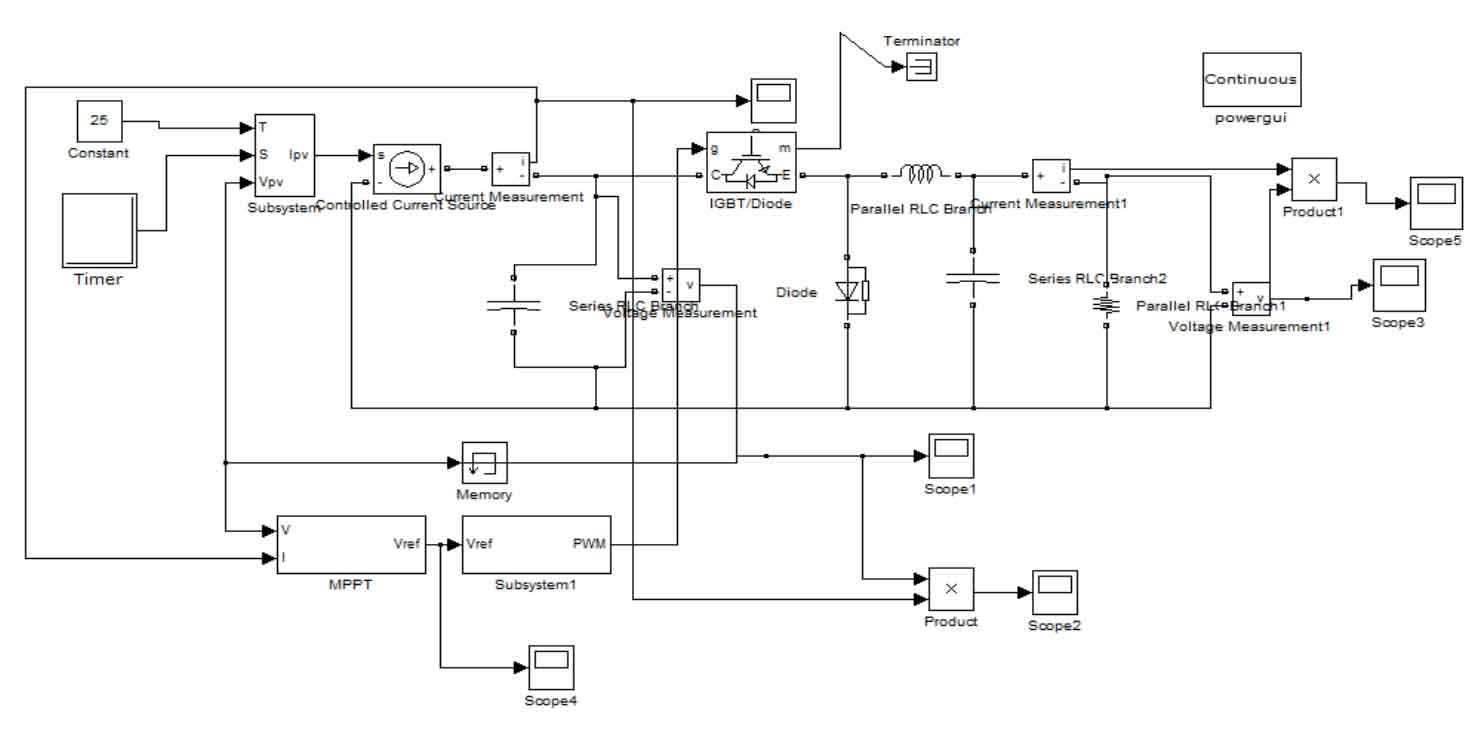
Hybrid PSO-P&O MPPT Algorithm
Conventional MPPT methods like Perturb & Observe (P&O) often fail under multi-peak conditions. The proposed algorithm combines Particle Swarm Optimization (PSO) for global exploration and P&O for local refinement:
- PSO Phase: Initial global search using velocity update:
$$ v_i^{k+1} = wv_i^k + c_1 r_1 (pbest_i – x_i^k) + c_2 r_2 (gbest – x_i^k) $$ - P&O Phase: Local optimization when voltage variation \( \Delta V < 0.1V \):
Performance comparison reveals superiority in convergence and oscillation reduction:
| Algorithm | Settling Time (s) | Power Ripple (%) |
|---|---|---|
| P&O | 0.04 | 1.86 |
| PSO | 0.07 | 4.21 |
| PSO-P&O | 0.05 | 1.12 |
Simulation and Experimental Validation
A 2×2 TEG array with mismatched temperatures (30–90°C) was tested. The hybrid algorithm achieved 4.78W output vs. 4.71W for P&O, demonstrating 1.49% improvement. Voltage-current characteristics confirmed multi-peak mitigation:
$$ P_{max} = \frac{(\alpha_{TEG} \Delta T)^2}{4R_{TEG}} $$
Industrial Application in Cooling Systems
Implemented in a nuclear cooling system with 50 TEG modules, the strategy enhanced power harvest under varying thermal gradients (Table 2):
| Scenario | ΔT (°C) | PSO-P&O Power (W) | Improvement vs P&O |
|---|---|---|---|
| Inlet-Outlet 1 | 38.7 | 1,208 | 17.88% |
| Inlet-Outlet 2 | 56.7 | 1,322 | 16.17% |
| Inlet-Outlet 3 | 79.5 | 1,379 | 14.16% |
Conclusion
The proposed thermoelectric array model accurately captures temperature-dependent behaviors, while the PSO-P&O MPPT strategy effectively addresses multi-peak challenges. Experimental results validate 14–18% power enhancement in practical applications, establishing a framework for optimized waste heat recovery systems.