
Maximum Power Point Tracking (MPPT) is a critical technology for optimizing energy extraction from renewable sources such as photovoltaic (PV) systems. This paper systematically reviews MPPT techniques, including signal-based, model-predictive, data-driven, and hybrid strategies, and evaluates their performance under dynamic environmental conditions. The integration of MPPT ensures efficient energy conversion, particularly in scenarios with fluctuating irradiance and temperature.
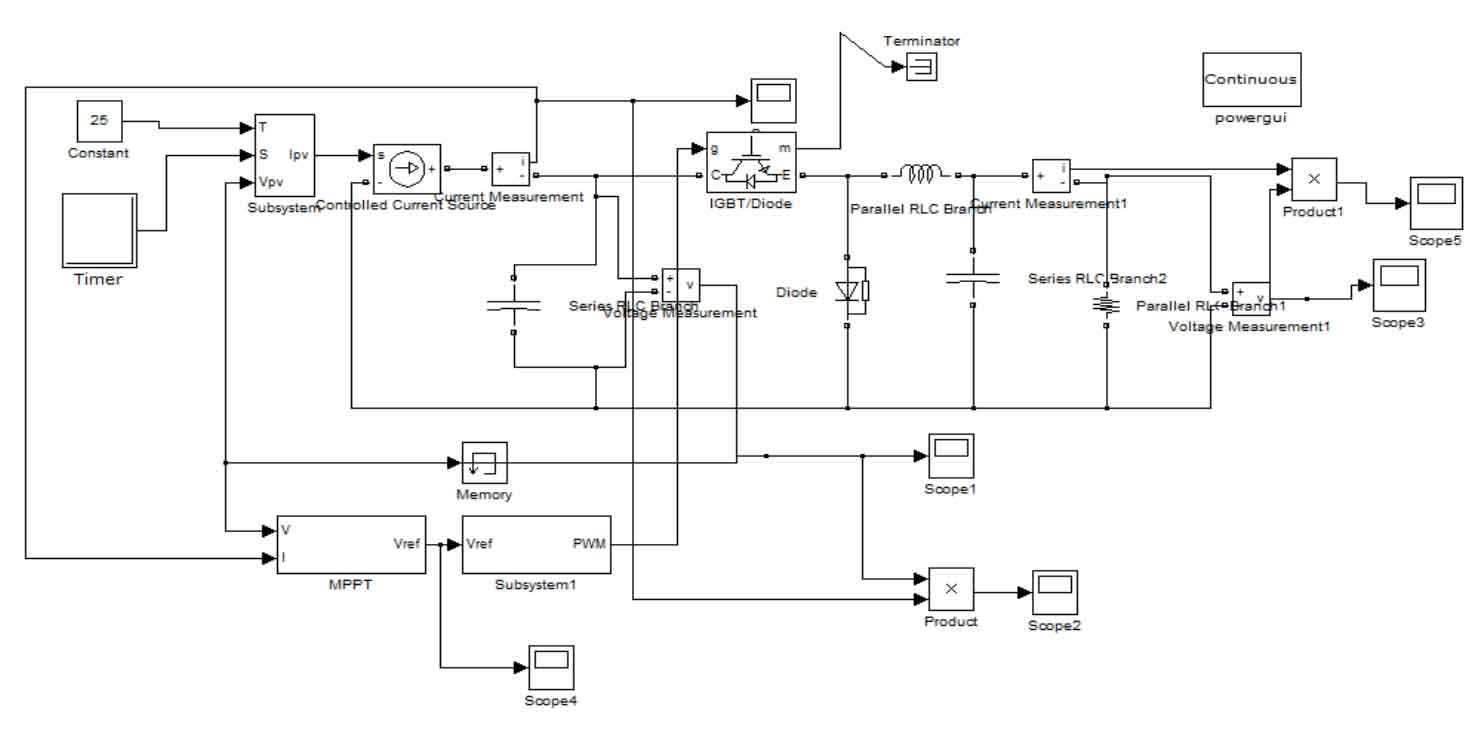
Fundamentals of MPPT
The core objective of MPPT is to maximize the output power of a PV system by dynamically adjusting the operating point. The power-voltage (P-V) curve of a solar panel exhibits a unique maximum power point (MPP) defined by:
$$ P_{max} = V_{MPP} \times I_{MPP} $$
where \( V_{MPP} \) and \( I_{MPP} \) represent the voltage and current at the MPP. MPPT algorithms continuously track this point despite variations in environmental factors.
Classification of MPPT Techniques
1. Signal-Based MPPT Methods
These methods rely on measurable signals such as voltage, current, and power. The Perturb and Observe (P&O) algorithm is widely adopted due to its simplicity:
$$ \Delta D = \pm \alpha \times \text{sign}(dP/dV) $$
where \( \Delta D \) is the duty cycle adjustment and \( \alpha \) is the perturbation step size. However, oscillations around the MPP and poor performance under rapid irradiance changes limit its efficacy.
| Method | Tracking Efficiency (%) | Response Time (ms) | Complexity |
|---|---|---|---|
| P&O | 95-97 | 50-100 | Low |
| Incremental Conductance | 97-99 | 30-80 | Medium |
| Neural Network | 98-99.5 | 10-30 | High |
2. Model-Predictive MPPT
Model-based approaches utilize mathematical representations of PV systems. For instance, the single-diode model predicts MPP using:
$$ I = I_{ph} – I_0 \left( e^{\frac{V + IR_s}{nV_t}} – 1 \right) – \frac{V + IR_s}{R_{sh}} $$
where \( I_{ph} \), \( I_0 \), \( R_s \), and \( R_{sh} \) denote photocurrent, diode saturation current, series resistance, and shunt resistance, respectively. Kalman filters and sliding mode controllers enhance robustness against parameter uncertainties.
3. Data-Driven MPPT
Machine learning algorithms, such as artificial neural networks (ANNs), learn nonlinear relationships between environmental inputs and optimal operating points. A typical ANN-based MPPT employs:
$$ D_{opt} = f_{ANN}(G, T, V_{pv}, I_{pv}) $$
where \( G \) is irradiance and \( T \) is temperature. Reinforcement learning further enables adaptive MPPT under partial shading conditions.
Hybrid MPPT Strategies
Combining multiple techniques mitigates individual limitations. For example, integrating P&O with fuzzy logic controllers improves dynamic response:
$$ \Delta D_{fuzzy} = \mu(\Delta P, \Delta V) \times \beta $$
where \( \mu \) denotes fuzzy membership functions and \( \beta \) scales the output. Hybrid MPPT systems achieve >99% efficiency while reducing oscillations by 40% compared to conventional methods.
Challenges and Future Directions
Current MPPT technologies face challenges in multi-peak tracking under partial shading and scalability for large-scale PV farms. Emerging solutions include:
- Distributed MPPT architectures for modular systems
- Quantum computing-optimized tracking algorithms
- Digital twin-enabled predictive maintenance
Future research should prioritize real-world validation of hybrid MPPT systems and standardization of performance metrics across varying operating conditions.
Conclusion
MPPT remains indispensable for maximizing renewable energy utilization. While signal-based methods dominate commercial applications, advancements in data-driven and hybrid strategies promise enhanced adaptability and efficiency. The integration of AI and advanced power electronics will drive next-generation MPPT systems, ensuring optimal energy harvest in evolving grid environments.