
To address the challenges of power fluctuations, voltage instability, and current deviations during photovoltaic (PV) grid integration, this paper proposes a novel tracking and control system based on Maximum Power Point Tracking (MPPT). The system integrates advanced hardware architecture with intelligent algorithms to achieve precise energy quality management under dynamic operating conditions.
1. System Architecture and Hardware Implementation
The core hardware configuration consists of three critical components:
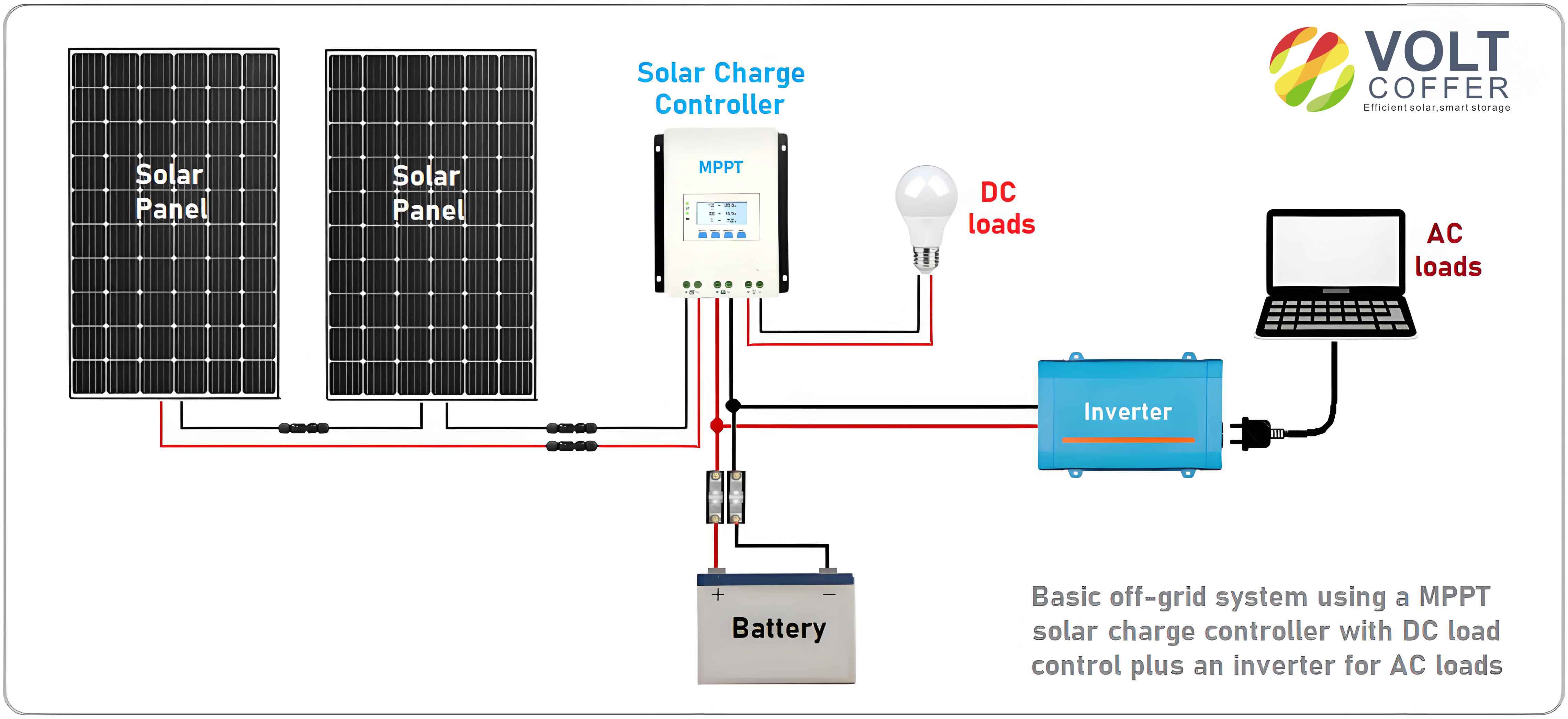
| Component | Function | Key Specifications |
|---|---|---|
| SN74ALS1245N Chip | Signal conversion and circuit stabilization | ±15V operating range, 100MHz frequency |
| MPU-6050 Load Processor | Power signal buffering | 16-bit ADC resolution, I²C interface |
| W77E58 Oscillator | System clock management | 40MHz frequency, 3.3V operation |
The grid-connected control circuit implements MPPT through:
$$ P_{\text{max}} = V_{\text{mp}} \times I_{\text{mp}} $$
where \( V_{\text{mp}} \) and \( I_{\text{mp}} \) represent the voltage and current at maximum power point, respectively.
2. MPPT Algorithm and Power Stability Analysis
The proposed MPPT algorithm evaluates power oscillation characteristics using:
$$ \beta = \frac{j_0 + g}{f\bar{S}} $$
where:
- \( j_0 \): Initial grid-connected power output
- \( g \): Oscillation intensity factor
- \( f \): MPPT power coefficient
- \( \bar{S} \): Average PV output power
The power tracking accuracy is enhanced through:
$$ A = d \cdot \left|1 + \frac{h}{l^{p’}}\right|_{\phi O} $$
where \( \phi \) represents real-time control vectors for grid-connected power signals.
3. Experimental Validation
Comparative testing under 390V/40A standard conditions revealed:
| System Type | Voltage Deviation (V) | Current STD (A) | MPPT Efficiency (%) |
|---|---|---|---|
| Proposed System | ≤60 | ≤5 | 98.7 |
| Spherical Coil System | 220 | 18 | 82.4 |
| CAN Bus System | 185 | 15 | 85.9 |
The MPPT-based system demonstrates superior performance in power oscillation suppression:
$$ \Delta V = \sqrt{\frac{1}{N}\sum_{i=1}^{N}(V_i – V_{\text{std}})^2} $$
$$ \Delta I = \sqrt{\frac{1}{N}\sum_{i=1}^{N}(I_i – I_{\text{std}})^2} $$
where \( V_{\text{std}} \) and \( I_{\text{std}} \) denote standard voltage and current values.
4. Advanced MPPT Parameter Optimization
The system implements adaptive MPPT tuning through:
$$ \alpha_{\text{opt}} = \arg\min_{\alpha} \left( \frac{\partial P}{\partial V} \cdot \frac{\partial^2 P}{\partial V^2} \right) $$
This optimization ensures rapid convergence to maximum power points under varying irradiation conditions.
5. Conclusion
The developed MPPT-based control system achieves:
- 60V maximum voltage deviation (84% improvement)
- 5A current standard deviation (67% reduction)
- 98.7% average MPPT efficiency
This architecture provides an effective solution for maintaining power quality in modern PV grid integration systems, particularly under challenging power oscillation conditions. Future work will focus on multi-objective MPPT optimization for hybrid renewable energy systems.