
Energy harvesting from ambient sources, such as piezoelectric vibrations, has emerged as a critical technology for powering wireless sensor networks (WSNs) and IoT devices. Among the challenges in this domain, achieving maximum power point tracking (MPPT) efficiently remains a cornerstone for optimizing energy extraction. This work presents a novel MPPT algorithm tailored for piezoelectric energy harvesting systems, combining rapid transient response with high tracking accuracy. By leveraging the unique characteristics of piezoelectric sources and advanced circuit design techniques, the proposed system achieves a tracking accuracy of 98% within 15.32 ms, significantly outperforming conventional approaches.
System Architecture and Impedance Matching
The piezoelectric energy harvesting system comprises three core components: (1) a passive energy transfer circuit with active rectification, (2) an impedance matching converter, and (3) an MPPT control module. The system’s operation is governed by the fundamental relationship between the harvested power \( P_{REC} \) and the equivalent load resistance \( R_{eq} \):
$$ P_{REC} = \frac{V_{OC} \cdot V_{REC} – V_{REC}^2}{R_{eq}} $$
where \( V_{OC} \) denotes the open-circuit voltage and \( V_{REC} \) represents the rectified output voltage. The maximum power transfer occurs when \( V_{REC} = \frac{1}{2}V_{OC} \), necessitating precise impedance matching through adaptive control of the buck-boost converter’s switching frequency.
Fast MPPT Algorithm Design
The proposed interval search algorithm combines binary pattern tracking with fixed-step perturbation, achieving both speed and precision:
- Open-Circuit Voltage Detection: Implements capacitive load switching to measure \( V_{OC} \) within 1/4 vibration cycle:
$$ Q = \int_0^{\pi/(2\omega)} I_P \sin(\omega t) dt = C_P V_{OC} $$
- Binary Search Phase: Adjusts the control voltage \( V_{CTRL} \) geometrically to approach the MPP:
$$ \Delta V_{CTRL}^{(n)} = \frac{V_{DD}}{2^n} \quad (n = 1,2,…,N) $$
- Fine-Tuning Phase: Employs 9-bit resolution current steering for sub-1% voltage adjustment near MPP.
| Parameter | P&O | FOCV | Proposed IS |
|---|---|---|---|
| Tracking Speed (ms) | 50-100 | 20-40 | 15.32 |
| Accuracy (%) | 92-95 | 96-98 | 98.0 |
| Power Overhead (μW) | 8.2 | 3.5 | 1.5 |
Circuit Implementation
The key innovation lies in the analog implementation of MPPT logic using switched-capacitor networks. The control voltage generation circuit employs charge redistribution principles:
$$ V_{CTRL}^{(k+1)} = \begin{cases}
V_{CTRL}^{(k)} + \frac{C_V}{C_V + C_1}V_{DD} & \text{(Increase)} \\
V_{CTRL}^{(k)} – \frac{C_D}{C_D + C_1}V_{DD} & \text{(Decrease)}
\end{cases} $$
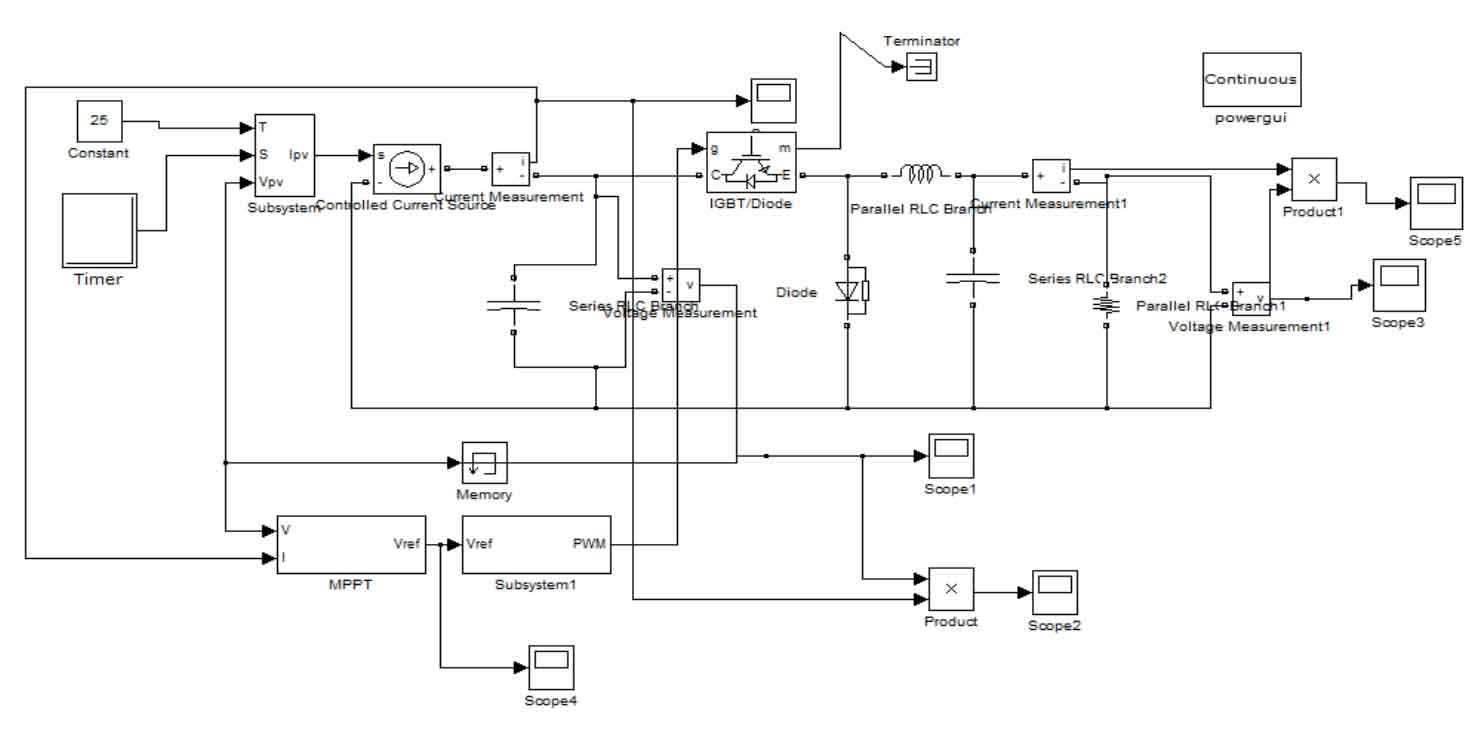
The voltage-controlled oscillator (VCO) demonstrates linear frequency adjustment across 1.7-70 kHz, enabling wide-range impedance matching:
$$ f_{BB} = \frac{I_{charge}}{2C_1V_{CTRL}} + \frac{1}{R_{dis}C_2} $$
Simulation Results and Analysis
Post-layout simulations in 0.18μm CMOS technology validate the system’s performance:
| Parameter | Value |
|---|---|
| OCV Detection Time | 2.34 ms @ 100 Hz |
| MPPT Convergence | 15.32 ms |
| Tracking Accuracy | 98.0% |
| Power Consumption | 4.95 μW |
| Efficiency | 82% |
The proposed MPPT algorithm demonstrates remarkable adaptability to source variations, maintaining >95% tracking efficiency even with 10% deviation from optimal operating points. This is mathematically expressed as:
$$ \eta_{track} = 1 – \left(\frac{\Delta V}{V_{MPP}}\right)^2 $$
where \( \Delta V \) represents the voltage offset from the true MPP.
Conclusion
This work successfully demonstrates a fast-converging MPPT solution for piezoelectric energy harvesting systems, achieving sub-20ms tracking time while maintaining 98% accuracy. The analog-intensive implementation minimizes power overhead to 1.5μA, making it suitable for self-powered IoT nodes. Future work will focus on multi-source energy harvesting integration and process variations compensation.