
Abstract
Solar energy, as an inexhaustible renewable resource, offers advantages including cleanliness, safety, longevity, and economic potential. With an average daily solar radiation exceeding 4 kWh/m² in most regions of China—reaching 7 kWh/m² in Tibet—solar photovoltaic (PV) systems have become critical for sustainable energy strategies. This article explores the components of PV systems, their operational principles, and applications, with a focus on the role of solar inverters in energy conversion and grid integration.
1. Components of a Photovoltaic Power Generation System
A solar PV system converts sunlight into electricity through interconnected components: solar panels, charge controllers, solar inverters, and grid integration infrastructure. The efficiency of energy conversion depends on material properties and system design.
1.1 Types of Silicon Solar Cells
Three commercialized silicon-based solar cells dominate the market:
| Type | Efficiency | Cost | Application |
|---|---|---|---|
| Monocrystalline | 13–15% | High | High-performance installations |
| Polycrystalline | 11–13% | Medium | Residential/commercial |
| Amorphous | 6–8% | Low | Low-power devices |
The photoconversion efficiency ($\eta$) is calculated as:
$$ \eta = \frac{P_{\text{out}}}{P_{\text{in}}} \times 100\% $$
where $P_{\text{in}}$ is incident solar power and $P_{\text{out}}$ is electrical output.
1.2 Solar Panel Configuration
A standard PV module contains 36 cells connected in series, generating ~18V under STC (Standard Test Conditions). Partial shading causes hot-spot effects, mitigated using bypass diodes:
$$ I_{\text{bypass}} = I_{\text{sc}} \times \left( \frac{N_{\text{shaded}}}{N_{\text{total}}} \right) $$
1.3 Solar Inverter Technologies
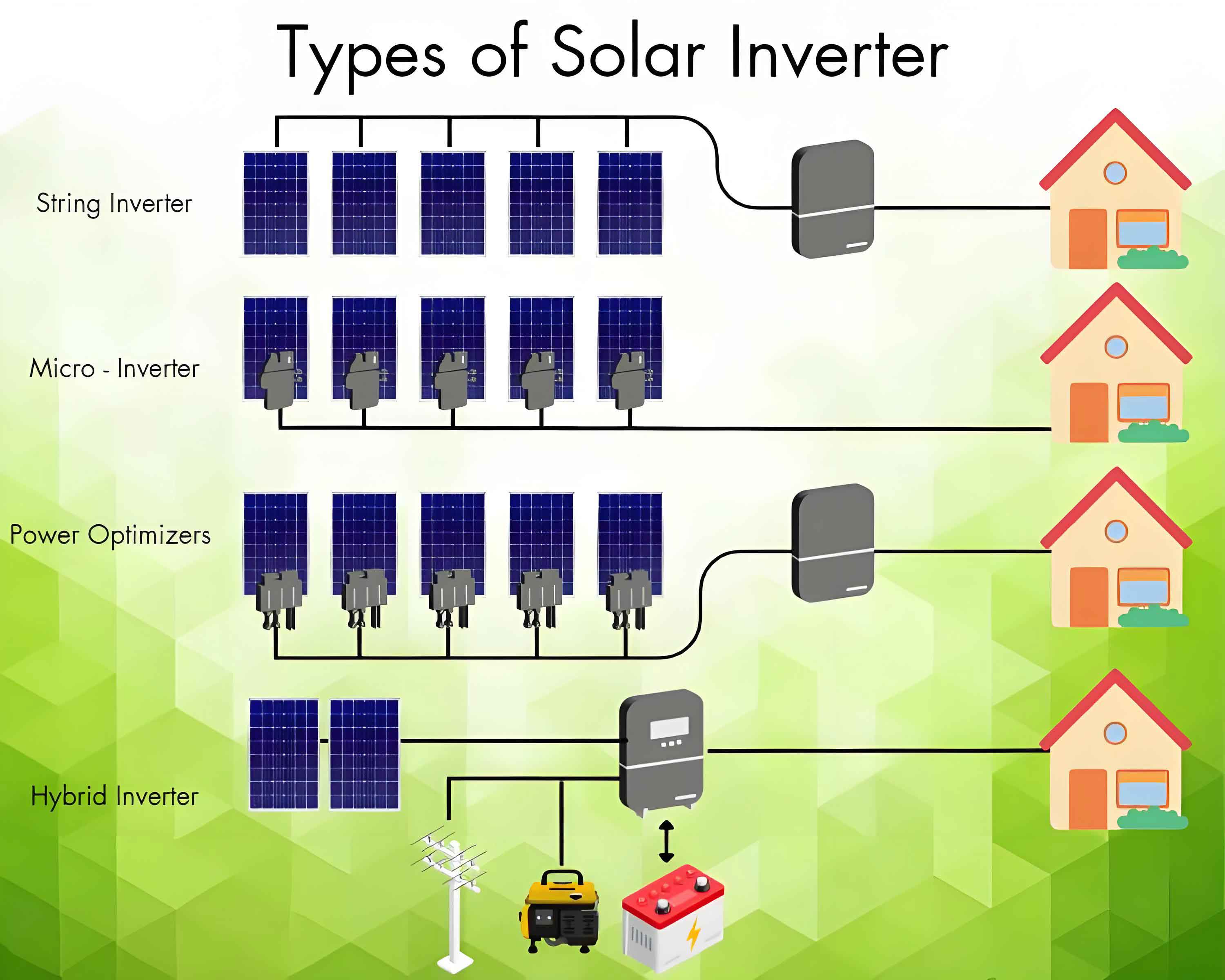
Solar inverters transform DC to AC power with two operational modes:
| Inverter Type | Input Voltage | Output Voltage | Efficiency |
|---|---|---|---|
| Stand-alone | 12–48V DC | 110/220V AC | 90–93% |
| Grid-tied | 200–600V DC | 220V/380V AC | 96–98% |
| Hybrid | 48–120V DC | Bi-directional AC | 94–97% |
Maximum Power Point Tracking (MPPT) algorithms optimize solar inverter performance:
$$ P_{\text{max}} = V_{\text{mpp}} \times I_{\text{mpp}} $$
where $V_{\text{mpp}}$ and $I_{\text{mpp}}$ are voltage and current at the maximum power point.
2. Grid-Connected PV System Architectures
Modern solar inverters enable three grid interaction modes:
2.1 Bidirectional Energy Flow Systems
Excess power feeds into the grid when $P_{\text{gen}} > P_{\text{load}}$, governed by:
$$ P_{\text{grid}} = P_{\text{gen}} – P_{\text{load}} $$
2.2 Unidirectional Systems
Priority power supply to loads with grid backup. Battery storage capacity ($C_{\text{batt}}$) is calculated as:
$$ C_{\text{batt}} = \frac{E_{\text{daily}} \times D_{\text{autonomy}}}{\eta_{\text{inv}} \times \text{DOD}}} $$
2.3 Hybrid Inverter Systems
Integrate multiple energy sources through advanced solar inverters:
$$ P_{\text{total}} = P_{\text{PV}} + P_{\text{wind}} + P_{\text{grid}} $$
3. Performance Optimization Strategies
Key parameters for solar inverter selection:
- Total Harmonic Distortion (THD < 3%)
- MPPT accuracy (> 99%)
- Anti-islanding response time (< 2s)
4. Economic and Environmental Impact
With levelized cost of energy (LCOE) for utility-scale PV systems:
$$ \text{LCOE} = \frac{\sum_{t=1}^{n} \frac{I_t + M_t}{(1+r)^t}}{\sum_{t=1}^{n} \frac{E_t}{(1+r)^t}}} $$
5. Future Trends
Next-generation solar inverters will incorporate artificial intelligence for predictive maintenance and blockchain-enabled peer-to-peer energy trading.
Conclusion
The integration of advanced solar inverters with PV systems enables efficient energy conversion and smart grid compatibility. As solar panel costs decline by 8–10% annually, PV systems coupled with intelligent inverters will dominate global energy transitions, particularly in sun-rich regions like Northwest China.