
This paper proposes a novel three-level adjustable two-stage solar inverter topology designed to address efficiency limitations in conventional boost-type two-stage inverters and single-phase systems. The structure integrates dual DC sources, soft-switching techniques, and coordinated control strategies to optimize energy conversion efficiency for photovoltaic applications.
1. System Architecture
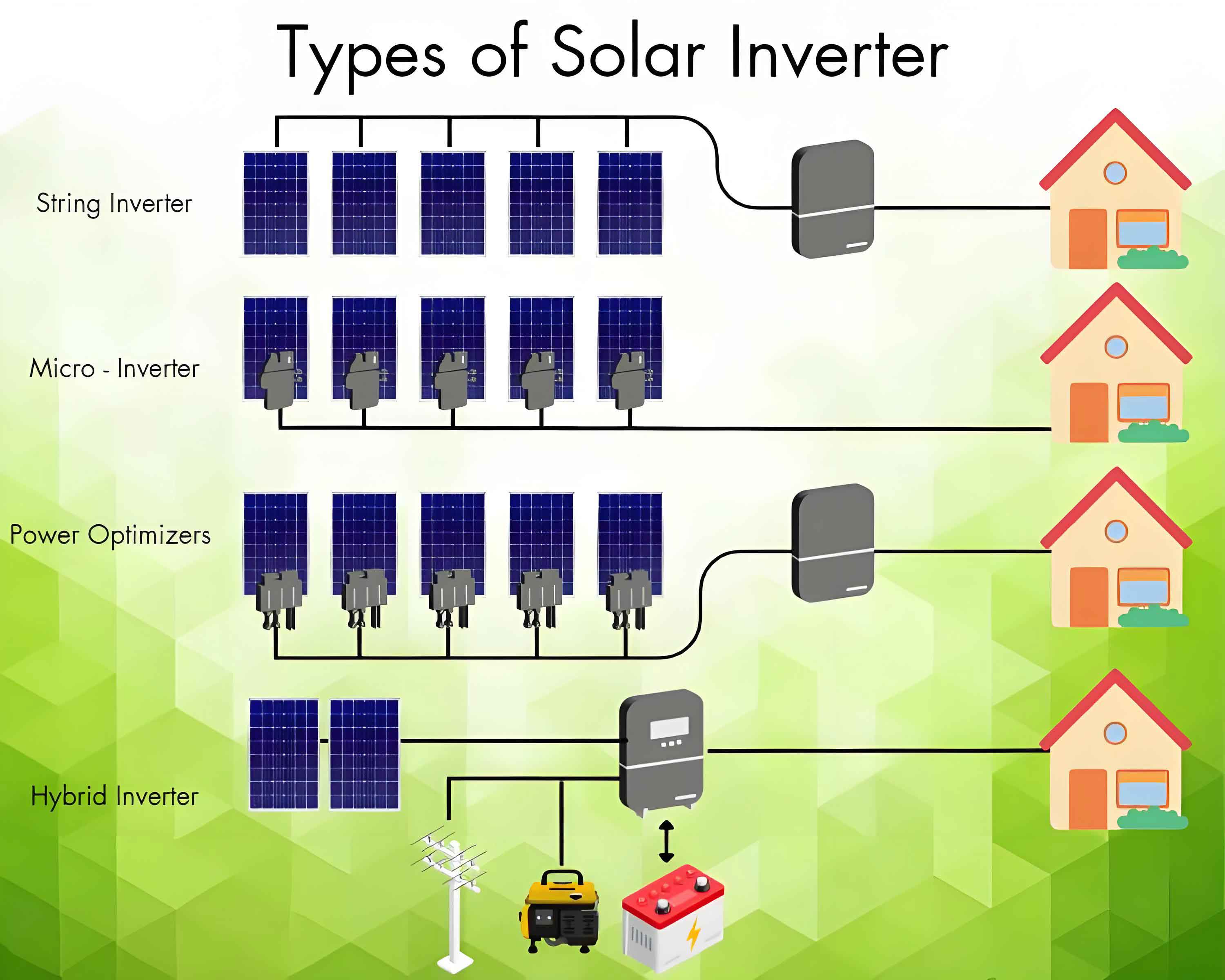
The proposed solar inverter consists of:
- Front-end voltage regulation circuit with dual DC sources
- Three-phase three-level inverter with midpoint control
- LC filter network
Key parameters for a 29kW system:
| Component | Value |
|---|---|
| DC Source Voltage (E1,E2) | 400V |
| Switching Frequency | 15kHz |
| Output Voltage (Line-Line) | 380V RMS |
| Filter Inductance (La,b,c) | 3.1mH |
| Filter Capacitance (Ca,b,c) | 2μF |
2. Mathematical Modeling
The voltage regulation stage maintains bus voltage ($V_{PN}$) and midpoint voltage ($V_{MN}$) through complementary switching:
$$V_{PN} = E(1 + D_{T1})$$
$$V_{MN} = V_{PN} \cdot D_{T3}$$
Three-phase output voltages are governed by:
$$
\begin{cases}
U_A(t) = U_m\sin\theta \\
U_B(t) = U_m\sin(\theta – \frac{2\pi}{3}) \\
U_C(t) = U_m\sin(\theta – \frac{4\pi}{3})
\end{cases}
$$
3. Efficiency Optimization
Power loss components in the solar inverter:
$$P_{total} = P_{cond} + P_{sw} + P_{mag}$$
| Loss Type | Calculation |
|---|---|
| Conduction | $P_{cond} = \sum(I_{rms}^2R_{on})$ |
| Switching | $P_{sw} = f_s(E_{on}+E_{off})$ |
| Magnetic | $P_{mag} = k_hf^\alpha\Delta B^\beta V_e$ |
Measured efficiency characteristics:
| Load (%) | Efficiency (%) |
|---|---|
| 5 | 95.88 |
| 50 | 98.79 |
| 100 | 98.47 |
4. Control Strategy
The coordinated control algorithm achieves:
- ZVS/ZCS operation in front-end converter
- Reduced switching frequency (4 transitions/cycle)
- Automatic midpoint voltage balancing
Voltage regulation PI control:
$$D_{T1} = \frac{V_{PN}}{E} – 1 + K_p\Delta V + K_i\int\Delta V dt$$
5. Harmonic Analysis
Output voltage THD comparison:
| Topology | THD (%) |
|---|---|
| Proposed | 2.19 |
| Conventional NPC | 4.82 |
| Boost Two-Stage | 5.67 |
The improved performance stems from:
$$
\Delta V_{step} = \frac{V_{PN}}{2^n-1}
$$
where n represents the number of voltage levels (n=3 in this design).
6. Conclusion
This three-level solar inverter demonstrates superior performance through:
- 98.79% peak conversion efficiency
- 98.47% CGC weighted efficiency
- 2.19% output voltage THD
- 60% reduction in switching losses
The topology shows significant potential for replacing conventional boost-type two-stage inverters in medium-voltage solar applications, particularly in distributed generation systems requiring high efficiency and power quality.