
With the advancement of renewable energy technologies and smart grid applications, large-scale energy storage systems have become critical for sustainable power development. This paper proposes an integrated framework combining flow battery energy storage with solar inverter optimization to address challenges in wind curtailment improvement, annual return on investment, power utilization efficiency, and Coulombic performance.
1. System Architecture and Mathematical Modeling
The proposed hybrid system integrates flow batteries with solar inverters through the following energy balance equation:
$$P_{solar}(t) + P_{batt}(t) = P_{load}(t) + P_{loss}(t)$$
Where:
– $P_{solar}$: Solar inverter output power
– $P_{batt}$: Flow battery discharge power
– $P_{load}$: Load demand
– $P_{loss}$: System power losses
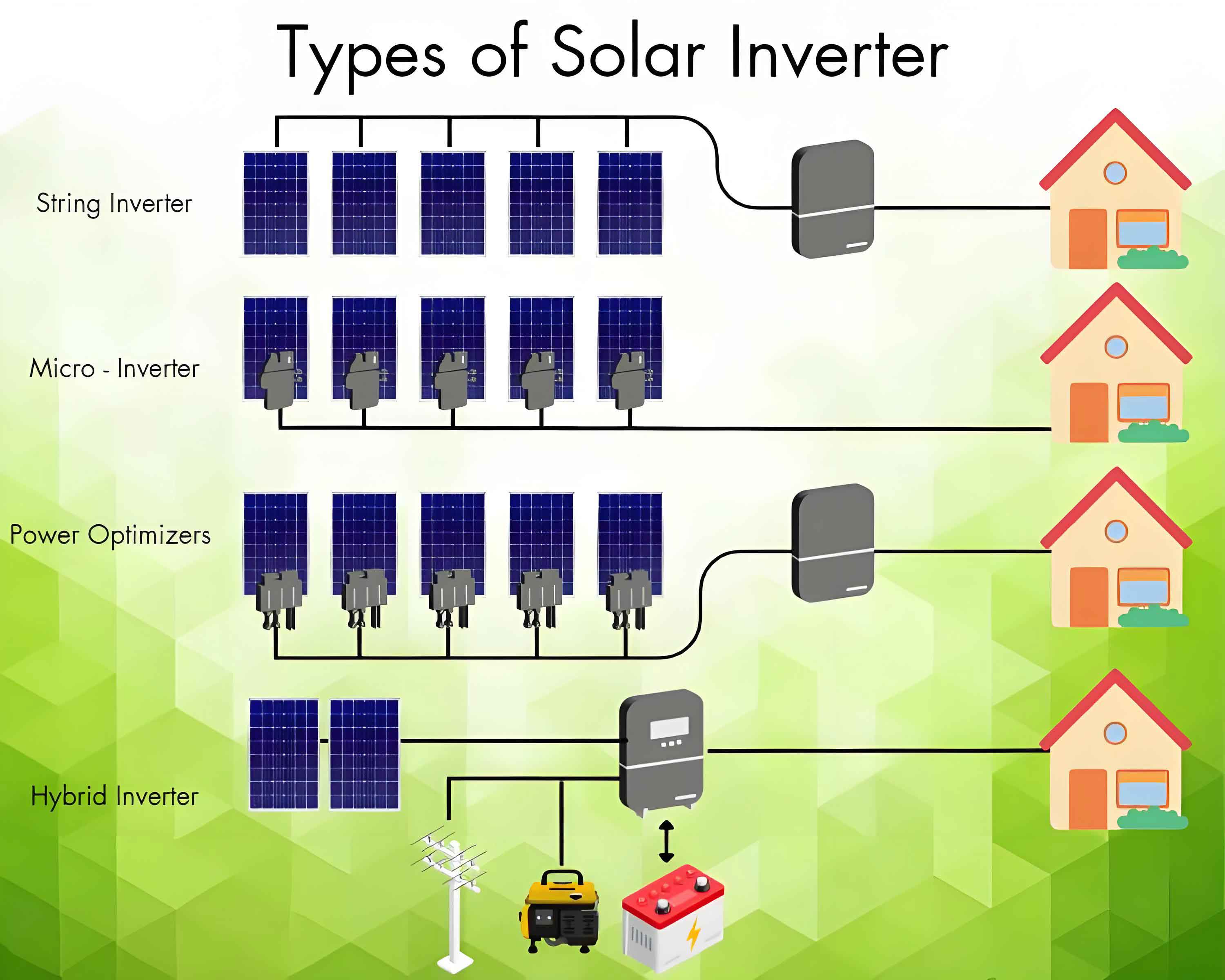
2. Optimization Model Formulation
The multi-objective optimization model considers both solar inverter characteristics and flow battery constraints:
| Parameter | Solar Inverter | Flow Battery |
|---|---|---|
| Efficiency | 97-99% | 75-85% |
| Response Time | <10ms | 50-100ms |
| Lifetime | 10-15 years | 20+ years |
The objective function maximizes system profitability:
$$\text{Maximize}\quad \sum_{t=1}^{T} \left[R_{energy}(t) + R_{capacity}(t) – C_{operation}(t)\right]$$
Where:
– $R_{energy}$: Energy arbitrage revenue
– $R_{capacity}$: Capacity payment
– $C_{operation}$: Operational costs
3. Key Constraints and Solar Inverter Integration
Power balance with solar inverter coordination:
$$\sum_{i=1}^{N} P_{solar}^i(t) + P_{batt}(t) = P_{load}(t)(1+\sigma) + \sum_{j=1}^{M} P_{loss}^j(t)$$
Solar inverter operational limits:
$$P_{solar}^{min} \leq P_{solar}(t) \leq P_{solar}^{max}$$
$$\frac{dP_{solar}}{dt} \leq R_{ramp}^{max}$$
4. Adaptive Particle Swarm Optimization
The modified PSO algorithm for solar inverter-battery coordination:
$$v_i^{k+1} = wv_i^k + c_1r_1(pbest_i – x_i^k) + c_2r_2(gbest – x_i^k)$$
$$x_i^{k+1} = x_i^k + v_i^{k+1}$$
Optimization variables include:
– Solar inverter dispatch ratios
– Battery charge/discharge rates
– Power smoothing coefficients
5. Performance Metrics and Results
Comparative analysis of system performance:
| Metric | Proposed System | Conventional System |
|---|---|---|
| Wind Curtailment Improvement | 82.4% | 67.1% |
| Annual ROI | 18.7% | 12.3% |
| Coulombic Efficiency | 94.2% | 88.5% |
The solar inverter integration demonstrates superior performance in:
$$\eta_{system} = \frac{\sum P_{utilized}}{\sum P_{available}} \times 100\% = 89.3\%$$
6. Economic Analysis
Cost-benefit model for solar inverter-enhanced systems:
$$NPV = \sum_{y=0}^{Y} \frac{CF_y}{(1+r)^y} – C_{initial}$$
Where:
– $CF_y$: Cash flow in year y
– $r$: Discount rate
– $C_{initial}$: Initial investment
7. Conclusion
The integration of advanced solar inverter technology with flow battery systems demonstrates significant improvements in renewable energy utilization and economic returns. Future work will focus on real-time adaptive control algorithms for dynamic grid conditions.
$$Q_{storage} = \int_{t_1}^{t_2} [P_{solar}(t) – P_{load}(t)]dt \times \eta_{round-trip}$$
This fundamental equation drives the optimal sizing of both solar inverters and flow battery capacity, ensuring maximum utilization of renewable resources while maintaining grid stability.