
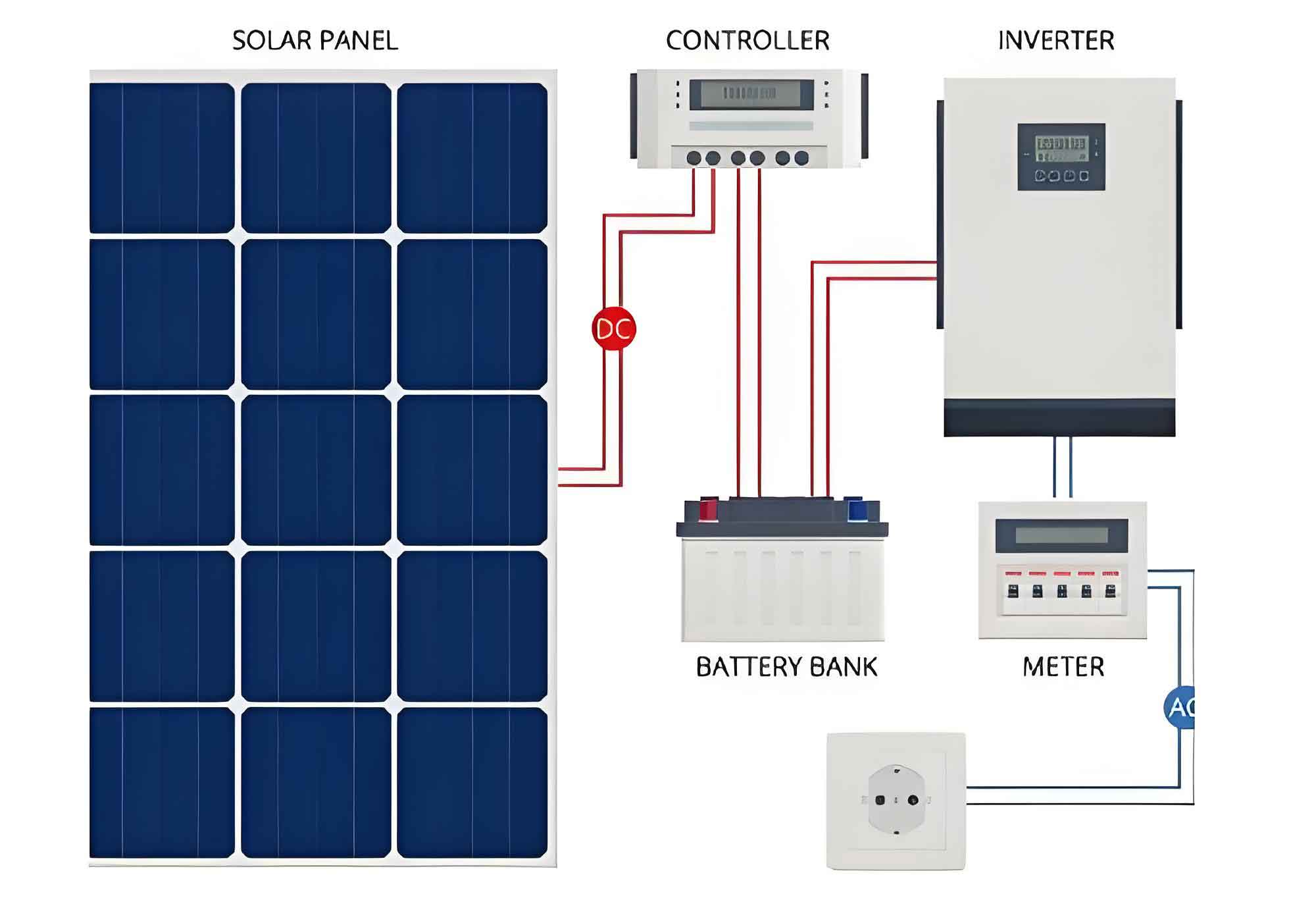
This study proposes a comprehensive solar energy utilization system for distributed households, integrating low-concentration photovoltaic (PV) power generation with thermal energy recovery. The system addresses the challenges of energy intermittency, seasonal variations, and cost-effectiveness through innovative optical design, thermal storage optimization, and novel grid-connection solutions. Key innovations include a specially designed cylindrical Fresnel lens for low-concentration PV, a dual-axis solar tracking mechanism, and a rotating three-phase solar inverter that significantly reduces electromagnetic pollution.
1. Optical System Design
The cylindrical Fresnel lens achieves 15.2× concentration with 95.4% relative efficiency, reducing silicon cell usage by 80% compared to conventional systems. The optical performance is quantified by:
$$ G_g = G \cdot \cos\alpha \cdot \cos\beta $$
where \( G_g \) represents effective irradiance on PV cells, and \( \alpha \), \( \beta \) denote solar azimuth and elevation angles. Material selection for lens fabrication was optimized through comparative analysis:
| Material | Transmittance (%) | Density (g/cm³) | Impact Resistance |
|---|---|---|---|
| Ultra-clear Glass | 92 | 2.5 | Low |
| Polycarbonate | 88 | 1.2 | High |
2. Thermal Management System
The thermal island storage system demonstrates 243 kWh/°C heat capacity, maintaining indoor temperatures through innovative ground-coupled heat exchange. The transient heat conduction equation governs thermal behavior:
$$ \frac{\partial u}{\partial t} = \frac{\kappa}{\rho\xi} \left( \frac{\partial^2 u}{\partial r^2} + \frac{1}{r}\frac{\partial u}{\partial r} \right) $$
where \( \kappa \), \( \rho \), and \( \xi \) represent soil thermal conductivity, density, and specific heat respectively. Field tests showed 42.8°C maximum storage temperature with 70% thermal efficiency.
3. Power Conversion and Grid Integration
The rotating three-phase solar inverter eliminates harmonic pollution through electromechanical conversion, achieving 98% sinusoidal purity. Key parameters are defined by:
$$ V_{\text{out}} = U \cdot K \cdot W \cdot K_e $$
where \( K \) represents voltage transformation ratio and \( K_e \) the winding coefficient. Comparative analysis reveals significant advantages over traditional PWM inverters:
| Parameter | Rotating Inverter | PWM Inverter |
|---|---|---|
| THD (%) | <2 | >15 |
| Cost (USD/kW) | 120 | 400 |
| Lifetime (years) | 15 | 8 |
4. Anti-Islanding Protection
The correlation function sampling method detects islanding conditions with 99.7% reliability, operating through:
$$ f_c(1,0) \times f_a = f_c(1,0)(f_c + f_n + f_d + f_w) $$
where \( f_c \) denotes injected test signal and \( f_a \) the composite feedback. This approach maintains grid power quality while achieving 10ms response time.
5. System Integration and Performance
The integrated PV-T system demonstrates 62% higher annual yield than fixed PV systems, with key performance metrics:
$$ P_{\text{total}} = 3 \cdot (1 \cdot 0.17 \cdot 0.954 \cdot 1.28) = 0.624\ \text{kW} $$
Field tests showed 1,585 kWh annual generation per 3.85 m² panel array, achieving 70°C domestic hot water supply with 83% thermal utilization efficiency.
Conclusion
This study presents a complete solution for distributed solar applications, combining optical innovation, thermal storage optimization, and advanced solar inverter technology. The rotating three-phase solar inverter particularly addresses critical challenges in grid compatibility and electromagnetic pollution, while the low-concentration design enables cost-effective deployment in rural areas. Future work will focus on large-scale field validation and automated control system development.