
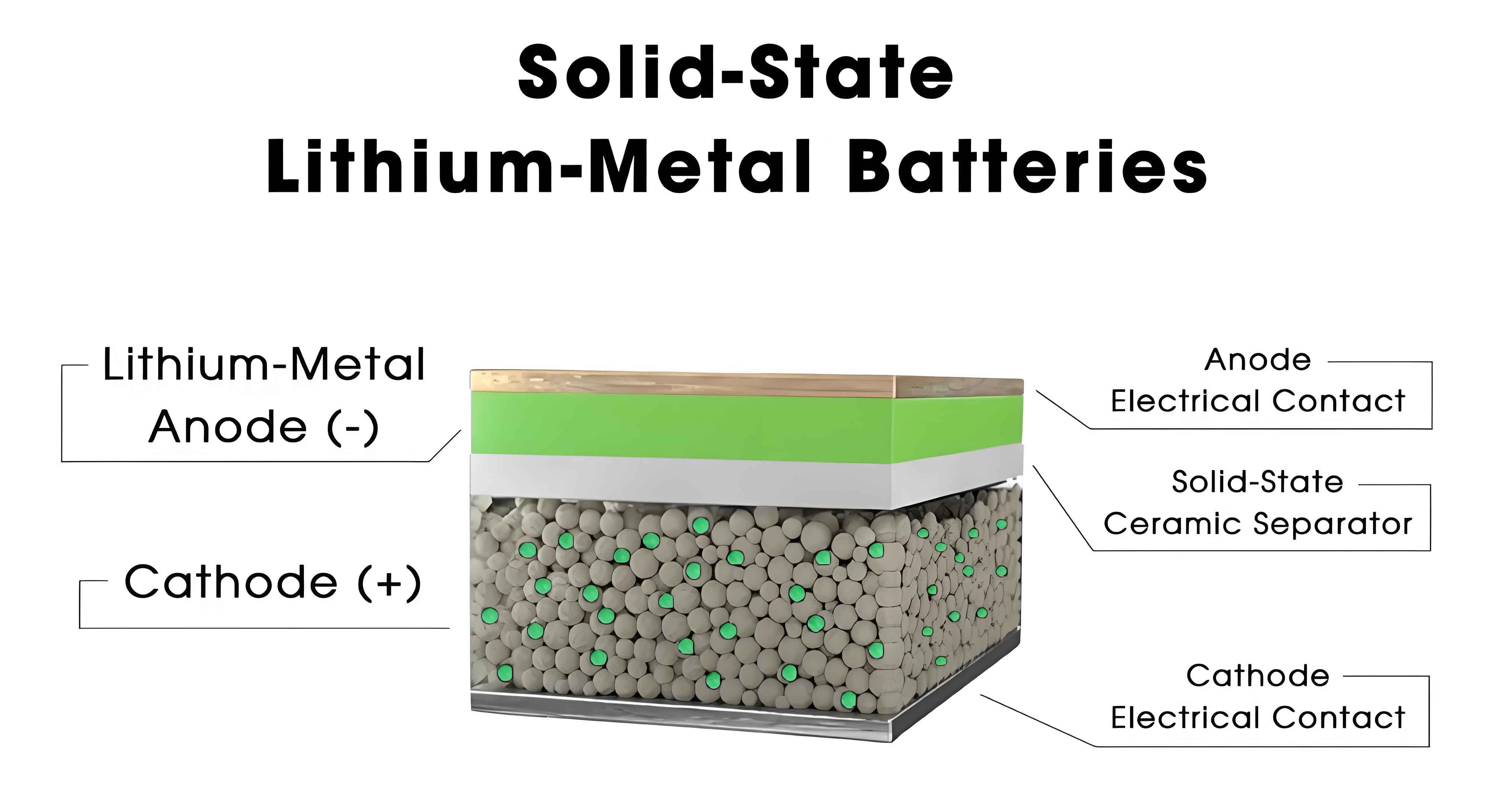
The development of solid-state batteries has emerged as a transformative solution for achieving high energy density and enhanced safety in energy storage systems. Among critical components, halide-based solid electrolytes have gained prominence due to their unique combination of high ionic conductivity, wide electrochemical stability, and compatibility with oxide cathodes. This work introduces a novel wet-chemistry synthesis route for Li3YCl3Br3 (LYCB), a dual-halide electrolyte, and systematically evaluates its structural, electrochemical, and interfacial properties for solid-state battery applications.
Synthesis and Structural Characterization
The LYCB electrolyte was synthesized via an ammonia-assisted wet-chemistry method using stoichiometric ratios of YCl3·6H2O, NH4Br, and LiBr. The precursor phase (NH4)3[YCl3Br3] was thermally decomposed at 450°C under argon to yield phase-pure LYCB. Structural refinement confirmed a monoclinic framework (space group C2/m) with lattice parameters:
$$
a = 6.809(3)\ \text{Å},\ b = 11.776(6)\ \text{Å},\ c = 6.7759(4)\ \text{Å},\ \beta = 108.79(5)^\circ
$$
The crystal structure features three distinct Li+ sites (4h, 4g, 8j), enabling low-energy migration pathways through octahedral-tetrahedral coordination vacancies. Table 1 summarizes key structural parameters derived from Rietveld refinement.
| Atom | Site | x | y | z | Occupancy |
|---|---|---|---|---|---|
| Li1 | 4h | 0 | 0.1637 | 0.5 | 0.973 |
| Y1 | 4g | 0 | 0.3414 | 0 | 0.261 |
| Cl1/Br1 | 8j | 0.2682 | 0.1633 | 0.2391 | 0.507/0.503 |
Ionic Transport Properties
LYCB demonstrated superior ionic conductivity (2.08 mS cm−1 at 25°C) compared to Li3YCl6 (LYC, 0.84 mS cm−1) and Li3YBr6 (LYB, 1.52 mS cm−1). The Arrhenius relationship:
$$
\sigma T = A \exp\left(-\frac{E_a}{k_B T}\right)
$$
yielded an activation energy (Ea) of 0.379 eV for LYCB, significantly lower than LYC (0.498 eV). This enhancement arises from halogen mixing effects, which broaden Li+ diffusion channels while maintaining structural stability.
Electrochemical Performance in Solid-State Batteries
All-solid-state lithium batteries (ASSLBs) employing LiNi0.83Co0.11Mn0.06O2 (NCM811) cathodes and LYCB electrolytes exhibited exceptional cycling stability:
$$
\text{Capacity retention} = 93\%\ \text{after 200 cycles at 0.3 C}\ (1\ \text{C} = 170\ \text{mA g}^{-1})
$$
Rate capability tests revealed 115 mAh g−1 at 2 C, outperforming LYB (58 mAh g−1) and LYC (38 mAh g−1). The enhanced performance stems from LYCB’s wide electrochemical window (3.8 V vs. Li+/Li) and stable cathode-electrolyte interface (CEI).
Interfacial Stabilization Mechanism
Operando XPS and TEM analyses identified an in situ-formed Y2O3 layer at the NCM811/LYCB interface during cycling. This inert phase suppresses oxygen loss from NCM811 while facilitating Li+ transport, as described by:
$$
\text{Li}_3\text{YCl}_3\text{Br}_3 + \text{O}_{\text{lattice}} \rightarrow \text{Y}_2\text{O}_3 + \text{LiCl} + \text{LiBr} + \text{Cl}_2/\text{Br}_2 \uparrow
$$
The Y2O3 layer (thickness ≈ 5 nm) effectively passivates the cathode surface, reducing interfacial resistance growth from 48 Ω cm2 (pristine) to 62 Ω cm2 after 200 cycles.
Comparative Analysis of Synthesis Routes
The wet-chemistry method offers distinct advantages over conventional ball milling (Table 2). Scalability and reduced processing time make it commercially viable for solid-state battery production.
| Parameter | Wet-Chemistry | Ball Milling |
|---|---|---|
| Processing Time | 24 h | 10 h + Annealing |
| Particle Size | 200-500 nm | 50-200 nm |
| Ionic Conductivity | 2.08 mS cm−1 | 1.12 mS cm−1 |
| Cost Efficiency | High | Medium |
Conclusion
This work establishes Li3YCl3Br3 as a premier halide electrolyte for solid-state batteries, combining scalable synthesis with exceptional electrochemical performance. The in situ interfacial engineering mechanism provides fundamental insights for designing stable high-voltage ASSLBs. Future efforts will focus on optimizing halogen ratios and exploring multi-metal doping to further enhance ionic transport while maintaining cost-effectiveness for industrial adoption.