
As global automakers accelerate their transition to electrification, solid-state battery technology emerges as the holy grail for next-generation energy storage. Unlike conventional lithium-ion batteries that use liquid electrolytes, solid-state batteries employ solid electrolytes, offering transformative advantages in safety and performance. The evolution can be quantified through key metrics:
| Parameter | Lithium-ion Battery | Solid-State Battery |
|---|---|---|
| Energy Density (Wh/L) | 500-700 | 900-1,500 |
| Cycle Life | 1,000-2,000 | 5,000+ |
| Charging Time (0-80%) | 30-60 min | 5-10 min |
| Thermal Runaway Risk | High | Negligible |
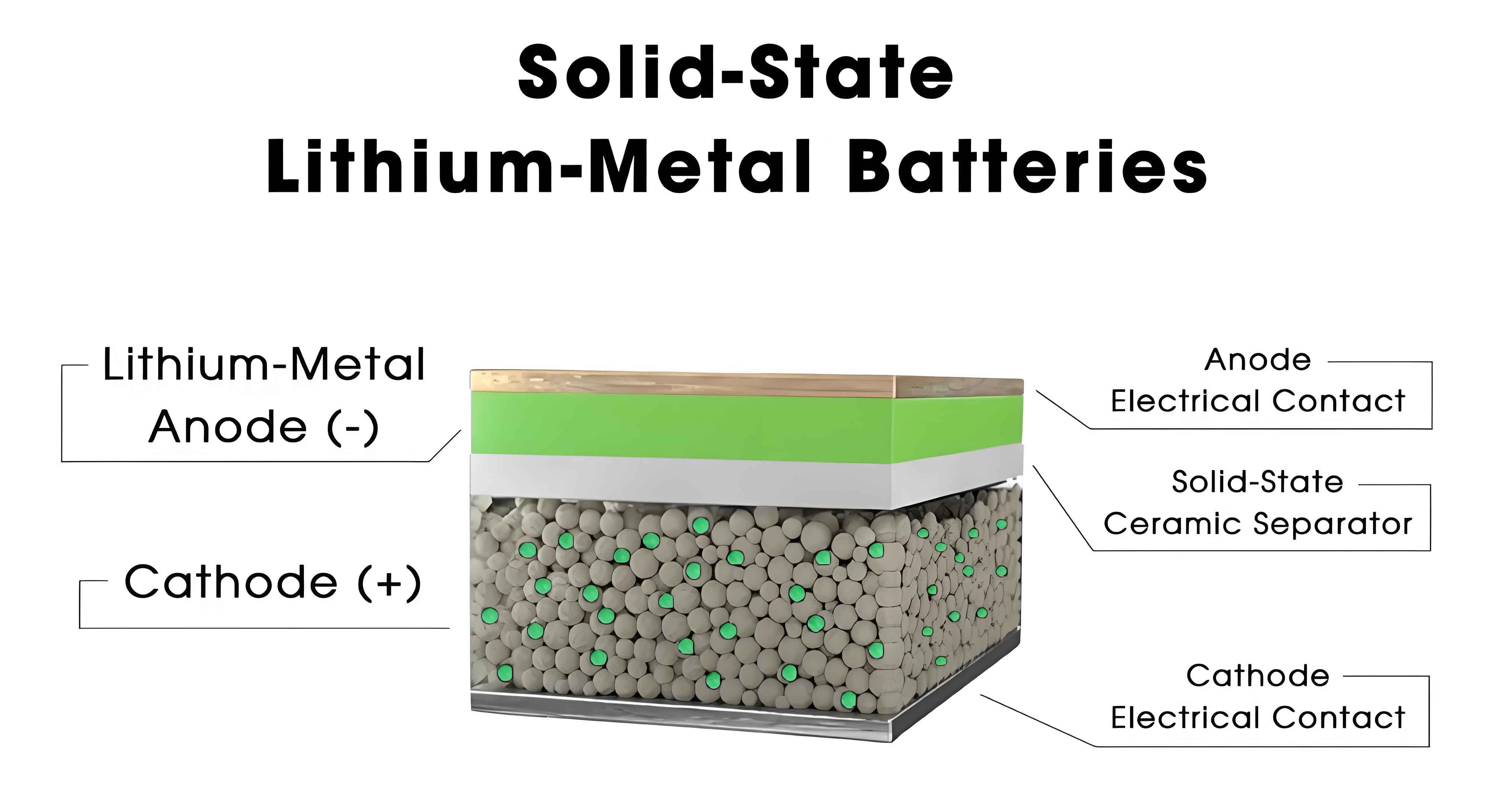
The fundamental superiority of solid-state batteries stems from their electrochemical stability. The ionic conductivity ($\sigma$) of solid electrolytes follows the Arrhenius equation:
$$ \sigma = \sigma_0 e^{-\frac{E_a}{RT}} $$
where $E_a$ represents activation energy, $R$ the gas constant, and $T$ absolute temperature. Advanced sulfide-based electrolytes now achieve $\sigma > 25$ mS/cm at room temperature, comparable to liquid electrolytes.
Technological Race: Global Landscape
China’s rapid progress in solid-state battery development is evidenced by patent statistics:
| Region | 2023 Patents | 2024 Patents | Growth Rate |
|---|---|---|---|
| China | 1,852 | 5,796 | 213% |
| Japan | 2,137 | 1,932 | -9.6% |
| USA | 896 | 1,245 | 39% |
This explosive growth aligns with China’s strategic roadmap:
- 2024: Prototype validation
- 2025-2026: Pilot production
- 2027: Initial commercialization
- 2030: Mass adoption
Performance Projections
The energy density ($E_d$) of solid-state batteries scales with cathode material selection:
$$ E_d = \frac{zF}{3.6M} \times V $$
Where $z$ is charge number, $F$ Faraday constant, $M$ molecular weight, and $V$ voltage. Using lithium-metal anodes and nickel-rich cathodes, theoretical limits reach:
$$ E_d^{\text{max}} \approx 1,700\ \text{Wh/L} $$
Current development stages show:
| Generation | Energy Density (Wh/kg) | Cycle Life | Cost ($/kWh) |
|---|---|---|---|
| Gen 1 (2027) | 450 | 800 | 150 |
| Gen 2 (2030) | 600 | 1,500 | 90 |
| Gen 3 (2035) | 900 | 3,000 | 50 |
Consumer Dilemma: To Wait or Not?
The technological progression follows Moore’s Law-like acceleration:
$$ \frac{dP}{dt} = kP^n $$
Where $P$ represents battery performance parameters and $k$ the innovation rate. For early adopters, the optimal purchase timing ($t_{opt}$) balances immediate needs against future improvements:
$$ t_{opt} = \frac{1}{\lambda} \ln\left(\frac{\alpha}{\beta}\right) $$
Here, $\lambda$ is the performance improvement rate, $\alpha$ the utility of current technology, and $\beta$ the opportunity cost of waiting.
Manufacturing Challenges
Despite promising lab results, solid-state battery production faces yield challenges. The defect density ($D$) in solid electrolyte layers correlates with pressure ($P$) during manufacturing:
$$ D = D_0 e^{-kP} $$
Current production yields remain below 60% for multi-layer designs, compared to >90% for lithium-ion cells. Breakthroughs in atmospheric control and interface engineering are critical for scalable manufacturing.
As battery architectures evolve, the vehicle electrification revolution enters its most dynamic phase. With solid-state batteries approaching commercialization, the automotive industry stands at the threshold of redefining energy storage paradigms – promising safer, faster-charging, and longer-range electric vehicles that could ultimately surpass internal combustion engines in every performance metric.