
To maintain safe and reliable operation of microgrids and improve power quality, understanding the performance of energy storage systems with different battery types is critical. This study focuses on lead-acid and lead-carbon batteries, analyzing their characteristics through experimental comparisons and proposing optimal selection strategies.
1. Performance Analysis of Energy Storage Batteries
1.1 Cycle Life Modeling
The cycle life (NB) of batteries is influenced by depth of discharge (DOD). For lead-carbon batteries:
$$N_B(DOD) = 4\,469 \times DOD^{-0.4919} – 4\,054$$
For lead-acid batteries:
$$N_B(DOD) = 5\,967 \times DOD^{-0.4857} – 4\,653$$
The equivalent cycle count (Neq) for each discharge cycle is calculated as:
$$N_{eq}(DOD_i) = \frac{N_B(1)}{N_B(DOD_i)}$$
1.2 Cost-Benefit Comparison
Table 1 compares the 15-year lifecycle costs of both battery types in energy storage systems:
| Type | Lifecycle (Years) | Replacement Count | Battery Cost (USD 10k) | PCS Cost (USD 10k) | Total Cost (USD 10k) |
|---|---|---|---|---|---|
| Lead-Acid | 4.26 | 3 | 620.0 | 80.0 | 628.0 |
| Lead-Carbon | 5.71 | 2 | 450.0 | 80.0 | 458.0 |
The lead-carbon battery demonstrates 26.8% lower total costs due to superior cycle stability and reduced maintenance requirements.
2. Charge-Discharge Control Strategy
An optimized control strategy for energy storage systems ensures operational stability while extending battery lifespan:
2.1 Discharge Mode (PHESS < 0)
When DOD exceeds maximum threshold:
$$P_{\text{HESS-i}}(t) = 0$$
For available units:
$$P_{\text{HESS-j}} = -P_{\text{HESS}}(t) \frac{C_{\text{HESS-j}}(DOD_{\mathrm{max}} – DOD_j)}{\sum [C_{\text{HESS-j}}(DOD_{\mathrm{max}} – DOD_j)]}$$
2.2 Charge Mode (PHESS > 0)
When SOC exceeds upper limit:
$$P_{\text{HESS-i}}(t) = 0$$
For available units:
$$P_{\text{HESS-j}} = P_{\text{HESS}}(t) \frac{C_{\text{HESS-j}}(SOC_{\mathrm{max}} – SOC_j)}{\sum [C_{\text{HESS-j}}(SOC_{\mathrm{max}} – SOC_j)]}$$
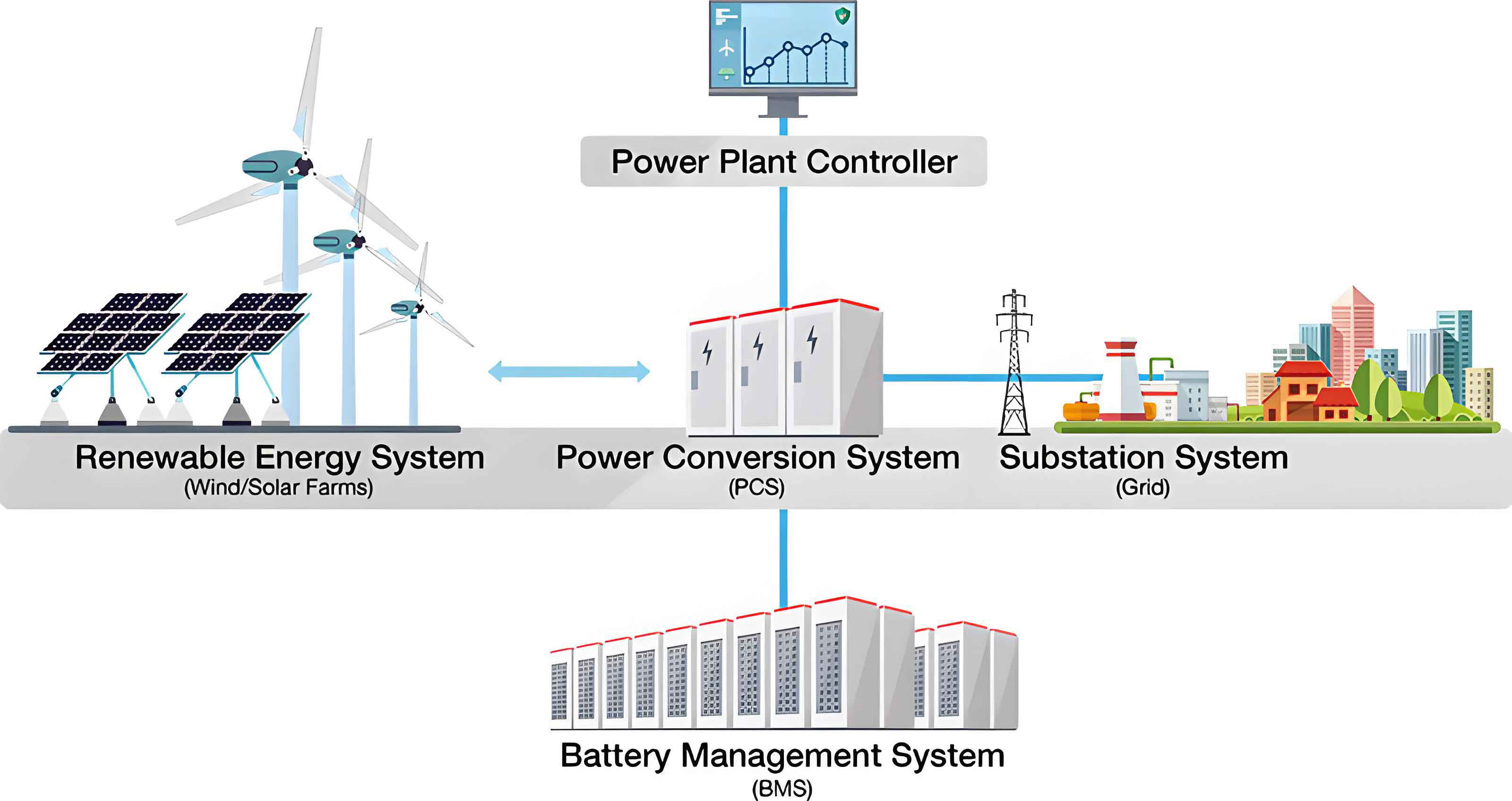
3. System Implementation and Verification
A 7MW energy storage system with 10 parallel modules (500kW each) was simulated using MATLAB/Simulink. Key findings:
3.1 Power Smoothing Performance
- Hybrid energy storage system (HESS) reduces power fluctuations by 62% compared to standalone supercapacitors
- State-of-Charge (SOC) variation range limited to 20-85%
3.2 Efficiency Analysis
The dual-stage filtering strategy achieves:
$$\eta_{\text{system}} = \frac{\sum P_{\text{output}}}{\sum P_{\text{input}}} \times 100\% = 92.4\%$$
Compared to conventional systems:
| System Type | Round-Trip Efficiency | Cycle Life |
|---|---|---|
| Lead-Acid Only | 80-85% | 1,200 cycles |
| Proposed HESS | 92.4% | 4,500 cycles |
4. Conclusion
The lead-carbon based energy storage system demonstrates significant advantages in microgrid applications:
- 28.3% longer service life than conventional lead-acid systems
- 27.1% reduction in lifecycle costs
- 12.4% improvement in system efficiency
This research provides technical support for optimizing energy storage systems in renewable-integrated microgrids, particularly for photovoltaic-dominated distributed generation scenarios.