
With the growing emphasis on carbon neutrality and the transition to renewable energy systems, integrating advanced energy storage technologies into distributed energy networks has become critical. This study proposes a novel hybrid energy storage system that synergizes biomass anaerobic digestion with solar thermal-coupled compressed air energy storage (CAES). The system enhances multi-energy complementarity while addressing operational challenges such as intermittent renewable generation and thermal energy utilization inefficiencies.
System Architecture and Energy Flow
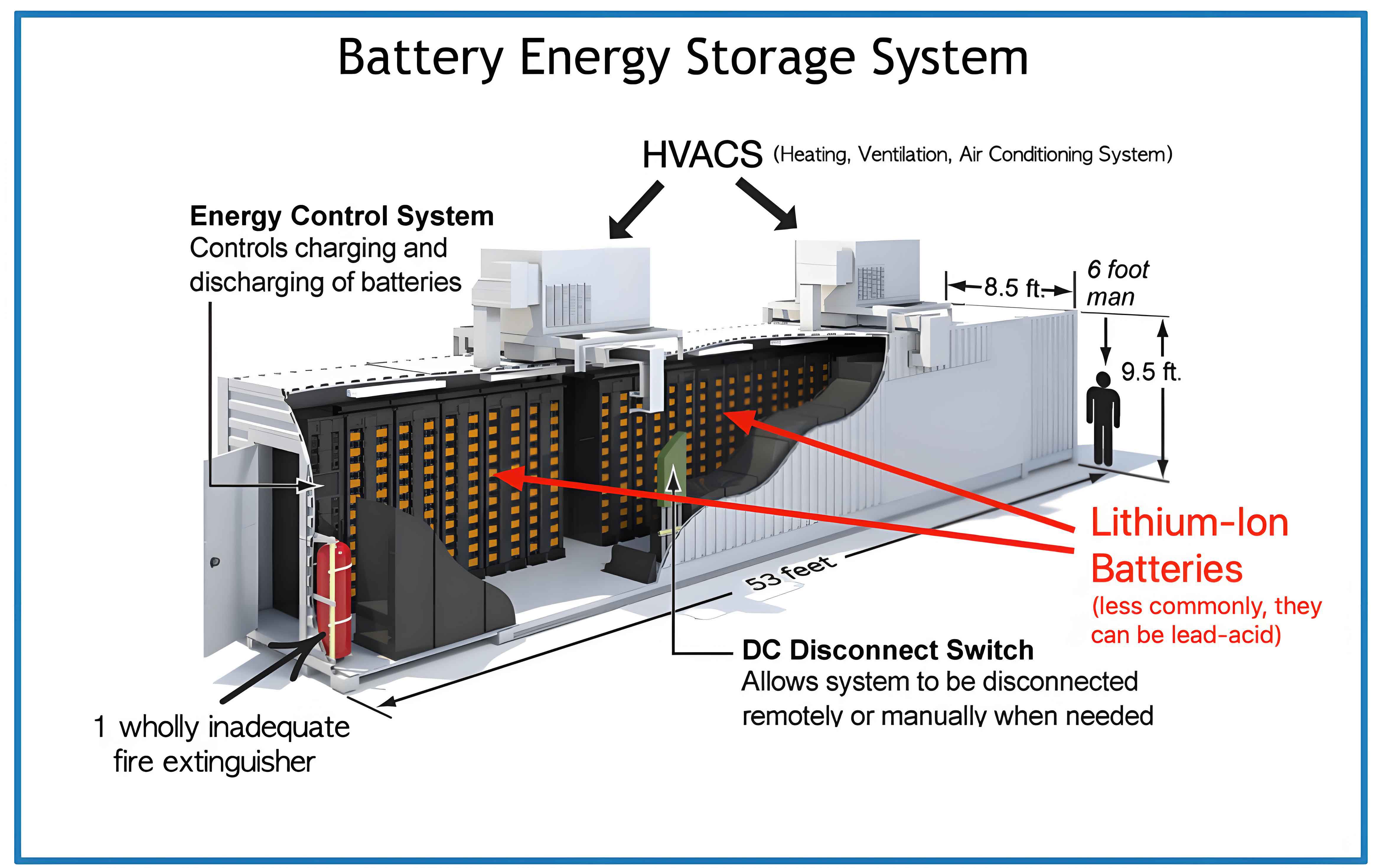
The integrated energy system (IES) comprises four energy carriers: electricity, heat, cooling, and biogas. Key components include:
- Renewable sources: Photovoltaic (PV), wind turbines, and solar thermal collectors
- Storage units: CAES with multi-stage compression/expansion and inter-stage heat recovery
- Biomass conversion: Anaerobic digester for biogas production
- Demand-side management: Price-elastic demand response (DR) mechanisms
Mathematical Modeling
1. Compressed Air Energy Storage System
The CAES operational model follows thermodynamic principles. The compressor power during charging is expressed as:
$$P_{\text{CAES,C},t} = \sum_{k=1}^{n} \frac{\gamma}{\gamma – 1} \cdot \frac{m_{c,t} R_g T_{\text{in},k}}{\eta_c} \left( \beta_{k,c}^{\frac{\gamma-1}{\gamma}} – 1 \right)$$
where $m_{c,t}$ is air mass flow rate, $\beta_{k,c}$ the compression ratio, and $\eta_c$ the isentropic efficiency.
2. Biogas Production and Utilization
Biogas generation through anaerobic digestion is modeled as:
$$Q_{\text{biogas}} = \eta_{\text{digester}} \cdot m_{\text{substrate}} \cdot \text{TS} \cdot \text{VS}$$
The CHP unit converts biogas to electricity and heat with efficiency factors:
$$P_{\text{CHP}} = \eta_{\text{elec}} \cdot Q_{\text{biogas}}$$
$$H_{\text{CHP}} = \eta_{\text{thermal}} \cdot Q_{\text{biogas}}$$
3. Carbon Trading Mechanism
A tiered carbon pricing model is implemented:
$$C_{\text{carbon}} =
\begin{cases}
\lambda_1 E_{\text{excess}}, & 0 \leq E_{\text{excess}} \leq h_1 \\
\lambda_2 E_{\text{excess}}, & h_1 < E_{\text{excess}} \leq h_2 \\
\lambda_3 E_{\text{excess}}, & E_{\text{excess}} > h_2
\end{cases}$$
where $E_{\text{excess}}$ represents emissions exceeding allocated quotas.
Optimization Framework
The multi-objective optimization model minimizes total operational costs while satisfying energy balances:
$$\min \left( C_{\text{grid}} + C_{\text{fuel}} + C_{\text{OM}} + C_{\text{carbon}} \right)$$
Subject to:
| Constraint Type | Mathematical Formulation |
|---|---|
| Power Balance | $P_{\text{PV}} + P_{\text{wind}} + P_{\text{CAES}} + P_{\text{grid}} = P_{\text{load}} – P_{\text{DR}}$ |
| Thermal Storage | $Q_{\text{storage},t+1} = Q_{\text{storage},t} + \eta_{\text{charge}} Q_{\text{in}} – \frac{Q_{\text{out}}}{\eta_{\text{discharge}}}$ |
| Demand Response | $\Delta P_{\text{DR}} = \sum_{t=1}^{24} \epsilon_{tt} \cdot \frac{\Delta c_t}{c_t} \cdot P_{\text{base},t}$ |
Case Study and Results
A rural community in Qinghai Province was analyzed under four operational scenarios:
| Scenario | Configuration | Total Cost ($) | CO₂ Emissions (kg) |
|---|---|---|---|
| 1 | Base CAES | 9,281 | 9,035 |
| 2 | CAES + Biomass | 8,900 | 8,254 |
| 3 | Scenario 2 + DR | 8,581 | 7,923 |
| 4 | Scenario 3 + Carbon Trading | 7,916 | 7,112 |
Key findings demonstrate:
- 12.4% reduction in total costs for the optimized energy storage system
- 11.3% decrease in carbon emissions through market-based mechanisms
- Peak-valley load differences reduced by 7.9–10.9% via demand response
Conclusion
The proposed hybrid energy storage system effectively addresses the intermittency of renewable generation while improving economic and environmental performance. The integration of biogas production with CAES enhances thermal energy utilization, achieving 77.3% total system efficiency. Future work will investigate dynamic operational characteristics of CAES under variable renewable penetration scenarios.
$$E_{\text{system}} = \frac{\sum (P_{\text{out}})}{\sum (P_{\text{in}} + Q_{\text{fuel}})} \times 100\%$$
This equation quantifies the overall energy efficiency of the integrated system, considering both electrical and thermal energy flows.