
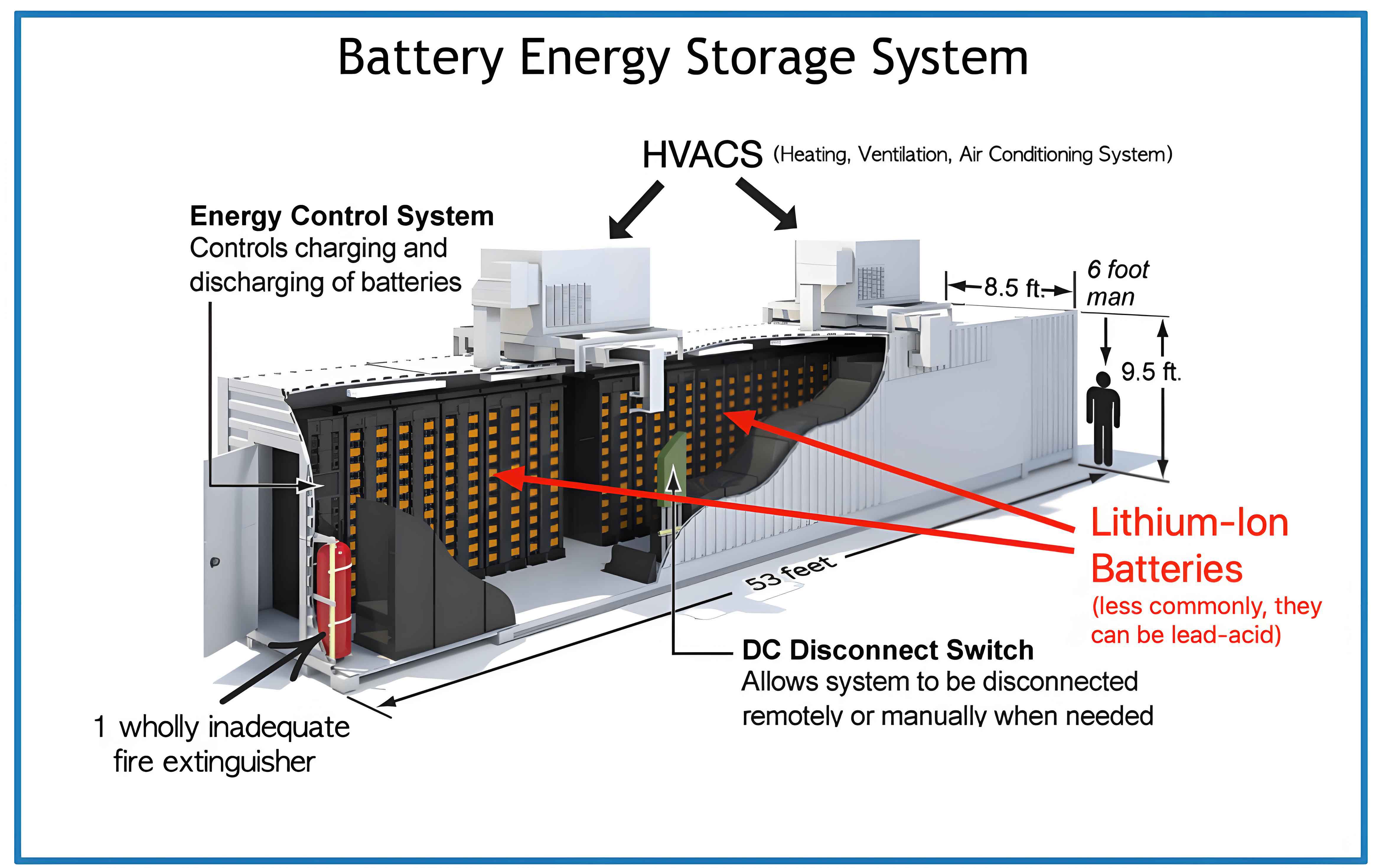
With the rapid integration of renewable energy sources, power grids face increasing challenges in frequency stability. Energy storage systems (ESS), particularly battery energy storage systems (BESS), have emerged as critical solutions for grid frequency regulation due to their fast response and precise control capabilities. This article systematically explores control strategies for BESS in primary and secondary frequency modulation, supported by policy analysis, mathematical models, and operational constraints.
1. Primary Frequency Regulation with Energy Storage Systems
Primary frequency regulation relies on the droop characteristics of generators and load-frequency responses. BESS enhances this process through virtual droop control and virtual inertia control. The dynamic models for these strategies are expressed as:
Virtual Droop Control:
$$ \Delta P_{droop} = -K_E \cdot \Delta f $$
where \( K_E \) represents the energy storage system’s virtual droop coefficient.
Virtual Inertia Control:
$$ \Delta P_{inertia} = -M_E \cdot \frac{d\Delta f}{dt} $$
where \( M_E \) denotes the virtual inertia constant of the energy storage system.
A comparative analysis of these strategies is summarized in Table 1.
| Parameter | Virtual Droop | Virtual Inertia |
|---|---|---|
| Response Speed | Steady-state focus | Transient-state focus |
| Frequency Deviation | Δf reduction: 40-60% | dΔf/dt reduction: 50-70% |
| ESS Capacity Utilization | High (80-90%) | Moderate (60-75%) |
The State of Charge (SOC) management for energy storage systems during primary regulation follows a segmented strategy:
$$ K_c = K_{max} \cdot \left(\frac{S – S_1}{S_2 – S_1}\right)^n \quad \text{(Charging)} $$
$$ K_d = K_{max} \cdot \left(\frac{S_3 – S}{S_4 – S_3}\right)^n \quad \text{(Discharging)} $$
where \( S \) represents SOC, and \( n \) determines the nonlinear adjustment intensity.
2. Secondary Frequency Regulation Strategies
For secondary frequency regulation, energy storage systems collaborate with Automatic Generation Control (AGC) through Area Control Error (ACE) signal tracking. The power allocation strategy considers multiple constraints:
| Operating Zone | Control Strategy | ESS Participation |
|---|---|---|
| Emergency Zone (|ACE| > 0.1 Hz) |
Maximize ESS power output | 70-100% capacity |
| Normal Zone (0.05 Hz < |ACE| ≤ 0.1 Hz) |
Hybrid ESS-generator coordination | 30-70% capacity |
| Dead Zone (|ACE| ≤ 0.05 Hz) |
SOC recovery mode | 0-10% capacity |
The optimal power distribution between energy storage systems and traditional generators follows:
$$ P_{ESS} = \delta \cdot (P_{AGC} – P_G) $$
Subject to constraints:
$$ -P_{c}^{max} \leq \delta \cdot (P_{AGC} – P_G) \leq P_{d}^{max} $$
$$ SOC_{min} \leq SOC(t) – \frac{\int P_{ESS} dt}{E_{rated}} \leq SOC_{max} $$
3. Multi-Objective Optimization Framework
A dual-layer optimization model coordinates frequency regulation performance and energy storage system longevity:
Objective Functions:
$$ \text{Maximize } f_1 = \alpha_1 \cdot RTE + \alpha_2 \cdot KPI_{reg} + \alpha_3 \cdot SOC_{balance} $$
$$ \text{Minimize } f_2 = \beta_1 \cdot \Delta DOD + \beta_2 \cdot T_{degrade} $$
where \( RTE \) represents regulation tracking efficiency, and \( KPI_{reg} \) denotes grid operator performance metrics.
4. Operational Challenges and Solutions
Critical challenges in energy storage system deployment include:
- Battery aging: Cycle life decreases by 0.05-0.2% per deep discharge cycle
- Capacity fade: Typical annual degradation of 2-5% for lithium-ion systems
- Economic viability: Requires ≥500 cycles/year at $0.15/kWh to achieve 7-year payback
Advanced solutions incorporate adaptive control algorithms:
$$ \delta(t) = \frac{1}{1 + e^{-k(SOC(t) – SOC_{opt})}} $$
This sigmoid-based participation factor dynamically adjusts energy storage system involvement based on real-time SOC.
5. Future Research Directions
Emerging trends in energy storage system applications include:
- Blockchain-based frequency regulation markets
- Hybrid ESS configurations (e.g., Li-ion + supercapacitors)
- AI-driven predictive maintenance frameworks
The energy storage system’s role in future grids will expand through improved control strategies and market mechanisms, particularly as renewable penetration exceeds 40% in major power systems.