
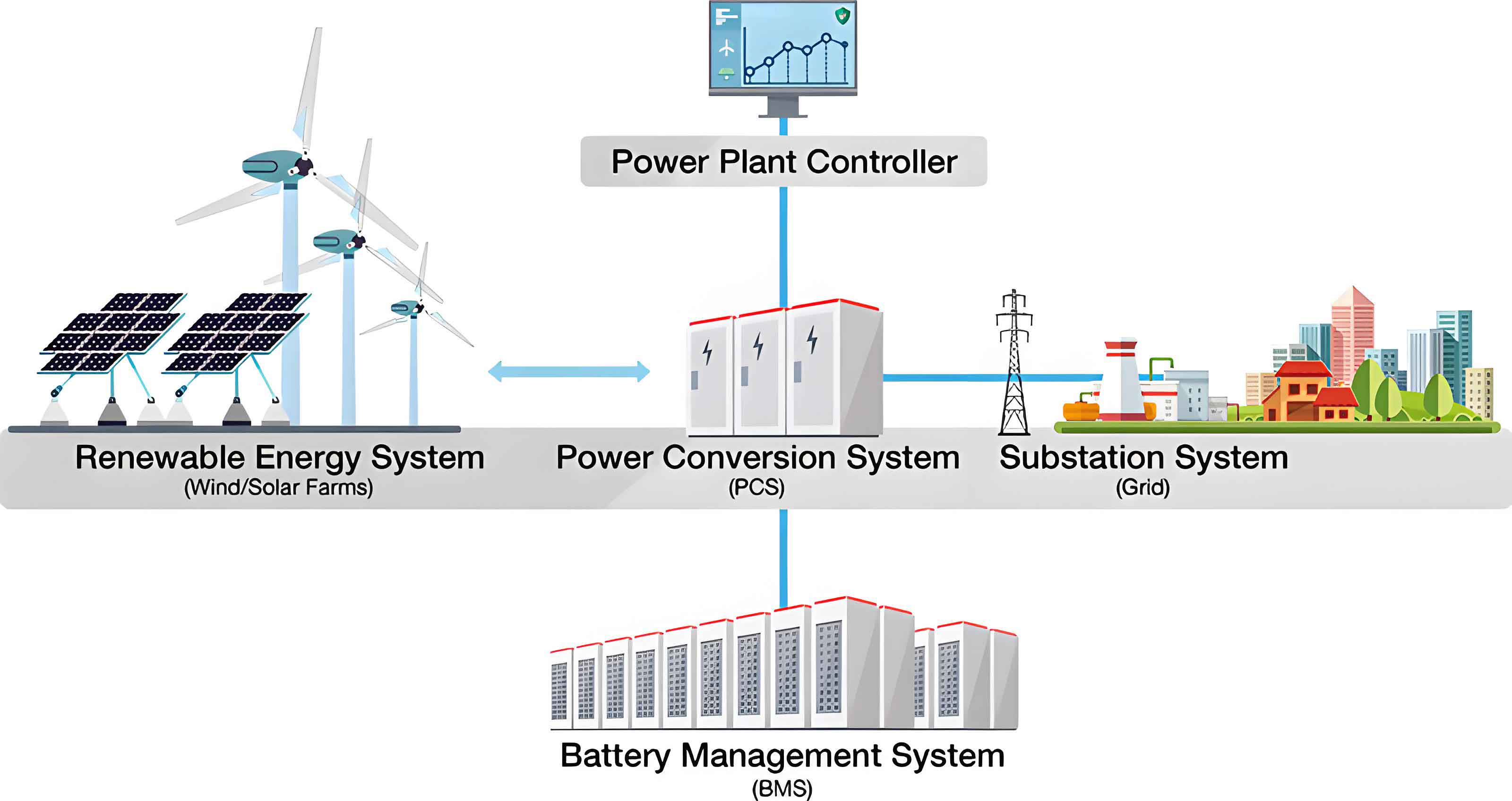
The evolution of next-generation power systems demands unprecedented integration of energy storage systems (ESS) to achieve decarbonization, security, flexibility, and intelligence. As renewable energy penetration exceeds 30% in many regions, ESS has become the backbone for stabilizing grid operations, mitigating intermittency, and enabling bidirectional energy flow. This article systematically explores cutting-edge methodologies, technological innovations, and implementation frameworks for ESS in modern power networks.
1. Intelligent Architecture of Energy Storage Systems
Modern energy storage systems require digital-physical fusion architecture to address the “Two Guarantees and One Promotion” objectives (ensuring continuous power supply, grid stability, and renewable accommodation). A three-layer intelligence framework emerges:
| Layer | Function | Key Technologies |
|---|---|---|
| Physical | Energy conversion | Li-ion batteries, flow batteries, supercapacitors |
| Cyber | Data processing | Digital twins, IoT sensors, blockchain |
| Decision | Optimal control | Reinforcement learning, MPC, swarm intelligence |
The state-space representation of an intelligent ESS can be expressed as:
$$
\begin{aligned}
\dot{x}(t) &= A x(t) + B u(t) + D w(t) \\
y(t) &= C x(t)
\end{aligned}
$$
Where \( x(t) \) represents state variables (SOC, SOH, temperature), \( u(t) \) denotes control inputs, and \( w(t) \) captures renewable generation uncertainties.
2. Multi-Timescale Coordination Framework
Energy storage systems must operate across temporal dimensions:
| Timescale | Control Objective | Algorithm |
|---|---|---|
| Millisecond | Frequency regulation | Virtual synchronous control |
| Minute | Peak shaving | Model predictive control |
| Hour | Energy arbitrage | Stochastic optimization |
| Day | Capacity planning | Markov decision processes |
The multi-objective optimization model for ESS scheduling is formulated as:
$$
\min \sum_{t=1}^{T} \left[ \alpha C_{op}(t) + \beta D_{deg}(t) + \gamma \Delta P_{grid}(t) \right]
$$
Subject to:
$$
\begin{align*}
SOC_{min} &\leq SOC(t) \leq SOC_{max} \\
P_{ESS}^{dis} &\leq \eta_{dis} \cdot P_{rated} \\
P_{ESS}^{ch} &\leq \eta_{ch} \cdot P_{rated} \\
SOC(T) &= SOC_{initial}
\end{align*}
$$
3. Safety and Reliability Enhancement
Advanced battery management systems (BMS) integrate three-dimensional state estimation:
$$
SOH(t) = SOH_0 – k \int_{0}^{t} \frac{I(\tau)}{Q_{rated}} d\tau \cdot e^{\frac{E_a}{R} \left( \frac{1}{T_{ref}} – \frac{1}{T(\tau)} \right)}
$$
Where \( k \) represents aging coefficients and \( E_a \) denotes activation energy. A novel safety index \( \Psi \) is proposed:
$$
\Psi(t) = \omega_1 \cdot \left(1 – SOH(t)\right) + \omega_2 \cdot \left|\frac{dSOC}{dt}\right| + \omega_3 \cdot T_{dev}(t)
$$
4. Cyber-Physical System Integration
The digital twin architecture for energy storage systems comprises:
| Component | Function | Data Source |
|---|---|---|
| Physical ESS | Energy storage/release | BMS, PCS, SCADA |
| Virtual ESS | Performance prediction | AI models, historical data |
| Control Center | Decision optimization | MPC, RL algorithms |
The information-energy coupling relationship follows:
$$
E_{loss} = \int_{0}^{T} \left[ \lambda_1 \cdot \| \hat{P}_{ESS}(t) – P_{ESS}(t) \|^2 + \lambda_2 \cdot \| \nabla SOC(t) \|^2 \right] dt
$$
5. Market Participation Mechanisms
Energy storage systems enable value stacking through multiple revenue streams:
| Service Type | Response Time | Revenue Model |
|---|---|---|
| Frequency regulation | 2-4 seconds | Capacity + performance payments |
| Voltage support | 5-15 minutes | Ancillary service market |
| Energy shifting | Hourly | Price arbitrage |
| Capacity deferral | Yearly | Avoided network costs |
The optimal bidding strategy maximizes total revenue:
$$
\max \sum_{m=1}^{M} \left[ \pi_m^{FR} \cdot C_{FR}^m + \pi_m^{DA} \cdot (P_{dis}^m – P_{ch}^m) \cdot \Delta t \right]
$$
Subject to:
$$
\begin{align*}
\sum_{m=1}^{M} (P_{ch}^m – P_{dis}^m) \cdot \Delta t &= 0 \\
SOC^{min} &\leq SOC_0 + \sum_{i=1}^{m} \frac{\eta_{ch}P_{ch}^i – P_{dis}^i/\eta_{dis}}{E_{rated}} \leq SOC^{max}
\end{align*}
$$
6. Future Development Pathways
The evolutionary trajectory of energy storage systems will focus on:
| Direction | Technical Challenge | Innovation Opportunity |
|---|---|---|
| Giga-scale ESS | Thermal runaway prevention | Solid-state battery integration |
| Hybrid ESS | Multi-physics coupling | Li-ion + flow battery hybrids |
| AI-driven ESS | Data quality assurance | Federated learning frameworks |
| Mobile ESS | Grid interconnection standards | Vehicle-to-grid (V2G) systems |
The ultimate performance metric for next-generation energy storage systems combines technical and economic factors:
$$
\Gamma = \frac{\sum_{i=1}^{N} (E_{throughput}^i \cdot LCOE^i)}{\sum_{j=1}^{M} (R_{ancillary}^j + R_{energy}^j)} \cdot \left(1 – \frac{T_{downtime}}{T_{total}}\right)
$$
As power systems transition toward 100% renewable penetration, energy storage systems will evolve into intelligent energy routers—mediating between generation and consumption, balancing stability and efficiency, while enabling new market paradigms. The integration of physics-informed machine learning with grid-forming converters will ultimately create self-organizing storage networks that autonomously maintain grid integrity while maximizing socioeconomic benefits.