
1. Introduction
The rapid integration of photovoltaic (PV) systems into modern power grids has highlighted the critical role of Maximum Power Point Tracking (MPPT) control in optimizing energy extraction. However, MPPT algorithms, particularly perturbation-based methods, introduce interharmonics into the DC-side voltage, which can propagate to the AC grid and trigger forced low-frequency oscillations. These oscillations threaten grid stability, especially in systems with high penetration of power electronic converters. While existing studies focus on the relationship between disturbance frequencies and weak damping modes, the impact of converter control characteristics, such as Virtual Synchronous Generator (VSG) dynamics, on exacerbating oscillations remains underexplored. This paper addresses this gap by developing a frequency-domain closed-loop transfer function model to analyze how MPPT-induced interharmonics interact with VSG control parameters, ultimately amplifying forced oscillations.
2. MPPT-Induced Interharmonics and Forced Oscillations
2.1 Mechanism of Interharmonic Generation
MPPT algorithms, such as the Perturb and Observe (P&O) method, adjust the DC voltage reference Vdc,refVdc,ref to track the maximum power point. This process introduces periodic voltage perturbations, generating interharmonics in the DC-link voltage. The time-domain expression for Vdc,refVdc,ref under P&O control is:Vdc,ref(t)={Vdc0≤t<TMPPTVdc+ΔUTMPPT≤t<2TMPPTVdc2TMPPT≤t<3TMPPTVdc−ΔU3TMPPT≤t<4TMPPTVdc,ref(t)=⎩⎨⎧VdcVdc+ΔUVdcVdc−ΔU0≤t<TMPPTTMPPT≤t<2TMPPT2TMPPT≤t<3TMPPT3TMPPT≤t<4TMPPT
where TMPPT=1/fMPPTTMPPT=1/fMPPT is the sampling period, and ΔUΔU is the perturbation step. The Fourier series expansion of Vdc,ref(t)Vdc,ref(t) reveals dominant interharmonic frequencies at:fn=(2k−1)fMPPT4,k=1,2,3,…fn=4(2k−1)fMPPT,k=1,2,3,…
These interharmonics propagate to the AC side through the inverter, acting as disturbance sources for forced oscillations.
2.2 Forced Oscillation Conditions
Forced oscillations occur when three conditions are met:
- Frequency Proximity: The disturbance frequency fdfd aligns with the system’s natural frequency fnfn.
- Low Damping: The system exhibits weak damping (ξ<0.1ξ<0.1).
- Sufficient Disturbance Magnitude: The interharmonic amplitude exceeds a critical threshold.
MPPT-generated interharmonics often satisfy these conditions in single-stage PV systems, where the DC/AC inverter simultaneously manages MPPT and grid synchronization.
3. Closed-Loop Transfer Function Model
3.1 System Configuration
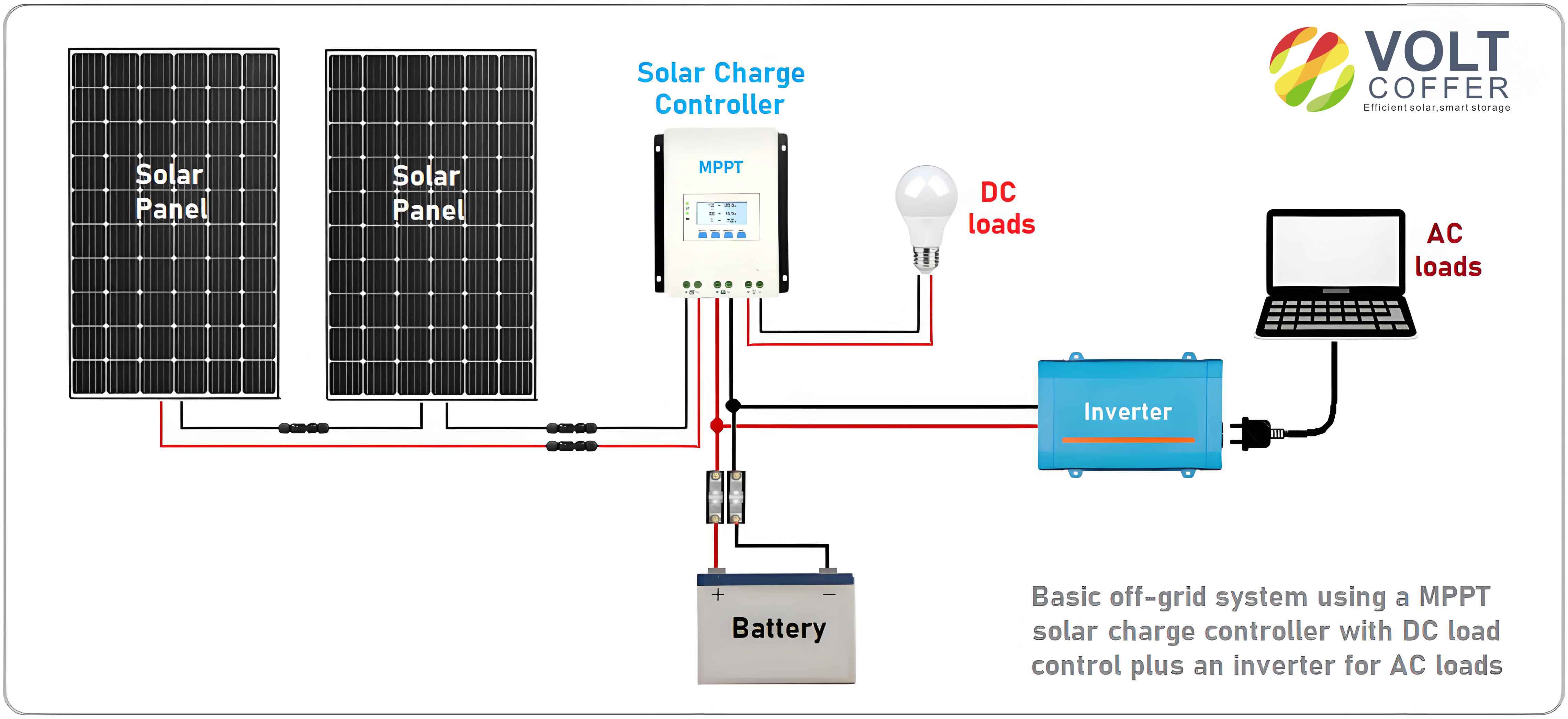
The studied single-stage PV system employs VSG control to emulate synchronous generator dynamics. The system structure includes:
- PV Array: Modeled as a DC voltage source.
- VSG Control Module: Generates voltage and frequency references for the inverter.
- MPPT Controller: Adjusts Vdc,refVdc,ref to maximize power extraction.
Key parameters are summarized in Table 1.
Table 1: System Parameters for VSG-Controlled PV System
| Parameter | Value | Parameter | Value |
|---|---|---|---|
| Base Power (SbSb) | 10 kVA | Virtual Inertia (JJ) | 6 kg·m² |
| Base Voltage (UbUb) | 380 V | Active Droop (kpkp) | 4000 W/Hz |
| Grid Resistance (RR) | 0.1 p.u. | Reactive Droop (kqkq) | 1000 var/V |
| Grid Reactance (XX) | 0.3 p.u. | Switching Frequency | 10 kHz |
3.2 Power Loop Transfer Functions
Linearizing the power flow equations yields the small-signal model:ΔP=HPδΔδ+HPEΔEΔP=HPδΔδ+HPEΔEΔQ=HQδΔδ+HQEΔEΔQ=HQδΔδ+HQEΔE
where HPδHPδ, HPEHPE, HQδHQδ, and HQEHQE are sensitivity coefficients. The closed-loop transfer function matrix is derived as:[PQ]=[p11(s)p12(s)p21(s)p22(s)][PrefQref][PQ]=[p11(s)p21(s)p12(s)p22(s)][PrefQref]
The elements p11(s)p11(s) and p22(s)p22(s) represent active and reactive power control loops, respectively, while p12(s)p12(s) and p21(s)p21(s) capture cross-coupling effects.
3.3 Frequency-Domain Analysis
The Bode plots of p11(s)p11(s) and p21(s)p21(s) (Fig. 1) reveal:
- Resonance Peaks: At 0.9–1.5 Hz, indicating susceptibility to forced oscillations.
- Low-Pass Filtering: High-frequency disturbances (>10>10 Hz) are attenuated.
M(ω)=ωn2(ωn2−ω2)2+(2ξωnω)2M(ω)=(ωn2−ω2)2+(2ξωnω)2ωn2
where M(ω)M(ω) is the magnitude response, ωnωn is the natural frequency, and ξξ is the damping ratio. Resonance occurs when ω≈ωnω≈ωn, amplifying oscillation amplitudes.
4. Impact of VSG Control Parameters on Forced Oscillations
4.1 Virtual Inertia (JJ)
Increasing JJ enhances system inertia but lowers the resonance frequency and amplifies oscillation magnitudes (Table 2).
Table 2: Impact of Virtual Inertia on Oscillation Amplitudes
| JJ (kg·m²) | Resonance Frequency (Hz) | Active Power Amplification | Reactive Power Amplification |
|---|---|---|---|
| 0 | 1.5 | 1.0× | 0.4× |
| 2 | 1.2 | 1.5× | 0.7× |
| 6 | 0.9 | 2.1× | 1.0× |
4.2 Active Droop Coefficient (kpkp)
Reducing kpkp weakens damping, increasing resonance peaks (Fig. 2). For kp=1000kp=1000 W/Hz, the active power amplification factor reaches 3.0×.ξ∝kp⇒B∝1ξξ∝kp⇒B∝ξ1
where BB is the forced oscillation amplitude.
4.3 Power Coupling Effects
Active-reactive power coupling, governed by:ρ21(s)=HQE1+HPδHAP+HQδHAQρ21(s)=1+HPδHAP+HQδHAQHQE
exacerbates oscillations when δ0+arctan(R/X)≠0δ0+arctan(R/X)=0. This coupling introduces additional resonance peaks in the reactive power response.
5. Simulation and Validation
5.1 MPPT-Generated Interharmonics
With fMPPT=2fMPPT=2 Hz and ΔU=18ΔU=18 V, the DC voltage spectrum exhibits dominant interharmonics at 0.5 Hz, 1.5 Hz, and 2.5 Hz (Fig. 3). These components align with the VSG’s resonance frequencies, triggering forced oscillations.
5.2 Oscillation Amplitude vs. Frequency
Injecting a 200 W disturbance at PrefPref demonstrates frequency-dependent amplification (Table 3).
Table 3: Oscillation Amplitudes Under Different Disturbance Frequencies
| fdfd (Hz) | Active Power Amplitude (W) | Reactive Power Amplitude (var) |
|---|---|---|
| 0.5 | 200 | 100 |
| 1.0 | 400 | 200 |
| 1.5 | 300 | 150 |
5.3 Parameter Sensitivity Analysis
- Virtual Inertia: Doubling JJ from 2 kg·m² to 4 kg·m² increases active power oscillations by 33% (Fig. 4).
- Droop Coefficient: Reducing kpkp from 4000 W/Hz to 1000 W/Hz triples the oscillation magnitude.
6. Conclusion
This paper establishes a frequency-domain framework to analyze forced low-frequency oscillations in single-stage PV systems under MPPT control. Key findings include:
- MPPT-Induced Interharmonics: Perturbation-based MPPT algorithms generate interharmonics at fn=(2k−1)fMPPT/4fn=(2k−1)fMPPT/4, which excite resonant modes in VSG-controlled systems.
- VSG Control Dynamics: Virtual inertia (JJ) and active droop (kpkp) critically influence oscillation amplitudes. Higher JJ or lower kpkp exacerbates oscillations.
- Mitigation Strategies: Optimizing fMPPTfMPPT to avoid resonance frequencies and tuning VSG parameters can suppress forced oscillations.
Future work will explore MPPT alternatives with reduced interharmonic content and advanced decoupling strategies for VSG controls.