
Introduction
Off-grid solar energy system is increasingly popular for providing reliable and sustainable energy solutions in remote and rural areas where grid access is unavailable or unreliable. These systems are designed to operate independently from the conventional electricity grid, ensuring a continuous power supply through solar energy. This article explores the key components, design considerations, and practical applications of off-grid solar energy system.
Importance of Off-Grid Solar Energy System
Off-grid solar energy system offer numerous benefits, including:
- Energy Independence:
- Enables remote and rural areas to access reliable electricity without depending on the central grid.
- Environmental Sustainability:
- Utilizes renewable energy, reducing carbon footprint and mitigating climate change.
- Cost Savings:
- Eliminates the need for expensive grid extension and reduces energy bills in the long term.
- Resilience:
- Provides a stable energy supply during natural disasters or grid failures.
Key Components of Off-Grid Solar Energy System
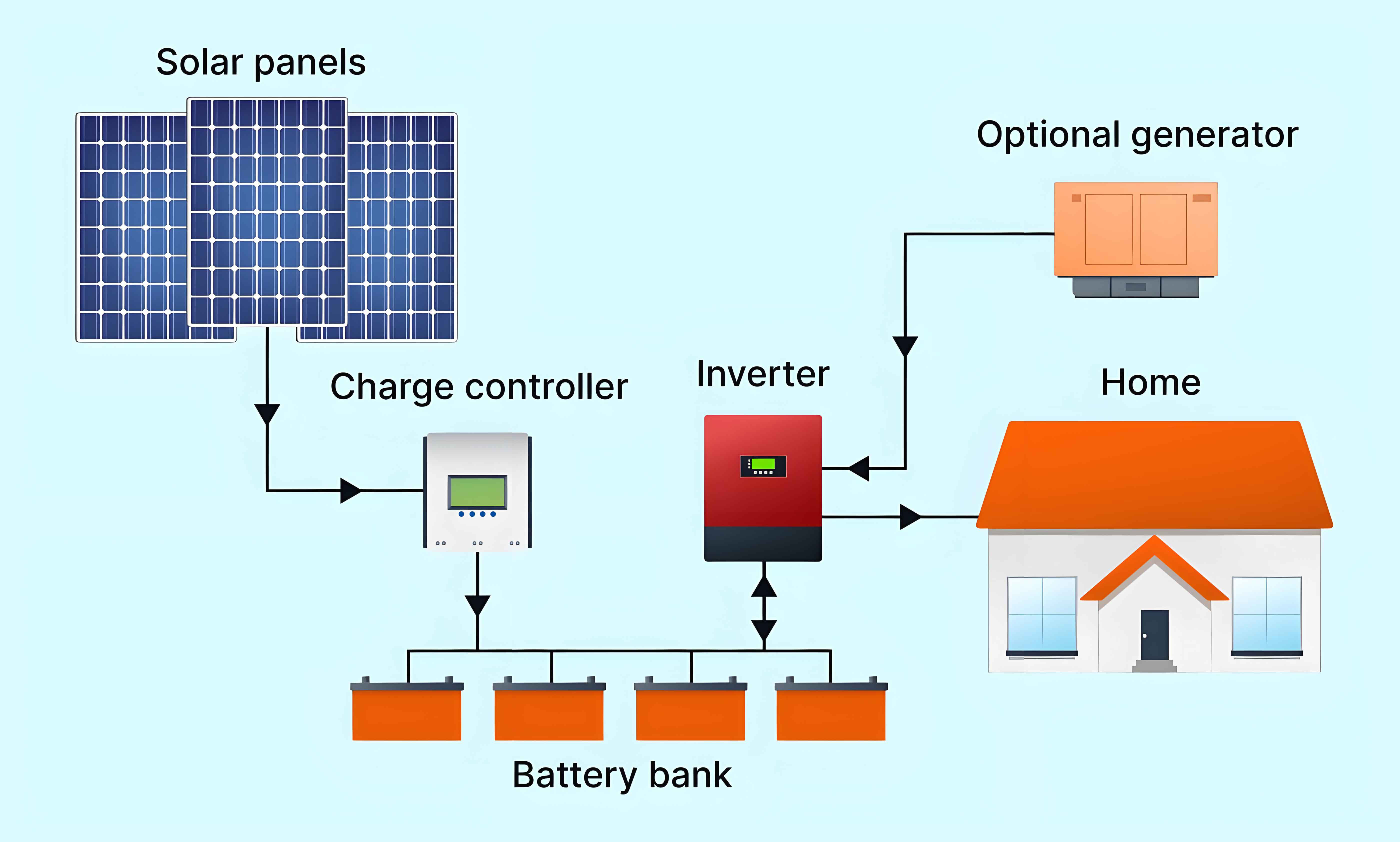
An effective off-grid solar energy system comprises several essential components that work together to generate, store, and distribute electricity.
Table 1: Key Components of Off-Grid Solar Energy System
| Component | Function |
|---|---|
| Solar Panels | Convert sunlight into direct current (DC) electricity |
| Charge Controller | Regulates the voltage and current from the solar panels to the batteries |
| Batteries | Store energy for use during periods without sunlight |
| Inverter | Converts DC electricity from the batteries to alternating current (AC) for household use |
| Backup Generator | Provides additional power during prolonged periods of low sunlight or high demand |
| System Monitoring | Tracks performance and ensures optimal operation |
Designing an Off-Grid Solar Energy System
Designing an off-grid solar energy system involves several critical steps to ensure it meets the energy needs of the intended application efficiently and reliably.
1. Assessing Energy Needs
Steps to Assess Energy Needs:
- Calculate Total Energy Consumption:
- List all electrical appliances and devices to be powered.
- Determine the wattage of each device and estimate the daily usage in hours.
- Calculate the total daily energy consumption in watt-hours (Wh).
Table 2: Example Energy Consumption Calculation
| Device | Wattage (W) | Daily Usage (hours) | Daily Consumption (Wh) |
|---|---|---|---|
| Refrigerator | 150 | 24 | 3600 |
| LED Lights (10) | 10 each | 5 | 500 |
| Laptop | 50 | 4 | 200 |
| TV | 100 | 3 | 300 |
| Water Pump | 500 | 1 | 500 |
| Total Daily Consumption | 5100 |
2. Sizing Solar Panels
Factors to Consider:
- Daily Solar Irradiance:
- Determine the average daily solar irradiance (kWh/m²/day) for the location.
- System Efficiency:
- Consider system losses due to inverter efficiency, battery charging, and temperature.
Calculation:
- Required Solar Panel Capacity (W):
- Divide the total daily energy consumption by the average daily solar irradiance.
- Adjust for system efficiency (typically around 75-85%).
Example Calculation:
- Daily energy consumption: 5100 Wh
- Average daily solar irradiance: 5 kWh/m²/day
- System efficiency: 80%

3. Sizing the Battery Bank
Factors to Consider:
- Autonomy Days:
- Number of days the system should operate without sunlight.
- Depth of Discharge (DoD):
- Maximum allowable discharge level to prolong battery life.
Calculation:
- Required Battery Capacity (Wh):
- Multiply the daily energy consumption by the number of autonomy days.
- Divide by the depth of discharge.
Example Calculation:
- Daily energy consumption: 5100 Wh
- Autonomy days: 3
- Depth of discharge: 50%

4. Selecting the Inverter
Factors to Consider:
- Total Load:
- Ensure the inverter can handle the peak load of all devices simultaneously.
- Surge Capacity:
- Inverters should manage temporary surges from devices like pumps and motors.
Example Calculation:
- Peak load: 1500 W (considering all devices running simultaneously)
- Surge capacity: At least 2000 W
Practical Applications of Off-Grid Solar Energy System
Off-grid solar energy system is versatile and can be tailored for various applications:
1. Residential Applications
- Remote Homes:
- Provides electricity for lighting, appliances, and electronic devices in areas without grid access.
- Vacation Cabins:
- Ensures a reliable power supply for temporary residences in isolated locations.
List of Commonly Powered Devices:
- Lighting
- Refrigeration
- Water pumps
- Communication devices
- Small household appliances
2. Agricultural Applications
- Irrigation Systems:
- Powers water pumps for irrigation, enhancing crop yields in remote farms.
- Livestock Operations:
- Provides energy for automated feeding systems, electric fences, and lighting.
Table 3: Agricultural Energy Consumption Examples
| Application | Wattage (W) | Daily Usage (hours) | Daily Consumption (Wh) |
|---|---|---|---|
| Water Pump | 1000 | 3 | 3000 |
| Electric Fence | 50 | 24 | 1200 |
| Automated Feeder | 200 | 2 | 400 |
| Total Daily Consumption | 4600 |
3. Commercial Applications
- Remote Businesses:
- Supports energy needs for small businesses, shops, and kiosks in off-grid areas.
- Telecommunication Towers:
- Powers telecommunication equipment to ensure connectivity in remote regions.
List of Commonly Powered Devices:
- Communication equipment
- Computers and office equipment
- Refrigeration units
- Lighting systems
4. Emergency and Disaster Relief
- Portable Systems:
- Provides immediate power supply for medical equipment, communication devices, and lighting in disaster-stricken areas.
- Community Centers:
- Establishes reliable energy sources for shelters and relief centers during emergencies.
Table 4: Emergency Energy Consumption Examples
| Device | Wattage (W) | Daily Usage (hours) | Daily Consumption (Wh) |
|---|---|---|---|
| Medical Refrigerator | 200 | 24 | 4800 |
| Communication Radio | 50 | 12 | 600 |
| Lighting (10 units) | 10 each | 8 | 800 |
| Total Daily Consumption | 6200 |
Advanced Technologies in Off-Grid Solar Energy System
1. Hybrid Systems
Description:
- Combines solar energy with other renewable sources such as wind or hydro, or with conventional generators to ensure a continuous power supply.
Benefits:
- Enhances system reliability and flexibility.
- Reduces dependency on a single energy source.
2. Smart Energy Management
Description:
- Utilizes advanced software and monitoring systems to optimize energy use and storage.
Benefits:
- Improves system efficiency by dynamically adjusting to energy demand and supply.
- Provides real-time data for better decision-making and maintenance.
3. Advanced Battery Technologies
Description:
- Incorporates newer battery technologies such as lithium-ion, flow batteries, and advanced lead-acid batteries.
Benefits:
- Increases energy storage capacity and lifespan.
- Enhances overall system efficiency and reliability.
Conclusion
Designing off-grid solar energy system involves careful planning and consideration of energy needs, system components, and application requirements. By assessing energy consumption, selecting appropriate components, and incorporating advanced technologies, these systems can provide reliable, sustainable, and cost-effective energy solutions for various applications. Off-grid solar energy system play a crucial role in promoting energy independence, environmental sustainability, and resilience, making them an essential component of the global transition to renewable energy.