
In the context of global energy transition, renewable energy sources have gained significant attention, with photovoltaic power generation standing out due to its pollution-free and renewable characteristics. Photovoltaic panels convert solar radiation into electricity through the photovoltaic effect, but their conversion efficiency is highly dependent on operating conditions. The efficiency of solar panels decreases as their temperature rises, with studies indicating a linear reduction in maximum power output by approximately 0.4% to 0.65% per degree Celsius increase above 25°C. This temperature sensitivity poses a challenge for maintaining optimal performance of photovoltaic systems in real-world environments, where temperatures often exceed ideal levels. Therefore, developing effective cooling methods for photovoltaic panels is crucial to enhance their efficiency and longevity.
Various cooling techniques have been proposed to address this issue, such as using phase change materials, air-cooled heat sinks, water spray systems, and radiative cooling. However, many of these methods involve complex structures or high costs, limiting their practical application. In this study, we explore a simple and low-cost approach by incorporating guide vanes to direct natural wind across the back of photovoltaic panels, thereby improving convective heat transfer and reducing temperature. We employ computational fluid dynamics (CFD) simulations using ANSYS FLUENT to analyze the cooling effects under different environmental conditions, focusing on how guide vanes influence temperature distribution and overall performance of solar panels.
The photovoltaic panel is modeled as a composite structure with multiple layers, each contributing to its thermal behavior. The properties of these layers are summarized in Table 1, which includes density, specific heat capacity, thermal conductivity, and thickness for components such as glass, ethylene-vinyl acetate (EVA), photovoltaic cells, and polyvinyl fluoride (PVF). These parameters are assumed to be independent of temperature and pressure variations for simplicity in simulation. Typically, crystalline silicon solar cells have an electrical efficiency ranging from 11% to 20%, with about 3% to 10% of solar radiation reflected by the tempered glass. In our model, we assume that 25% of solar energy is converted to electricity and reflected, while the remaining 75% is treated as input heat flux, with a global absorption coefficient of α = 0.75 for the photovoltaic panel.
| Layer | Density (kg/m³) | Specific Heat Capacity (J·kg⁻¹·K⁻¹) | Thermal Conductivity (W·m⁻¹·K⁻¹) | Thickness (mm) |
|---|---|---|---|---|
| Glass | 2450 | 790 | 0.7 | 3.5 |
| EVA | 960 | 2090 | 0.311 | 0.5 |
| PV cell | 2330 | 677 | 130 | 0.21 |
| PVF | 1200 | 1250 | 0.15 | 0.3 |
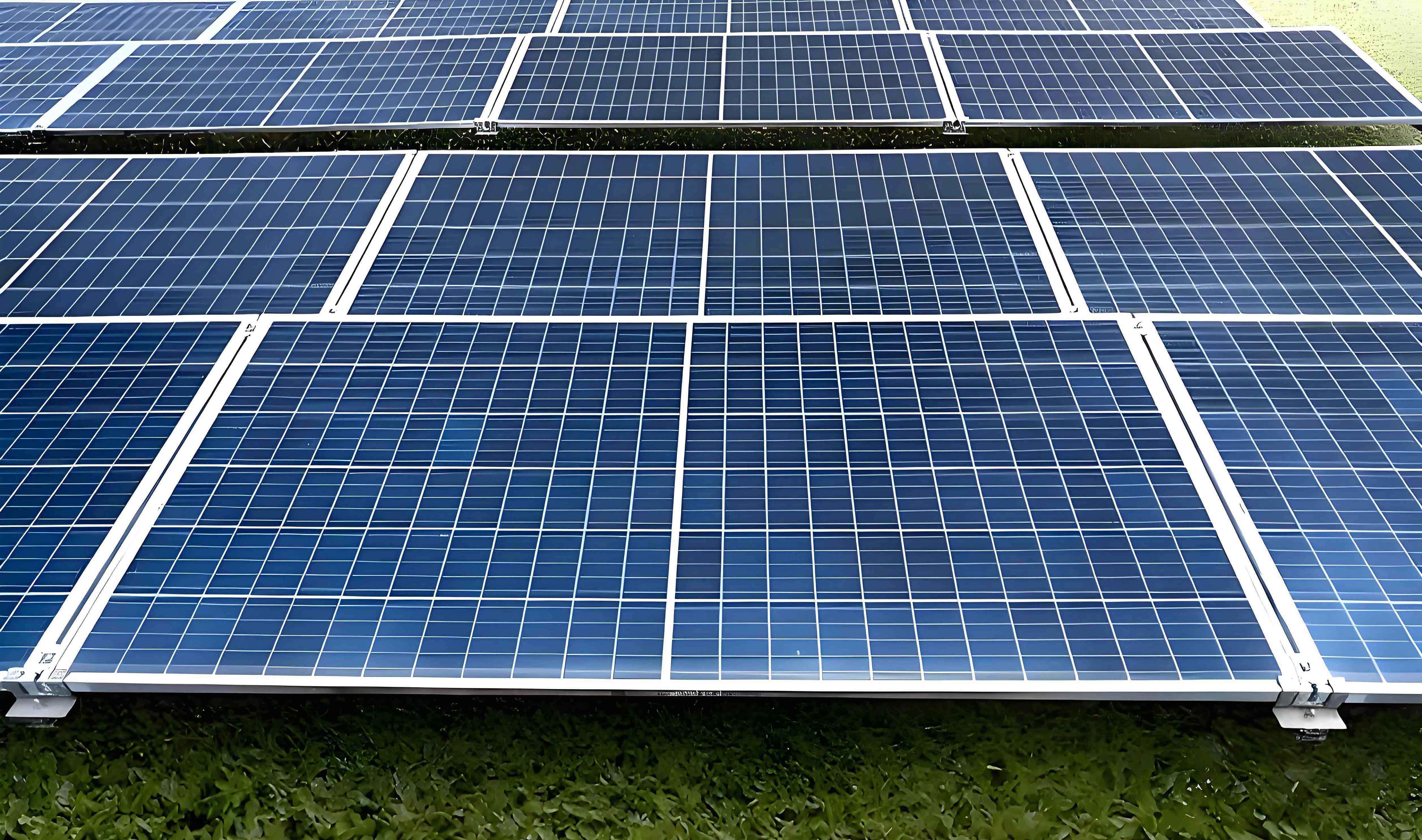
To simulate the cooling effect, we establish a three-dimensional model of a photovoltaic panel system with guide vanes. The photovoltaic panel measures 1000 mm by 500 mm and is inclined at 43 degrees to the ground, with its lower edge 200 mm above the surface. Four guide vanes, each 100 mm wide and 5 mm thick, are positioned at a 25-degree angle to the ground and evenly distributed behind the panel. The computational fluid domain is a 3000 mm × 2000 mm × 3000 mm enclosure, with the air inlet defined in the x-direction. The photovoltaic panel is treated as a unique composite layer, and we assume steady-state conditions for the simulation.
For numerical analysis, we use the Reynolds-averaged Navier-Stokes equations with the k-ε renormalization group (RNG) turbulence model to account for turbulent flow conditions. The Reynolds number (Re) and turbulence intensity (I) are calculated based on the hydraulic diameter D of the fluid domain, which is 2.4 m, and the air inlet velocity v. The formulas are given by:
$$ Re = \frac{\rho v D}{\mu} $$
and
$$ I = 0.16 Re^{-1/8} $$
where ρ is the air density (kg/m³) and μ is the dynamic viscosity (kg·m⁻¹·s⁻¹), both varying with temperature. The simulations cover a range of air inlet velocities (1 m/s, 3 m/s, and 5 m/s) and ambient temperatures (293 K, 298 K, 303 K, 308 K, and 313 K) to conduct an orthogonal study on the cooling performance with and without guide vanes. The SIMPLE algorithm is employed for pressure-velocity coupling, and second-order upwind schemes are used for discretization. Convergence criteria are set to 10⁻⁷ for energy and 10⁻⁵ for other residuals, ensuring accurate results for the photovoltaic panel temperature distribution.
The impact of wind speed on photovoltaic panel temperature is a critical factor in natural cooling. Experimental observations show that as wind speed increases, the average surface temperature of solar panels initially decreases but may rise beyond a certain critical point due to reduced convective efficiency. For instance, at low wind speeds, such as 1 m/s, the cooling effect is minimal, but at moderate speeds like 3 m/s, significant temperature reduction occurs. This nonlinear relationship highlights the importance of optimizing wind conditions for photovoltaic cooling. The efficiency of photovoltaic panels can be expressed in terms of temperature dependence using a linear approximation:
$$ \eta = \eta_{ref} – \beta (T – T_{ref}) $$
where η is the efficiency at temperature T, ηref is the reference efficiency at Tref (typically 25°C), and β is the temperature coefficient, ranging from 0.004 to 0.0065 per °C for silicon-based photovoltaic cells. This equation underscores the need for effective cooling to maintain high efficiency in solar panels.
In our simulations, we analyze the temperature distribution on the photovoltaic panel with and without guide vanes. For example, at an ambient temperature of 313 K and wind speed of 3 m/s, the guide vanes significantly reduce the maximum and average temperatures. Without guide vanes, the temperature is concentrated in the central region due to limited edge cooling, leading to hotspots. With guide vanes, the wind is directed to flow vertically across the back of the panel, enhancing convective heat transfer and reducing the maximum temperature by up to 5.7°C and the average temperature by 4°C. This improvement is attributed to the altered flow patterns, as visualized in velocity streamlines, where the guide vanes create a more uniform and intense wind sweep over the photovoltaic surface.
To quantify the cooling effects under varying conditions, we perform orthogonal simulations and summarize the results in Table 2, which shows the average and maximum temperature reductions for different wind speeds and ambient temperatures. The data indicate that the guide vanes are most effective at moderate wind speeds (e.g., 3 m/s), where they facilitate optimal heat dissipation. At higher wind speeds (e.g., 5 m/s), the cooling benefit diminishes, possibly due to flow separation or reduced contact time. This trend emphasizes the role of guide vane design in maximizing the cooling potential for photovoltaic panels.
| Wind Speed (m/s) | Ambient Temperature (K) | Average Temperature Reduction (°C) | Maximum Temperature Reduction (°C) |
|---|---|---|---|
| 1 | 293 | 1.2 | 2.5 |
| 1 | 298 | 1.3 | 2.6 |
| 1 | 303 | 1.4 | 2.7 |
| 1 | 308 | 1.5 | 2.8 |
| 1 | 313 | 1.5 | 2.7 |
| 3 | 293 | 3.5 | 5.0 |
| 3 | 298 | 3.7 | 5.2 |
| 3 | 303 | 3.8 | 5.5 |
| 3 | 308 | 3.9 | 5.6 |
| 3 | 313 | 4.0 | 5.7 |
| 5 | 293 | 2.0 | 3.5 |
| 5 | 298 | 2.1 | 3.6 |
| 5 | 303 | 2.2 | 3.7 |
| 5 | 308 | 2.3 | 3.8 |
| 5 | 313 | 2.3 | 3.8 |
The effectiveness of guide vanes in cooling photovoltaic panels can be further analyzed through the heat transfer coefficient, which is enhanced by the directed airflow. The convective heat transfer rate Q can be described by Newton’s law of cooling:
$$ Q = h A (T_s – T_\infty) $$
where h is the convective heat transfer coefficient (W/m²·K), A is the surface area (m²), T_s is the surface temperature of the photovoltaic panel, and T_∞ is the ambient temperature. By increasing h through guide vane-induced turbulence, the heat dissipation from the solar panels improves, leading to lower operating temperatures. In our simulations, we observe that the guide vanes increase the local heat transfer coefficients by up to 20% in the central regions of the photovoltaic panel, where temperatures are typically highest.
Moreover, the guide vane design parameters, such as angle and placement, play a crucial role in optimizing cooling performance. For instance, varying the angle of the guide vanes relative to the ground can alter the wind direction and velocity profile, affecting the overall heat removal. We recommend future studies to explore these parameters in depth to achieve the best cooling outcomes for photovoltaic systems. Additionally, the low cost and simplicity of guide vane implementation make this method highly feasible for large-scale photovoltaic installations, contributing to improved energy efficiency and reduced maintenance costs.
In conclusion, our FLUENT-based simulations demonstrate that guide vanes effectively reduce the temperature of photovoltaic panels by enhancing natural wind convection. The cooling effect is most pronounced at moderate wind speeds, such as 3 m/s, where average temperature reductions of up to 4°C and maximum temperature reductions of 5.7°C are achievable. This approach offers a practical and economical solution for maintaining the efficiency and durability of solar panels in various environmental conditions. By integrating guide vanes into photovoltaic systems, we can mitigate temperature-related efficiency losses and support the broader adoption of renewable energy technologies. Further research should focus on experimental validation and optimization of guide vane configurations for different photovoltaic panel designs and climates.